
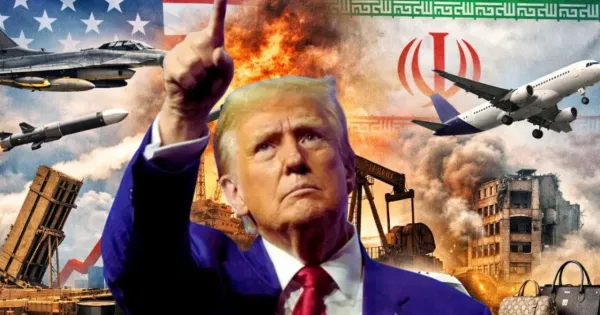
Iran War: America’s warning to Iran, blocking the oil route will result in twenty times more losses

Washington. US President Donald Trump on Tuesday warned Iran that if its forces block the transportation of oil through the Strait of Hormuz, they will be attacked ‘twenty times more worse’. Trump said on his social media platforms, “If Iran does anything to stop the flow of oil through the Strait of Hormuz, the US will attack them with twenty times more force than they have done so far।”
Additionally, he said, the US would eliminate easily destroyed targets, making it almost impossible for Iran to stand up again as a nation. Trump described the warning as ‘a gift from the United States to China and all countries that make significant use of the Strait of Hormuz’. He expressed hope that this ‘initiative’ would be greatly appreciated.
It is noteworthy that as of March 10, commercial traffic in the Strait of Hormuz route has almost completely come to a standstill. Although there has been no formal announcement of closure, traffic on this route has effectively stopped due to cancellation of insurance by insurance companies due to extreme risks. Major transport companies such as Maersk, CMA CGM and Hapag-Lloyd have suspended traffic on this route and are diverting ships via the ‘Cape of Good Hope’.
At least eight sailors have been killed and several tankers damaged in drone and missile attacks since the war began. On March 6, the UAE-flagged yacht Mussafa-2 sank after an explosion, leaving three crew members missing. On March 7, the Malta-flagged tanker ‘Prima’ was reportedly attacked by an Iranian drone. India is currently considering options for the safe evacuation of 36 Indian-flagged ships stranded in the region.
France has also announced preparations for a mission to escort the ships to safety once the intensity of the fighting subsides. As a result of the blockade, crude oil prices rose to US$120 per barrel on March 9, which later declined to around $88–90. Kuwait and Qatar have declared ‘force majeure’ on some energy contracts as tankers are unable to safely exit the Persian Gulf.
‘Force Majeure’ is a general clause that essentially releases both parties from liability or obligation when an extraordinary event or circumstance occurs beyond the control of the parties. The strait is effectively closed to commercial traffic bound to Western countries. However, there are some exceptions to this. Some Chinese-flagged ships have successfully transited by broadcasting their position via Automatic Identification System (AIS).
About 20 percent (one fifth) of global oil consumption passes through this water area. According to the US Energy Administration, about 84-89 percent of the crude oil and 83 percent of the LNG passing through the strait is destined for Asia. This waterway is very important for energy supply in India, China, Japan and South Korea.

Comments are closed.