
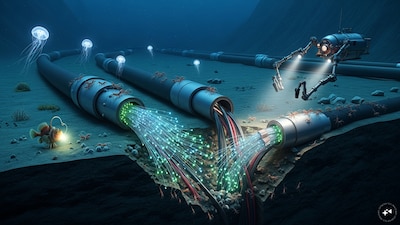

In a significant escalation of regional tensions, Iran’s Islamic Revolutionary Guard Corps (IRGC) has issued a chilling warning, identifying undersea fiber-optic cables and cloud-based data networks as legitimate “strategic targets” in the Persian Gulf. This move, surfacing amidst a fragile and frequently violated truce between Iran and Western powers, marks a dangerous shift from conventional maritime threats to the “digital arteries” that sustain the modern global economy.
For decades, the Strait of Hormuz has been viewed primarily as an energy chokepoint, a narrow corridor through which 20% of the world’s petroleum flows. However, the IRGC’s latest rhetoric signals that Tehran has modernized its “chokehold” strategy. By shifting focus to undersea infrastructure, Iran is targeting the “hyper-connectivity” of its rivals, specifically the Gulf Cooperation Council (GCC) states like the UAE and Saudi Arabia, which have invested billions into becoming global hubs for Artificial Intelligence (AI) and digital services.
According to military analysts, this “scissors strategy” aims to exploit the physical vulnerability of the 17 major submarine cable systems that transit the Persian Gulf and Red Sea. These cables carry an estimated 30% of global internet traffic and the vast majority of real-time financial settlement data between Asia and Europe.
Cloud Infrastructure in the Crosshairs
The threat is not limited to the ocean floor. The IRGC has explicitly flagged cloud networks and regional data centers, many of which are operated in partnership with U.S. tech giants like Microsoft, Google, and Amazon as potential targets. Recent intelligence suggests that Iranian-aligned drone units have already tested the defenses of data centers in Bahrain and the UAE.
For the Gulf states, these facilities are more than just IT hubs; they are the backbone of their “Vision 2030” style economic diversification plans. A sustained attack on this infrastructure would not only cause local outages but could effectively “disconnect” the Middle East from the global digital economy, paralyzing everything from airline logistics to automated healthcare.
The “Attribution Problem”
One of the most alarming aspects of this threat is what experts call the “attribution problem.” Sabotage occurring 60 to 100 meters underwater is notoriously difficult to prove. In 2024, when three cables were severed in the Red Sea, initial reports blamed a ship’s anchor, but lingering suspicions of state-sponsored sabotage remained.
By targeting subsea assets, the IRGC can inflict massive economic damage while maintaining a level of plausible deniability that avoids triggering a direct, full-scale military retaliation from the U.S. or Israel. This “grey-zone” warfare allows Iran to exert maximum pressure with minimal immediate accountability.
The international response to these threats has been swift and fearful. Alcatel Submarine Networks (ASN), a major player in subsea cable installation, has reportedly issued force majeure notices for several projects in the region. Work on the “2Africa Pearls” project intended to be the world’s longest subsea cable has ground to a halt in the Persian Gulf due to security risks.
If these “digital arteries” were to be cut:
Financial Markets: Global currency and stock markets would face massive latency issues, potentially freezing trillions in transactions.
India and Southeast Asia: These regions would see a drastic drop in internet speeds and cloud reliability, as they rely heavily on the Gulf-Red Sea corridor for data transit to Europe.
Regional Stability: The fragile truce currently in place could collapse if a “cyber-kinetic” strike leads to significant loss of life or economic ruin.
A Fragile Peace at Risk
The timing of these threats is particularly sensitive. As diplomats work to maintain a tenuous ceasefire, the IRGC’s focus on undersea targets suggests that hardliners within Iran are preparing for a long-term, low-intensity conflict. By flagging these assets now, they are signaling that even if “the guns fall silent” on land, the digital war beneath the waves is just beginning.
As the world watches the Strait of Hormuz, the focus is no longer just on the tankers on the surface, but on the silent, glowing pulses of data moving through the dark waters below. The message from the IRGC is clear: in the 21st century, the most effective way to cripple an enemy is to cut the cord.

Comments are closed.