
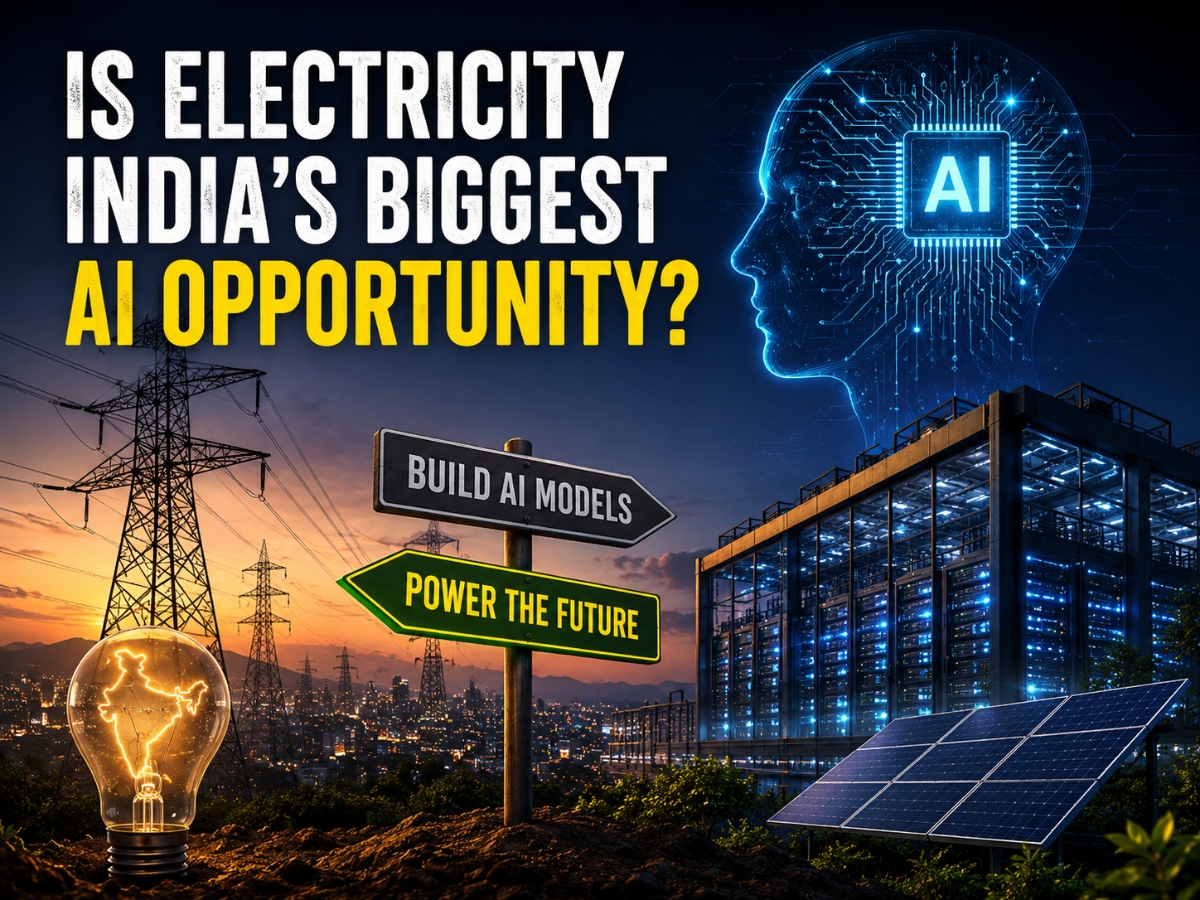

Everyone is talking about artificial intelligence, new AI models and the race to create the next ChatGPT. But what if India’s largest opportunity in the AI revolution has nothing to do with building its own AI chatbot?
India’s real opportunity might be somewhere far less glamorous—but potentially far more practical: supplying the electricity and infrastructure that keep AI data centres running, according to a new thematic report from Shriram Mutual Fund.
The AI investment cycle is, above all, a power story, says the report “The AI Bubble Debate: A Unit-Economics Lens.” “For India, the AI capex cycle is first and foremost a power-demand story.”
| Metric | Figure |
|---|---|
| Big Tech AI capex (2021-2025) | $1.08 trillion |
| Planned AI capex in 2026 | Nearly $725 billion |
| Estimated AI capex (2025-2030) | $5.3 trillion |
| Cost of a 1 GW AI data centre | $20-50 billion |
| Electricity use | Equivalent to 750,000 homes |
AI Needs More Than Just Chips
The talk around AI tends to run towards powerful graphics processing units (GPUs), the latest chips and the latest AI models. But they are no longer the biggest challenge, the report says.
Instead, electricity is becoming the real bottleneck. The GPU is not the real constraint on the whole build-out; it’s electricity. Electricity consumption will render the winner of the unit economics debate, the winner of the lab race, and the speed of token deflation irrelevant in the end.
In simple terms, all artificial intelligence systems will still require huge amounts of electricity to function, regardless of who the eventual winner among AI companies is – be it OpenAI, Google, Meta or Anthropic.
That makes power infrastructure an investment theme that encompasses the entire AI industry.
Why Is Power So Important Now?
AI spending has reached a new level.
Four of the world’s largest hyperscale technology companies spent roughly $1.08 trillion on capital expenditures from 2021 to 2025, according to the report. Their intended expenditure alone for 2026 is projected to hit nearly $725 billion. Goldman Sachs forecasts that cumulative AI-related capital spending will reach $5.3 trillion from 2025 to 2030.
Building these huge AI facilities is very expensive. Construction costs are almost 60% made up of GPUs and networking equipment. But once a data centre is up and running, its biggest ongoing requirement is electricity.
The report says that a single AI-grade one-gigawatt data centre can cost between $20 billion and $50 billion and use as much electricity as around 750,000 homes. With the growth in scale and power requirements of AI data centres, the supply of electricity and the capacity of grids are becoming limiting factors on global AI expansion.
That’s different from traditional cloud computing, where AI models are trained on thousands of GPUs at once. They run 24/7 and produce a lot of heat, which means you need equally energy-intensive cooling systems. Simply put, AI data centres require electricity not just to power the computing hardware but also to keep it cool and running efficiently.
For countries like India, the report says the sector offers opportunities far beyond the AI software, with demand set to grow for power generation, transmission networks and electrical infrastructure.
Where Does India Stand?
The report points out that India currently has limited direct exposure to the global AI model race.
“India has no listed frontier lab and no hyperscaler.”
But India’s growing electrical equipment manufacturing base and the expanding power infrastructure may enable it to be a participant in the AI investment cycle from a different perspective. As countries continue to build AI data centres, demand for transformers, switchgear, cables, transmission equipment and grid infrastructure is expected to grow in line with electricity consumption.
Unlike the US, India does not have listed companies that directly compete with OpenAI, Anthropic, Google or Meta to build frontier AI models or operate hyperscale cloud platforms.
Instead, the report argues that India could benefit by manufacturing and supplying the equipment every AI data centre needs.
The report says India’s best bet may lie in companies that support AI infrastructure, not the ones building AI models. They include switchgear, transformers, grid infrastructure, cooling systems, wires and cables, power generation, power transmission, transmission EPC projects, power financing and diesel generator manufacturing businesses.
Demand for these sectors is likely to grow as AI data centres expand globally and require reliable electricity and infrastructure support, the report said.
The report describes these businesses as the “picks and shovels” of the AI boom—companies that stand to benefit regardless of which AI platform eventually becomes the market leader.
Could This Be The Reason For The Bullish Outlook On Power Stocks?
The report says yes.
Shriram Mutual Fund said it continues to be overweight in the power sector, backed by long-term demand expected from AI infrastructure.
Instead of betting on which AI company will win, the fund thinks investors may find steadier opportunities in companies that provide the physical backbone for AI expansion.
But What If AI Is Just A bubble?
The report also answers one of the biggest questions investors are asking today: is AI becoming another dot-com bubble?
The fund house says that’s not the right question.
Instead, investors should consider whether AI companies can generate enough revenue from their infrastructure before it becomes obsolete. “The entire ‘bubble or not’ debate collapses into one question of unit economics. Does the revenue thrown off by the compute earn an adequate return on the capital sunk into building it before that capital depreciates? Everything else is just headline numbers.”
The report also makes the case that the current AI investment cycle differs from past tech bubbles in that much of the investment is being made by highly profitable tech companies, rather than by over-borrowing.
That is a big difference. Many dot-com era companies grew aggressively without sustainable profits. Today, however, the spending on AI is coming from some of the world’s largest and most profitable tech companies, so the debate is less about the fiscal health and more about whether the massive investments will pay off in the long run. “On the evidence today, it is not a solvency bubble since the spend is overwhelmingly self-funded by the most cash-generative companies on earth… It is instead a return-on-capital question, and that question is still genuinely open.”
Power: Why It Could Be India’s AI Jackpot
The key message of the report is simple: India may not be creating the world’s next big AI model anytime soon, but that’s acceptable.
The report’s message is that India does not need to build the next ChatGPT in the world to benefit from the AI revolution. As long as global technology companies continue to invest in AI infrastructure, demand for electricity and electrical equipment likely will continue to rise.
In that case, India’s chance may not be in competing to build frontier AI models but in supplying the power, transformers, cables, switchgear and other infrastructure that every AI data centre needs. It’s a quieter chapter of the AI story, but one the report believes could offer long-term opportunities regardless of which AI company ends up winning the race.
Also Read: IPO Rush Next Week: SBI Funds Management, Alpine Texworld Open; What Should Investors Track?
(With inputs from ANI)
Priyanka Roshan is a business writer and assistant editor at the NewsX website who tracks everything from stock market swings and corporate earnings to personal finance trends and policy shifts. Known for turning fast-moving business developments into sharp, reader-friendly stories, she combines speed, accuracy, and a data-driven approach to break down complex financial news for everyday audiences.
With over 9.5 years of newsroom experience, Priyanka has worked with leading media organisations, including Bussiness, Times Now, and Ping Digital, covering diverse beats such as business, politics, technology, auto, travel, sports, and the world. From live breaking news desks to SEO-led digital storytelling, she specialises in creating engaging content that keeps readers informed without overwhelming them.
The post Is India’s Biggest AI Bet Actually Electricity? What a New Report Reveals appeared first on NewsX.

Comments are closed.