
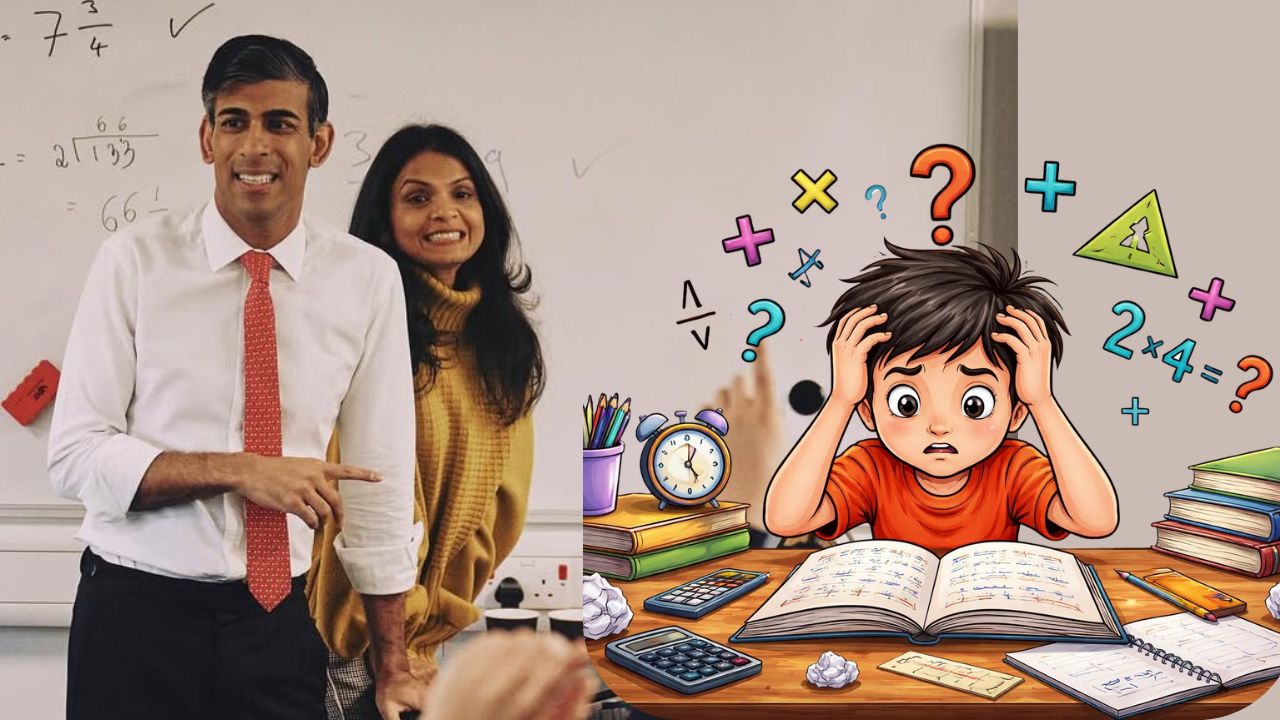
Is the fear of maths being transferred from mothers to daughters? Shocking survey of Rishi Sunak-Akshata Murthy’s charity

Do you feel a little scared or uncomfortable when you hear the name of Maths? As a child, did homework with numbers give you sleepless nights, like it was a nightmare? If yes, then the real reason may be hidden not in the school class but in the home environment. Especially in the behavior of mothers.
Recently, former British Prime Minister Rishi Sunak and his wife Akshata Murthy have started an education charity named The Richmond Project. This same organization has conducted a big survey, in which a very surprising result has emerged. This survey shows how the fear of maths is passed secretly from mother to daughter from generation to generation.
Mothers unknowingly create fear of maths in their daughters.
According to the survey, if a mother herself has trouble with numbers or gets nervous while doing maths, then there is a high possibility of her daughter also having less confidence in maths. Akshata Murthy said in an interview to ‘The Sunday Times’ newspaper that women have more anxiety and fear regarding maths than men. When a little girl sees her mother upset, nervous or stuck in difficulty while doing her homework, it gets ingrained in her mind that maths is a very difficult thing. ‘This fear gradually becomes so deep that the child herself starts running away from maths and this fear later reaches her daughter also. In this way it continues like a chain.
Instagram: akshatamurty_official
Boys’ confidence increases, girls are left behind
Some surprising figures have also emerged in this survey:
Among children aged 4 to 8 years: 51% of boys consider maths easy, while only 41% of girls think so, meaning the difference starts at such a young age.
In children aged 9 to 18: This difference becomes even bigger. At this age, 86% boys feel confident in maths, but this number remains only 63% among girls.
A total of 8,000 elders were talked to in the survey. It was found that women are twice as nervous as men while dealing with numbers. The same trend is visible in office or professional life too – 61% men enjoy working with numbers, while only 43% women say so.
Instagram: akshatamurty_official
Include maths in everyday life
Akshata Murthy told that she herself never felt afraid of maths. The reason for this was that his mother (Sudha Murthy) was an engineer and his aunts were also from science background. Mathematics was always viewed in a positive manner at home. Inspired by this experience, Akshata is now changing the way she teaches maths to her daughters Krishna and Anushka. She deliberately does not limit maths to books and formulas. He says that instead of considering Maths as just ‘a subject’, it should be made a part of daily life like:
-Calculating while buying vegetables
-Seeing train timetable
-Measuring ingredients in recipes
-Distributing the bill in the restaurant
Instagram: akshatamurty_official
Make maths fun not a burden
When children see maths being used in this way, their fear will automatically reduce. The full report is yet to be officially released next week, but its findings have already sparked a lot of discussion. People are talking about how parenting styles at home, old gender stereotypes (e.g. maths is a boy’s subject), and how attitudes towards maths are formed at an early age, all have a deep impact on children’s future.

Comments are closed.