
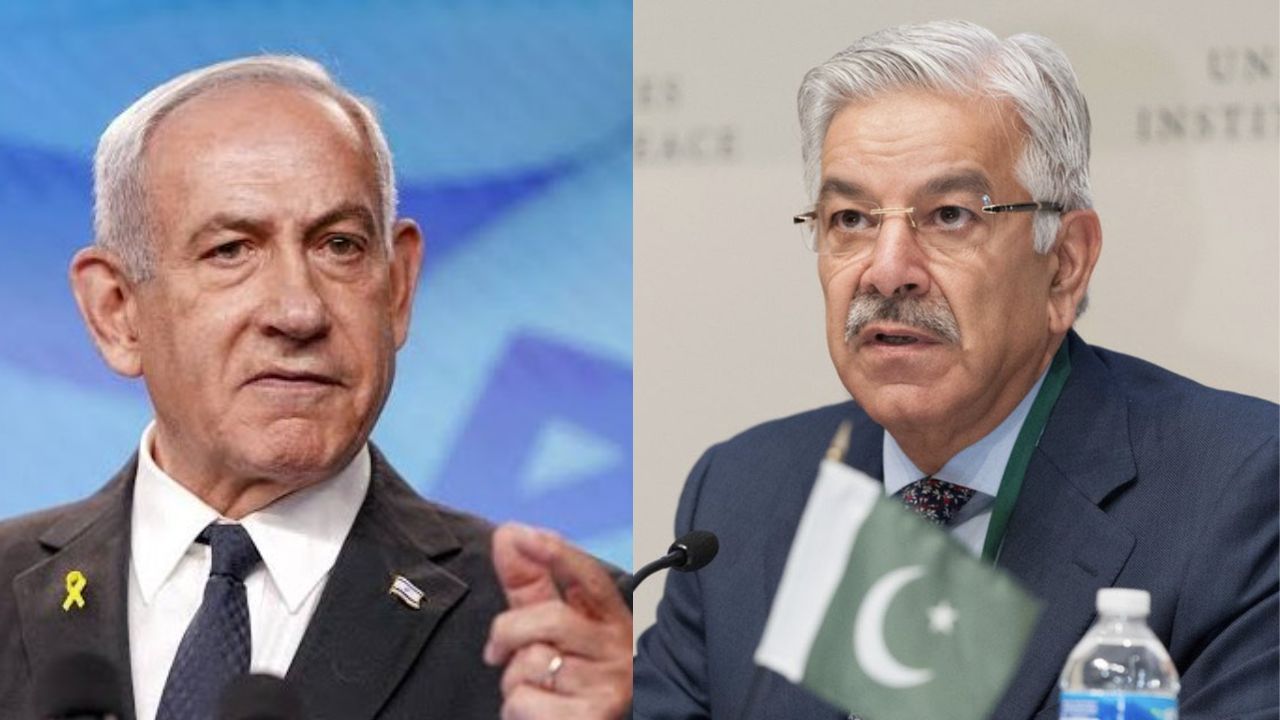

middle east Where a 2-week ceasefire is going on, which was announced by US President Donald Trump. On the other hand, Israel is continuously targeting Hezbollah in Lebanon. Regarding which now a controversial statement of Pakistan Foreign Minister Khwaja Asif has come to light. With this statement of Khawaja Asif, the conflict of rhetoric between Pakistan and Israel has come to the fore.
In a post made on social media, the Pak Foreign Minister has made serious allegations against Israel while mentioning the deaths of civilians in Gaza, Iran and now Lebanon. Israel has also given a befitting reply to Khwaja Asif.
What is the controversial statement of Khwaja Asif?
On one hand, Pakistan is highlighting its important role in peace talks, while on the other hand, its Foreign Minister is giving controversial statements. Khawaja Asif posted on social media, “While peace talks are going on in Islamabad, genocide is taking place in Lebanon. Innocent civilians are being killed by Israel, first in Gaza, then in Iran and now in Lebanon. The bloodshed continues unabated. I hope and pray that those who created this cancer-like state on Palestinian land to get rid of European Jews, burn in hell.”
What did Israel say?
Israeli Prime Minister Benjamin Netanyahu described the statement as highly condemnable, with his office responding to the statement saying “This is not a statement that can be tolerated from any government, especially one that claims to be an impartial broker of peace.”
Israel’s Foreign Minister Gideon Sa’ar also criticized Pakistan, calling it a clear anti-Semitic bloodbath. He warned that calling Israel a cancer is like calling for its destruction and said that the country will take every possible step for its security.
Has there been a rift between the two countries?
This development has come to light at a time when there are already no formal diplomatic relations between Pakistan and Israel. Israel has traditionally adopted a policy of avoiding direct confrontation with Pakistan, but this time the public reaction has highlighted the seriousness of the situation. Israeli Ambassador to India Reuven Azar had recently said that Israel does not consider Pakistan a reliable mediator in peace talks.
Israel’s stance on Lebanon
Tension in the Middle East increased further when Iran-backed organization Hezbollah launched rocket attacks on Israel. It was told that this attack was carried out to avenge the assassination of Iran’s supreme leader Ayatollah Ali Khamenei. After this, Israel took large-scale military action in Lebanon, in which hundreds of people were reported killed. The attack came on the heels of the recent shaky peace deal between the US and Iran, once again escalating tensions in the region.
Why differences of opinion on ceasefire?
Israeli Prime Minister Netanyahu has said that he supported US President Donald Trump’s decision to pause attacks against Iran for two weeks. However, he clarified that this ceasefire does not apply to Lebanon. In contrast, Pakistan Prime Minister Shehbaz Sharif claimed that the ceasefire applies everywhere, including Lebanon.
What will be the further strategy?
Netanyahu has instructed his ministers to begin direct negotiations with Lebanon with the aim of disarming Hezbollah. At the same time, according to the US State Department, representatives of Israel and Lebanon can hold talks in Washington next week.

Comments are closed.