
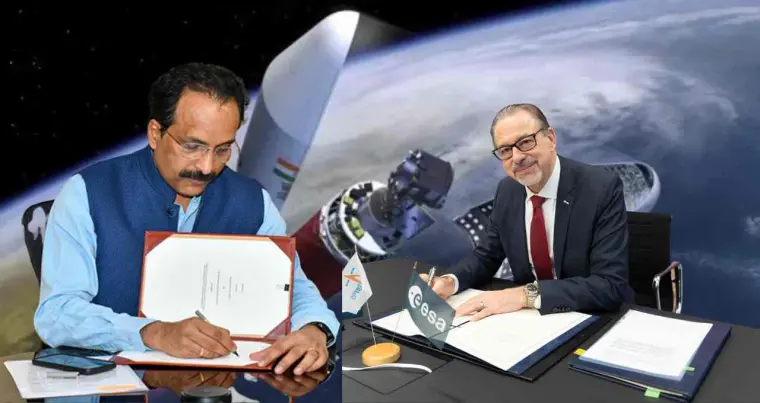
ISRO and ESA sign cooperation agreement for calibration, validation and scientific studies for Earth Observation Missions

The Indian Space Research Organization (ISRO) and the European Space Agency (ESA) have signed a new agreement to strengthen cooperation for Earth Observation missions. Under this agreement, both the agencies will jointly work on calibration, validation activities and scientific studies, which will improve the accuracy and reliability of Earth related data and research.
This agreement was signed virtually on March 4. On this occasion, ISRO’s Scientific Secretary M. Ganesh Pillai and ESA’s Director of Earth Observation Simonetta Chailli participated. The objective of this cooperation is to strengthen the exchange of information and technology between the two agencies in the areas of earth sciences, environmental monitoring and space based exploration.
Long-running collaboration between ISRO and ESA
Collaboration between space agencies of India and Europe is not new. The two organizations first began their partnership in 1978, which was later renewed in 2002. The new agreement is considered an important step towards further strengthening data sharing and scientific research for upcoming space missions.
Importance of collaboration for ESA’s FLEX mission
This collaboration is particularly important for ESA’s upcoming FLEX (Fluorescence Explorer) mission. The objective of this mission is to measure fluorescence signals emitted by vegetation present on Earth. Through this data, scientists will be able to understand how effectively plants are performing photosynthesis.
This information can help assess vegetation health, understand the effects of climate change, improve agriculture and environmental monitoring, and advance studies related to the carbon cycle.
creation of technical cooperation
Under this partnership, ISRO and ESA will work jointly in several technical areas. This will include calibration and validation of satellite data, joint scientific research related to Earth observations and cooperation through ground stations and tracking networks. Along with this, data analysis and mission support will also be provided.
The purpose of these steps is to increase the accuracy and reliability of data received from space-based Earth observation systems.
ESA has previously provided ground station and tracking support for India’s major missions such as Chandrayaan and Aditya L1. ISRO, on the other hand, has provided technical support to many international missions through its Deep Space Antenna Facility.
According to experts, this agreement can strengthen many important missions related to future Earth observation and support scientific studies related to climate change, environmental protection and agricultural research. According to him, this cooperation between India and Europe shows the growing international cooperation in space science.

Comments are closed.