
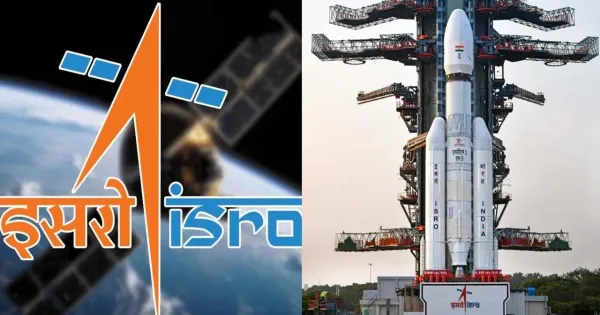
ISRO EOS-N1 Mission: Countdown begins, India’s ‘third eye’ will reach space tomorrow, ISRO’s big mission Anvesha will be launched

Chennai. The countdown for the launch of PSLV-C62/EOS-N1 ‘Earth Observation Satellite’ mission and 15 other satellites has started on Sunday morning at the space center in Sriharikota, Andhra Pradesh. This mission will take off from Sriharikota at 10:17 am on Monday. This will be ISRO’s first launch in the new year.
EOS-N1, also known as Anwesha, is an Indian hyperspectral Earth imaging satellite, built by DRDO for strategic defense purposes as well as civilian monitoring in agriculture, urban mapping and environmental assessment. ISRO said that after receiving the approval from the Launch Authorization Board (LAB) and clearance for the launch from the Mission Readiness Review (MRR), the 22-hour countdown started at 12:17 pm on Sunday. During this period, propellant (fuel) will be filled in this four-stage rocket.
ISRO said on social media platform ISRO said the integration of the vehicle and satellites has been completed and the pre-launch testing and final testing processes are continuing.
The PSLV-C62 mission will lift off from the first launch pad of Satish Dhawan Space Center in Sriharikota at 10:17 am on Monday. PSLV is a four-stage rocket with a height of 44.4 meters and a flight mass of 260 tonnes, which operates on solid and liquid propellants (fuel). It is ISRO’s most versatile, most reliable and most versatile launch vehicle.
EOS-N1 and 14 other satellites will be placed in a sun-synchronous orbit at an altitude of 505 km with an inclination of 97.5 degrees, while the KID capsule will be sent on a re-entry path. After placing EOS-N1 and 14 satellites in orbit, the PS4 stage (fourth stage) will be restarted to decelerate to allow re-entry. After this the KID capsule will be separated.
Both the PS4 stage and the KID capsule will re-enter Earth’s atmosphere and fall into the South Pacific Ocean. The PSLV-C62 mission is one of the longest missions conducted by ISRO. About 16 minutes after takeoff, the fourth stage engine of the rocket will be shut down and will move forward at inertial speed for about one minute and about 17 minutes after takeoff, the Indian satellite ‘Anvesha/EOS-N1’ and 14 other satellites will be separated.
One of the interesting satellites to be launched in this mission will be ‘Aulesat’, developed by the Indian company ‘OrbitAid’, which is a kind of ‘space fuel tanker’ for spacecraft. This facility for refueling in Earth orbit will increase the lifetime of orbiting satellites, thereby reducing both the overall cost and space waste.
ISRO said this is the 9th dedicated commercial mission operated by NewSpace India Limited (NSIL), under which the EOS-N1 Earth observation satellite is being built and launched for the user. Along with this, launch services are also being provided to 14 other satellites of domestic and international customers through it.
The PSLV-C62 mission will also showcase a Spanish startup ‘KID’ (Kestrel Initial Technology Demonstrator), a small-scale prototype of the re-entry vehicle being developed by that startup. KID will be the last satellite to separate, after which it is scheduled to re-enter Earth’s atmosphere and fall into the South Pacific Ocean.
The PSLV-DL version will be used in this launch, which will have two solid fuel ‘strap-on’ motors. This will be the fifth mission of the PSLV-DL variant. This mission will be the 64th flight of PSLV. The PSLV launch vehicle has completed 63 flights so far.
These include notable missions like Chandrayaan-1, Mars Orbiter Mission (Mangalyaan), Aditya-L1 and Astrosat Mission. In 2017, PSLV created a world record by launching 104 satellites in a single mission. The importance of these upcoming launches has increased even more after the Indian Space Agency has faced some setbacks in recent years amid preparations for many important missions.

Comments are closed.