
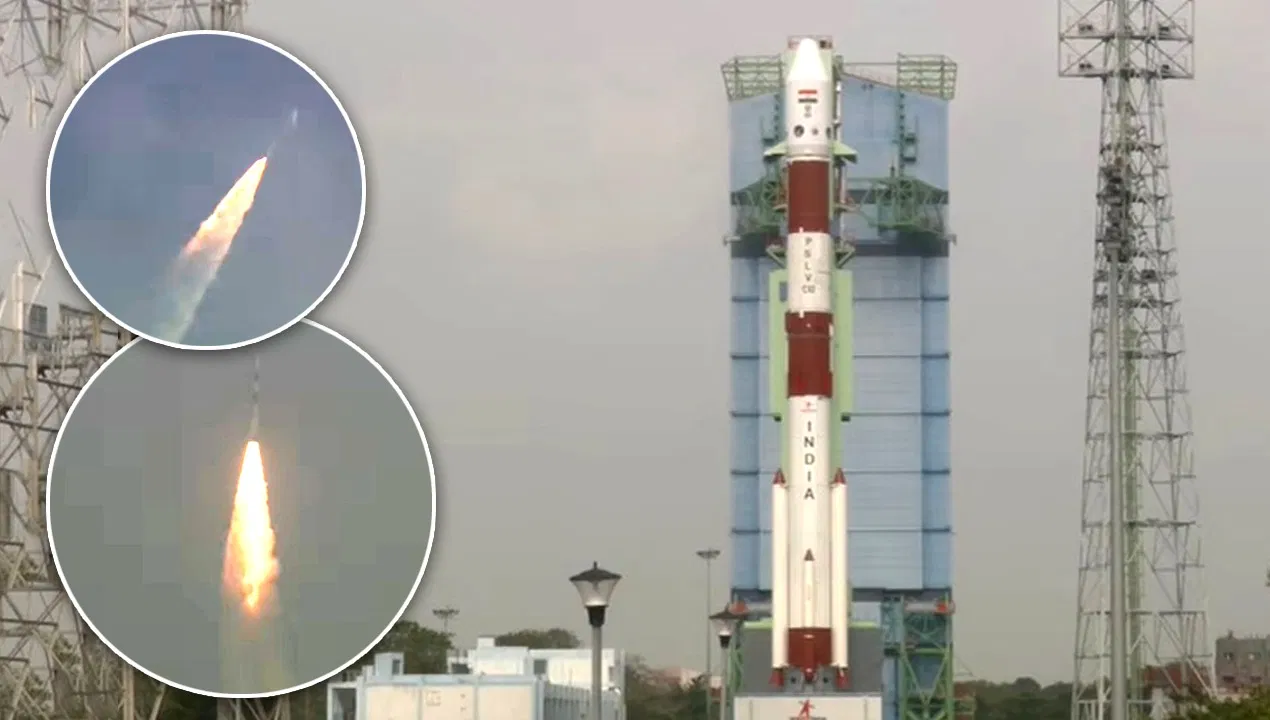
ISRO’s first mission of 2026 incomplete, technical glitch in PSLV-C62 launch, EOS-N1 ‘Anvesha’ could not reach orbit

Tezzbuzz Desk- The Indian Space Research Organization (ISRO) launched the first satellite mission of the year 2026 on Monday, January 12. The launch was carried out at 10:18 am by Polar Satellite Launch Vehicle (PSLV-C62) from the Satish Dhawan Space Center in Sriharikota, Andhra Pradesh. However, this mission could not be completely successful due to technical glitches in the final stages of launch.
In an official statement issued by ISRO, it was said that the problem occurred in the last part of the third stage (PS3 Stage) of the PSLV-C62 mission. According to ISRO, at the end of this stage, an unusual change was observed in the roll rate of the rocket, after which there was a deviation in the flight path. At present, all the data related to the mission is being analyzed in detail, so that the exact reasons for the disturbance can be found out.
ISRO Chairman Dr. V. Narayanan said,
“PSLV-C62 is a four-stage launch vehicle, consisting of two solid and two liquid stages. The performance of the vehicle was as expected until the last part of the third stage, but thereafter disturbances in roll rate and changes in flight path were observed. We are analyzing the entire data.”
The most important payload of this mission was the Earth Observation Satellite EOS-N1 ‘Anwesha’. It was to be placed in Sun-Synchronous Polar Orbit (SSO) about 600 kilometers above the Earth. But due to technical fault, this satellite could not reach its designated orbit and the mission remained incomplete.
Anvesha was considered very important for India’s security system. It is also being called ‘India’s Space CCTV’, because with its help, terrorists, infiltrators and suspicious activities were to be kept a close watch.
EOS-N1 Anvesha has been developed by Defense Research and Development Organization (DRDO). It is a state-of-the-art hyperspectral imaging satellite, which works on Hyperspectral Remote Sensing (HRS) technology. This technology can detect much more spectrum than normal satellites.
Its biggest feature is that it is capable of taking clear pictures of enemies hidden in forests, bunkers and difficult areas. Once Anwesha became operational, it could keep a close watch on enemy activities, arms and drug smuggling, and cross-border infiltration. For this reason it is being considered a “secret weapon” for the Indian Army.
A total of 15 satellites were to be sent into space under the PSLV-C62 mission. These included one main Indian satellite EOS-N1 and 14 other smaller satellites. Out of these 14, 8 were foreign satellites, which were associated with countries like France, Nepal, Brazil and Britain.
ISRO has made it clear that at present all aspects related to the mission are being thoroughly investigated. Only after the analysis is completed, it will be decided what the next step will be and when an important satellite like EOS-N1 will be launched again.
Although there is disappointment with the mission remaining incomplete, ISRO’s track record shows that after learning from such challenges, the organization comes back stronger than before. The country will now wait for Anwesha to fly again and her success.

Comments are closed.