
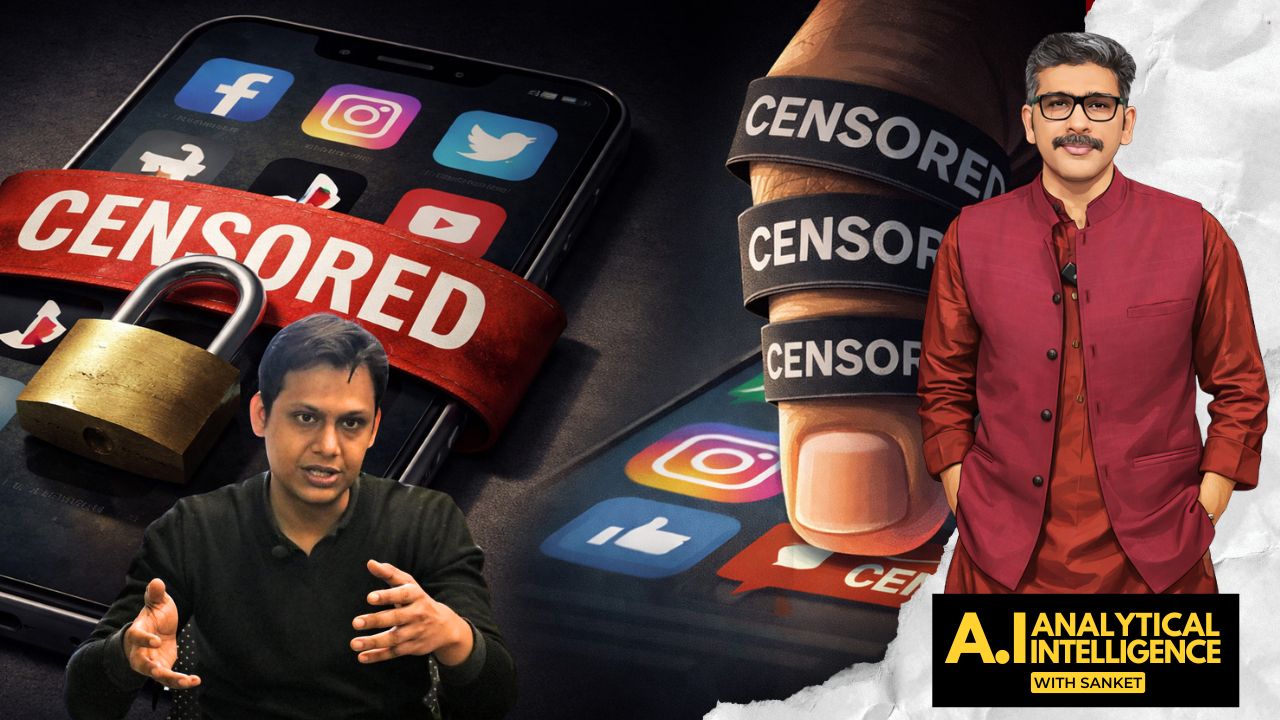

Amid fresh proposals by the central government to amend the IT Rules, expanding its powers over online content, surveillance, and user data, The Federal in this episode of AI With Sanket spoke to internet freedom advocate Apar Gupta to understand what exactly has changed and what it means for free speech, privacy, and digital rights in India.
What has changed?
Gupta explained that the foundation of internet regulation in India lies in the Information Technology Act and the subsequent Information Technology Rules 2021. These rules determine how social media platforms operate and what responsibilities they carry.
He noted that earlier provisions protected platforms from liability for user-generated content, provided they followed certain compliance rules. However, recent amendments have significantly expanded the scope of regulation.
According to Gupta, the government has been steadily increasing its censorship powers through multiple changes, including attempts to introduce fact-checking authority, which was later struck down by the Bombay High Court as unconstitutional.
Expanded powers
The latest proposals, he said, introduce three major changes. First, the government can now issue advisories, standard operating procedures, and codes of practice that may not even be made public but would still be binding on platforms.
Also read: Centre proposes bringing users posting news content on social media under IT Rules: Report
“This effectively allows the ministry to direct platforms to take down broad categories of content without transparency,” Gupta said, highlighting concerns over accountability.
Second, the scope of regulation is being extended beyond platforms and publishers to include ordinary social media users. This means individuals posting opinions on current affairs could face takedown orders or even account-level action.
User surveillance
The third major change relates to data retention. Gupta pointed out that user data, which was earlier required to be stored for 180 days, could now be retained for longer, potentially indefinitely.
“This includes not just what you post, but what you watch, engage with, and how long you engage,” he said, warning that this increases both surveillance risks and the possibility of data leaks.
He described the combined effect of these provisions as a serious threat to both freedom of expression and privacy.
Global comparison
Comparing the proposals with global standards, Gupta said such provisions would be difficult to justify in constitutional democracies.
Also read: AI three-hour takedown rule: When speed becomes the censor
He argued that laws in democratic systems typically go through legislative scrutiny, unlike advisory-based mechanisms that can be implemented without public debate.
“I have not seen such non-transparent, binding advisories in other countries,” he said, adding that combining regulation of platforms, publishers, and individual users under one framework is also unusual.
Selective enforcement
Addressing the government’s justification of tackling misinformation, Gupta said the problem is real but questioned whether the proposed approach is appropriate.
He pointed out that misinformation is often spread by politically affiliated actors across parties, raising concerns about selective enforcement.
“There is widespread abuse online, often linked to political interests, and yet enforcement appears uneven,” he said.
Gupta suggested that instead of expanding censorship powers, the government should strengthen independent journalism, improve transparency, and invest in public broadcasting systems.
Chilling effect
One of the most significant concerns, Gupta said, is the chilling effect on free speech. He cited a study by Lokniti CSDS which found that two-thirds of online users in India already avoid expressing political views due to fear of legal consequences.
Also read: India mandates 3-hour takedown for AI content: FAQ of what you need to know
“This shows that self-censorship is already widespread,” he said.
He added that public discourse often includes anger and criticism, which are natural in a democracy, and should not be suppressed through excessive regulation.
Free speech debate
Gupta also addressed the argument that online abuse and misinformation need stricter control. He acknowledged these as real issues but emphasised that legal safeguards already exist.
“There are criminal provisions to deal with misinformation and panic,” he said, arguing that the focus should be on enforcement of existing laws rather than creating new, sweeping powers.
He stressed that satire, criticism, and even harsh language are part of democratic expression and should be addressed through public discourse rather than censorship.
Digital shift
The discussion also highlighted the growing importance of digital media in India. Online platforms have become the primary space for news, commentary, and public debate.
With this shift, the stakes of regulation have become higher, raising questions about whether new rules are aimed at ensuring safety or controlling narratives.
Also read: Govt tightens IT rules on AI, mandates 3-hour takedown deadline
Gupta maintained that the current trajectory suggests a move towards centralised control over digital expression.
What next?
The proposed amendments are currently open for public consultation, giving citizens an opportunity to respond.
Gupta urged people to engage with the process and voice their concerns, saying the issue affects all users regardless of their political views.
“Today, the internet gives a voice to people who may not be heard elsewhere. Any expansion of control must be carefully scrutinised,” he said.
(The content above has been transcribed from video using a fine-tuned AI model. To ensure accuracy, quality, and editorial integrity, we employ a Human-In-The-Loop (HITL) process. While AI assists in creating the initial draft, our experienced editorial team carefully reviews, edits, and refines the content before publication. At The Federal, we combine the efficiency of AI with the expertise of human editors to deliver reliable and insightful journalism.)

Comments are closed.