
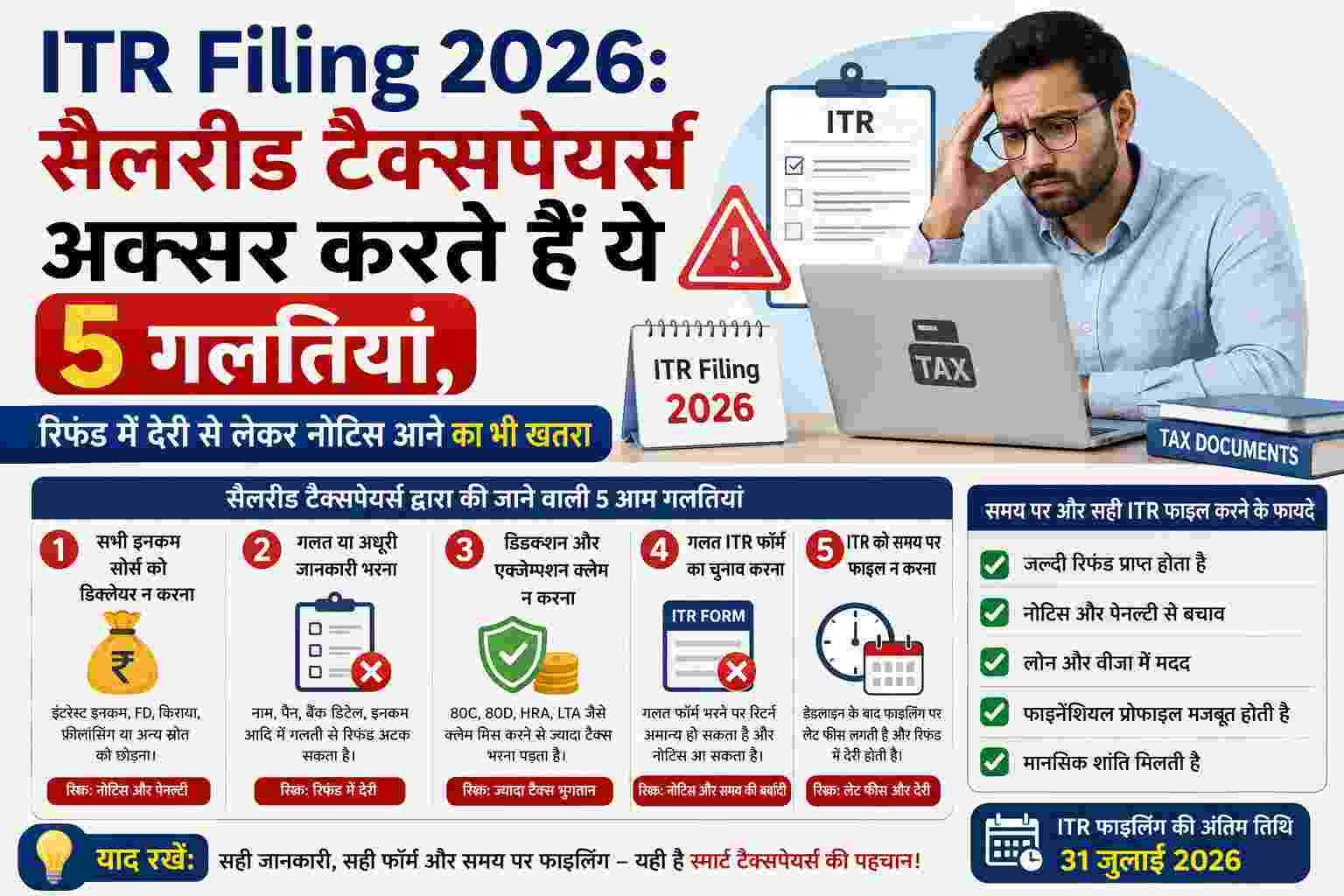
ITR Filing 2026: Salaried taxpayers often make these 5 big mistakes, there is a risk of refund getting stuck and tax notice.

For salaried salaried people, now filing Income Tax Return (ITR Filing 2026) has become much easier and digital than before. The entire process has become very easy because of the information already pre-filled in Form 16, Form 26AS and Income Tax Portal. Despite this, every year lakhs of taxpayers, due to haste or lack of knowledge, commit serious mistakes due to which their refund gets stuck, they have to pay additional tax along with penalty or they directly receive a legal notice from the Income Tax Department. If you are also going to file your ITR this year, then definitely avoid these 5 common mistakes.
Mistake 1: Considering Form 16 as everything
Most salaried employees assume that Form 16 received from the company contains all the information about their tax and earnings and they directly file returns based on that data. But this may prove to be a big mistake. Form 16 contains only the details of your salary and the TDS deducted by the company on it.
If you have earned interest on bank account, interest from fixed deposit (FD) or RD, dividend from company shares, house rent, capital gain on sale of mutual funds or shares or any additional income from freelancing, then it will not be reflected in Form 16. Hiding or forgetting the income from other sources may prove costly for you.
Mistake 2: Not matching these three important documents
Many taxpayers directly download Form 16 and submit ITR without any verification. The Income Tax Department has information about every major financial transaction of yours. Therefore, it is very important to match Form 16, Form 26AS and AIS (AIS – Annual Information Statement) before filing the return.
Form 26AS contains information about the total TDS, TCS deducted by different entities and self-assessment or advance tax deposited by you on your PAN card. At the same time, AIS contains detailed information about your financial history throughout the year (such as high-value transactions, stock market investments, etc.). If there is even a slight mismatch between the data of these three documents and the ITR data filed by you, your refund is stopped or the department sends a demand notice for additional tax.
Mistake 3: Choosing the wrong ITR form
The Income Tax Department has prescribed several types of ITR forms (such as ITR-1, ITR-2, ITR-3 and ITR-4) depending on different categories of taxpayers and their sources of income. For example, if your income is only from salary and rent from a house, you can choose ITR-1 (Sahaj).
But, if you have made capital gains from selling shares or property, you have any foreign asset, you are a director in a company, you own more than one house or you have any business income, then the second ITR form will be applicable to you. Selecting the wrong form may result in your return being rejected as a ‘defective return’ and you will have to file a revised return again with the correct form.
Mistake 4: Ignoring advance tax liability
Often employed people think that because their company has deducted TDS from their salary every month, their tax responsibilities are fulfilled. This thinking is not always correct.
Apart from salary, if you have substantial additional income from bank interest, house rent, dividend or any other short-term investment, your total tax liability increases. If your total tax liability (after deducting TDS) in the financial year exceeds ₹ 10,000, then you have to deposit ‘Advance Tax’ on time as per rules. If you do not pay advance tax on time, you may have to pay additional interest under Section 234B and 234C of the Income Tax Act.
Mistake 5: Claiming tax deductions without proper documentation
People are often careless while claiming tax exemptions like Section 80C (PPF, LIC, ELSS etc.), 80D (Health Insurance Premium), Home Loan Interest or HRA (House Rent Allowance). Many times, in order to save tax, fake claims are made without any investment.
It is very important to note that although you do not have to upload any receipt or document on the portal while filing ITR, the Income Tax Department can ask you for strong proof of these claims or investment receipts at any time during scrutiny. If you do not have valid documents at the spot, the department may reject your claims and charge you heavy fines, additional tax and interest in case of tax evasion.

Comments are closed.