
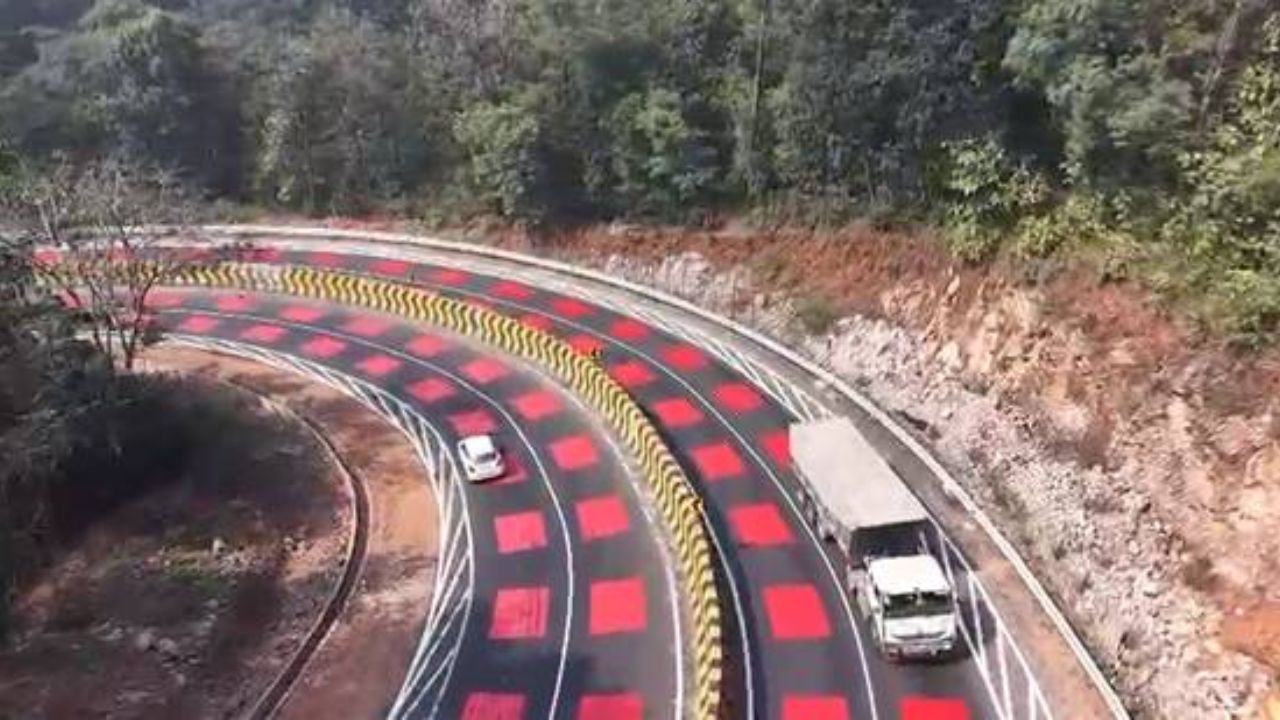

Jabalpur Instead of white and yellow lines, now wide red marks are visible on the road on National Highway-45. At first sight this change is shocking, but behind it is not just the design but the big idea of saving the lives of wild animals. The area passes near Nauradehi Wildlife Sanctuary and Veerangana Durgavati Tiger Reserve, where tigers, deer and other wildlife often cross the road.
Read now on WhatsApp also, click to subscribe
In such a situation, NHAI has made the road itself a medium of warning to alert the drivers in advance. This new experiment of NHAI is considered to be the first of its kind in India.
NH-45: Collision of forest and road
The Hiren–Sindoor stretch of NH-45 is approximately 12 kilometers long and runs along the Nauradehi Wildlife Sanctuary and Veerangana Durgavati Tiger Reserve. This is not an empty forest. Tigers, deer, sambar and jackal pass through this route daily. Despite the installation of warning boards and fencing for many years, there have been collisions between animals and vehicles on this road, especially at night.
Why was the road colored red?
Now a new initiative can be seen on this section. Instead of relying only on signs and fences, the road itself has started issuing warnings. Bright red square markings are spread across the road, which are slightly elevated and signal drivers to slow down. There is no sudden pothole or strong shock in it, rather the vehicle slows down first visually and then by touch. Actually the red color has been chosen deliberately. It is more visible than the white or yellow lines on the asphalt, and the slight elevation under the tires warns that this is not a normal road, but that animals can cross at any time.
Complete arrangements for the protection of wildlife
Apart from the markings, NHAI has built 25 wildlife underpasses on this route so that animals can pass safely under the road. Eight feet high iron fences are installed on both sides, which guide the animals towards these safe routes. Despite this, incidents of collision have been happening in the morning and night. Red marks have been placed to fill this gap.
Why is this experiment special?
Madhya Pradesh government recently shared the video of this project on social media, calling it a “sacred duty to protect wild life”. State level figures show that in Madhya Pradesh alone, in the last two years, there were 237 animal-vehicle collisions and 94 animals died. As the number of tigers is increasing, the animals are moving out of their traditional areas and crossing the road.
Benefits and future path
This upgrade of NH-45 will be completed by 2025 at a cost of Rs 122 crore. It is part of NHAI’s Green Highway initiative, which aims to build eco-friendly roads. Not only safety, better roads will also boost tourism and local economic activities. If this experiment is successful, then the highways passing through other forests of the country can also adopt it. This change shows that the road no longer just wants its own way, but is learning to share it with the life of the forest.

Comments are closed.