
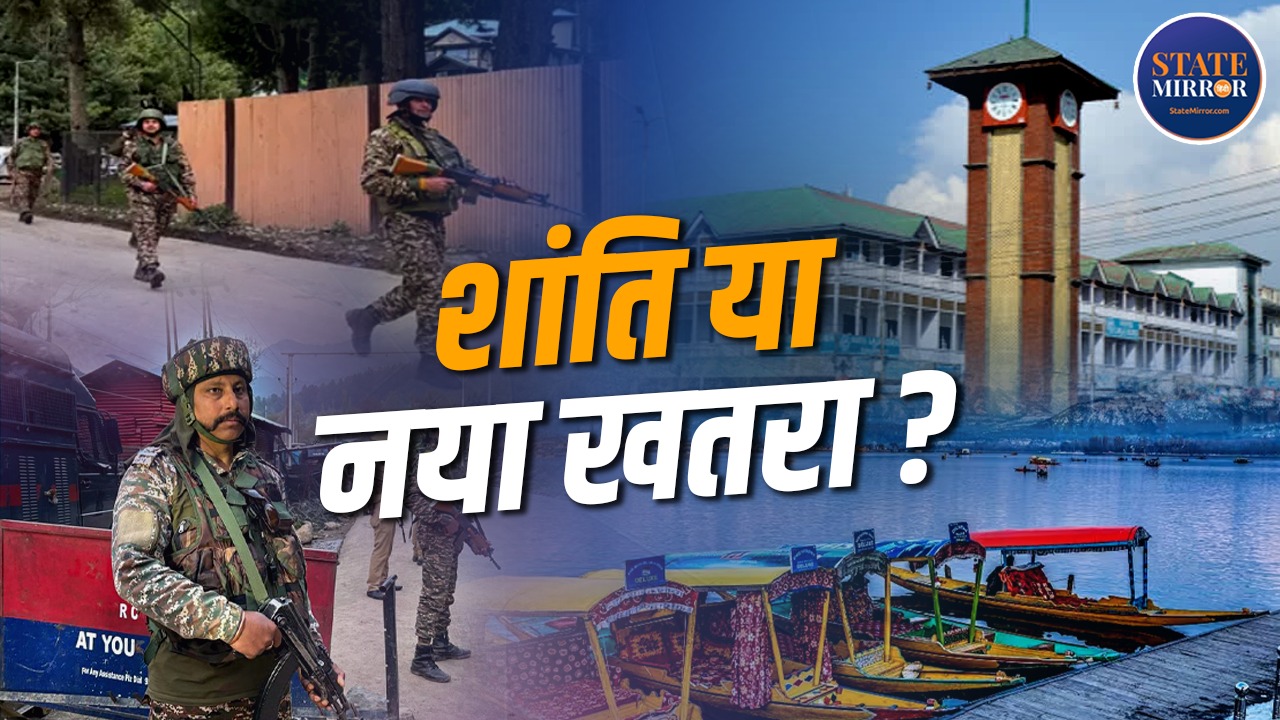
Guns silenced or the calm before the storm? What do the figures say on terrorism in 2026? How much has Jammu and Kashmir changed in three decades?

The story of terrorism in Jammu and Kashmir is not just about guns and ammo, but also about the ups and downs of changing defense and political strategies, security operations and Pakistan-backed terrorism from across the border. The insurgency that started in 1989 took its most terrifying form in the 1990s, but by 2026 the picture has changed significantly. According to the South Asia Terrorism Portal (SATP) and government data, there has been a historic decline in deaths due to terrorism. Now people have come out of the fear of terror to a large extent.
However, security experts do not consider this a declaration of the end of terrorism, but call it a new phase of changing threat and security strategy. Understand what has happened in Jammu and Kashmir in the last three decades, which is considered to be a relief to the people of the state in the changed environment.
1989–1999: The bloodiest decade of terrorism
The most violent phase of terrorism in Jammu and Kashmir was seen between 1989 and 1999. According to data from the Home Ministry and South Asia Terrorism Portal (SATP), about 7,229 civilians, 1,980 security personnel and 12,813 terrorists were killed during this period.
The maximum violence during this period was recorded between 1993 and 1996, when the influence of terrorist organizations was at its peak in the valley. During that period, encounters, kidnappings, murders and major terrorist attacks became common almost every day.
2000-2009: Security operations intensified, but violence continues
After the year 2000, Indian security forces made anti-terrorism operations more aggressive. Due to stopping infiltration on the border, breaking the network of terrorists and strengthening the local intelligence system, violence gradually started reducing.
Despite this, the impact of terrorism remained high from 2000 to 2009. In this entire decade, about 5,347 civilians, 3,610 security personnel and 13,148 terrorists were killed. This was the period when the action of security forces also intensified and terrorist organizations suffered continuous losses.
2010-2019: The changed form of terrorism
After 2010, the nature of terrorism started changing. Major attacks and civilian casualties declined, but after 2016, terrorist activities again came into focus due to recruitment of local youth, social media propaganda and increase in encounters.
About 551 civilians, 544 security personnel and 1,960 terrorists were killed in this decade. That is, there has been a decline in overall violence compared to the 1990s and 2000s, but terrorism has not completely ended.
2020-2025: Big decline in violence, threat remains
There has been a shocking decline in the total figures related to terrorism in the last few years. Between 2020 and 2025, about 252 civilians, 189 security personnel and 1,114 terrorists were killed.
Notably, terrorism-related deaths in 2025 were at their lowest levels in the last two decades. This indicated that the impact of continuous action by security forces, better technical surveillance and strictness on the border is beginning to be seen on the ground.
Trend of 2026: Danger not completely averted
The biggest sign in the year 2026 is not that terrorism has ended, but that there has been a massive reduction in major terrorist attacks and deaths due to terrorism.
Only 3 deaths related to terrorism were recorded in January 2026. These included 1 security personnel, 1 terrorist and 1 Pakistani infiltrator. The most important thing was that not a single civilian died. This is included in the lowest January figures in recent years.
January to May 2026: Such a period for the first time in three decades
May 2026 was considered an important month from security point of view. According to available reports, not a single death related to terrorism or infiltration was recorded throughout the month.
This was the first time in more than three decades that an entire month passed without any terrorism-related death. This was considered to be the result of continuous operations by security agencies, better intelligence coordination and strict surveillance on the border.
What changed after the removal of Article 370?
After the removal of Articles 370 and 35A from Jammu and Kashmir on August 5, 2019, extensive changes were made in the security arrangements. The central government adopted a multi-layered strategy against terrorism. Surveillance was strengthened to prevent cross-border infiltration, crackdown on terror financing was intensified, frequent raids were conducted on networks of overground workers (OGWs) and intelligence-based operations were increased to dismantle terrorist modules.
The result was that the impact of terrorist incidents and bandh calls in many areas was less than before. Improvement was also seen in tourism, investment and general life. Schools, colleges, markets and tourism activities became more regular in the valley than before.
Is terrorism over?
It would be considered too early to say so. This is because between 2023 and 2025, many major terrorist attacks took place in districts like Rajouri, Poonch, Reasi and Kathua of Jammu division. From this it became clear that terrorist organizations are trying to increase their activity in Jammu region instead of the valley by changing their strategy.
This means that despite violence reducing in the valley, the threat has not completely ended, rather its geographical and strategic nature is changing.
Why are security agencies still on high alert?
Busting of terrorist modules, recovery of weapons and arrests of terrorists continued in 2026 also. Security agencies remained on high alert especially during the Amarnath Yatra and unprecedented security arrangements were implemented.
It is clear that security agencies are still taking the threat of active terrorist networks, cross-border infiltration and sleeper cells seriously. The nature of terrorism is changing, hence the security strategy is also being continuously developed.
What do the figures say?
If we compare the 1990s with 2026, the picture has completely changed. There has been a sharp decline in civilian and security forces casualties, major terrorist attacks have reduced and the success of counter-terrorism operations is clearly visible. It is also true that the cross-border terrorist infrastructure has not been completely destroyed and efforts for infiltration and activation of small modules are continuing from time to time.
The story of 2026 is not one of “terrorism is over”, but of “a historic decline in violence, changing terror tactics and sustained security operations”. Defense experts see the environment of 2026 as “the guns are silent, but vigilance is still necessary”.

Comments are closed.