
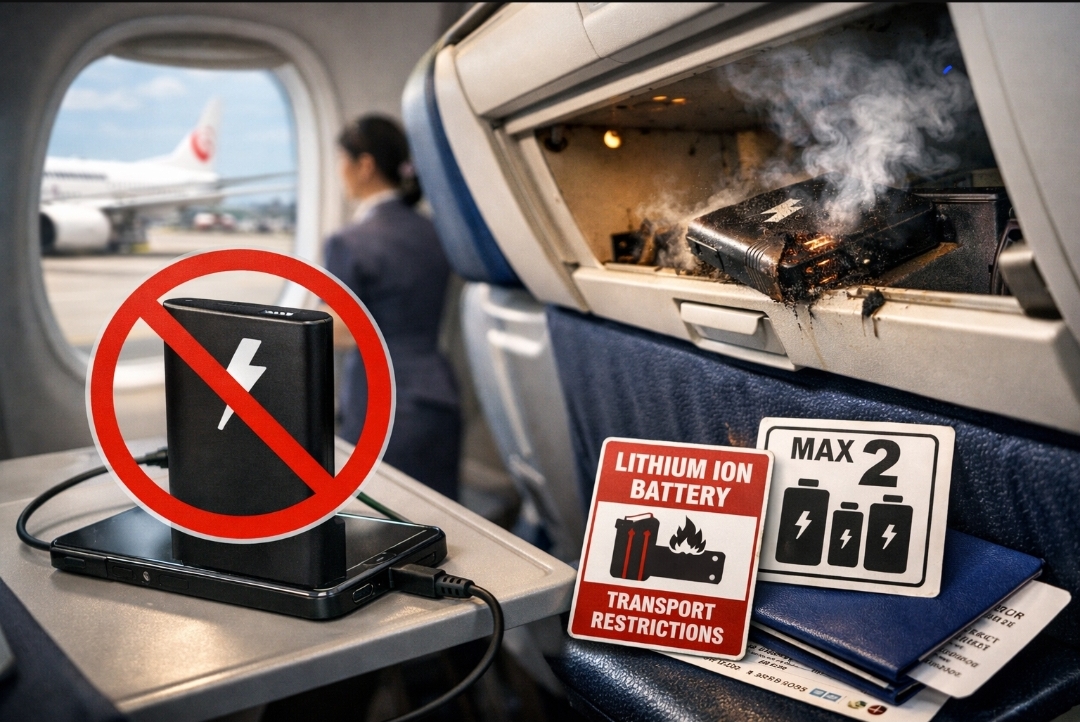

Japan is preparing to introduce tougher restrictions on portable power banks aboard commercial flights, responding to a series of battery-related incidents that have heightened concerns about cabin safety. The updated measures, expected to come into force in mid-April, will sharply limit how many spare batteries passengers can carry and will effectively end the use of power banks during flights.
The planned changes are being rolled out as Japanese authorities anticipate new international aviation safety guidance from the International Civil Aviation Organization (ICAO), the United Nations body responsible for setting global standards for civil aviation. Fresh recommendations from ICAO are expected as early as March, and Japan is moving proactively to ensure its domestic regulations align with those global standards.
The country’s Ministry of Land, Infrastructure, Transport and Tourism began inviting public feedback on February 27 as part of the formal process to amend its Civil Aeronautics regulations. Officials have pointed to the increasing fire risks associated with lithium-ion batteries, which power most smartphones, tablets, laptops, and portable charging devices used by travelers today.
What Will Change for Passengers?
Under current Japanese aviation rules, portable chargers are classified as “spare batteries.” These devices are already banned from checked baggage because lithium-ion batteries can ignite if damaged, short-circuited, or exposed to high temperatures in a cargo hold where detection and response may be delayed.
Passengers are allowed to carry spare batteries in their cabin bags, but there are limits depending on battery capacity. Batteries exceeding 160 watt-hours are prohibited entirely. For those between 100 and 160 watt-hours, travelers may carry up to two units. Devices rated at 100 watt-hours or less — which include most consumer-grade power banks — currently have no numerical restriction.
The proposed revision tightens these allowances. While the outright ban on batteries over 160 watt-hours will remain unchanged, the overall number of spare batteries a passenger can carry — including portable power banks — will be limited to two in total.
Importantly, power banks themselves will be capped at two per passenger, regardless of their watt-hour rating. Even smaller units well under the 100 watt-hour threshold will no longer be unlimited. This represents a significant shift from the previous rules, which placed no quantity cap on lower-capacity batteries.
In addition to limiting the number of devices, the new framework will prohibit charging power banks during flights. Passengers will also be strongly discouraged from using them in the cabin at all. Although some of the language describes this as a recommendation, airlines operating within Japan are expected to enforce the policy strictly, making it an effective ban on in-flight power bank usage.
Fires That Sparked Concern
The policy overhaul follows several alarming incidents in recent months that have underscored the potential danger posed by lithium-ion batteries in aircraft cabins.
One of the most serious cases occurred in January last year at South Korea’s Gimhae International Airport. A fire broke out on a plane operated by Air Busan while it was on the ground. The blaze caused extensive damage to the aircraft, leaving it nearly half-destroyed.
All 176 passengers and crew members were evacuated safely, though 27 people sustained injuries in the incident. Investigators later determined that the fire likely began near an overhead luggage compartment, where the remains of a burned power bank were discovered. The episode served as a vivid reminder of how quickly a small battery malfunction can escalate into a serious emergency.
Lithium-ion battery fires are particularly hazardous because they can burn intensely and reignite even after appearing to be extinguished. In a confined aircraft cabin, smoke and flames can spread rapidly, leaving little time for crew to respond.
Similar Incidents on Japan-Linked Flights
Japan has experienced its own battery-related scares. In April last year, a mobile battery ignited during a flight operated by Hawaiian Airlines traveling from Honolulu to Tokyo’s Haneda Airport. Flight attendants were able to contain the situation before it developed into a more dangerous scenario.
Later, in October, smoke was reported from a portable battery aboard a flight operated by All Nippon Airways (ANA) flying from Naha in Okinawa to Haneda. While no major injuries were reported, the incident once again highlighted the vulnerability of aircraft cabins to battery malfunctions.
These episodes have reinforced warnings from aviation safety experts that even widely used consumer electronics can present risks when packed tightly into overhead bins or carried in large numbers by passengers.
Airlines Already Adjusting Procedures
Even before regulators finalized the new restrictions, Japanese airlines had begun taking preventive measures. Since July last year, major carriers have advised passengers not to store power banks in overhead compartments. Instead, travelers have been encouraged to keep them at their seats, where any signs of overheating or smoke can be spotted immediately.
The logic is straightforward: if a battery ignites inside an overhead bin, flames and smoke may go unnoticed until they have grown more severe. By keeping devices within view, cabin crew can act faster to contain potential fires.
With the upcoming regulatory changes, airlines are expected to formalize these precautions and possibly intensify screening at airports. Travelers may encounter clearer guidance during check-in and boarding, along with more explicit instructions about the number and use of spare batteries.

Comments are closed.