
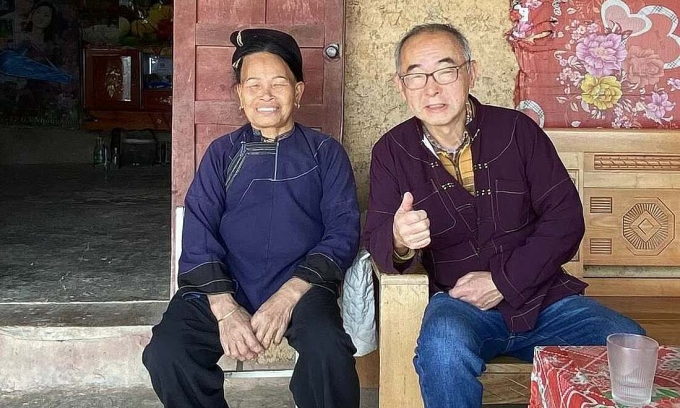

Yasushi Ogura remains connected to Ha Giang every day from back in Tokyo.
Fluent in Vietnamese, which he taught himself, the 69-year-old checks in on life in Lo Lo Chai village and follows the progress of restoration of houses in Sang Tung Commune.
“Ha Giang has become my second home,” he says.
“Life there feels more comfortable than in Japan because of the friendships I’ve built.”
Yasushi Ogura (4th, L) shares a meal with residents of Lo Lo Chai Village, Ha Giang. Photo courtesy of Yaushi Ogura |
His bond with Vietnam began 30 years ago. In 1995 he traveled all over the country. In the early 2000s Ha Giang remained absent from the tourism map except for some backpackers and a small number of foreign travelers.
Ogura recalls: “The road to Dong Van had been paved with cement, but it was narrow and only one bus could pass at a time. The journey took an entire day.”
Despite the difficult conditions there, he fell in love with the virginity houses made of clay and mud and with yin-yang roof tiles and earthen walls.
In 2010 he returned to Ha Giang and arrived in Lo Lo Chai, where he noticed traditional homes being replaced by concrete structures. This abandoning of the local heritage in pursuit of modern comfort saddened him.
In 2014 he invested around VND200 million (US$7,600) from his retirement savings to open Cuc Bac Café inside a 200-year-old earthen house belonging to Diu Thi Huong’s family.
His goal was simple: to create a model that would encourage people to preserve their architectural traditions.
He says: “Running a coffee shop inside a traditional house provides a steady income. Only then will people have the motivation to protect and preserve them.”
In the beginning Huong’s family members spoke little Vietnamese and had never seen coffee before.
Ogura brought two university students from Hanoi to teach both coffee-making and basic Vietnamese.
Beyond the cafe, he provided money for building homestay facilities and stone walls in communal spaces to maintain the village’s identity.
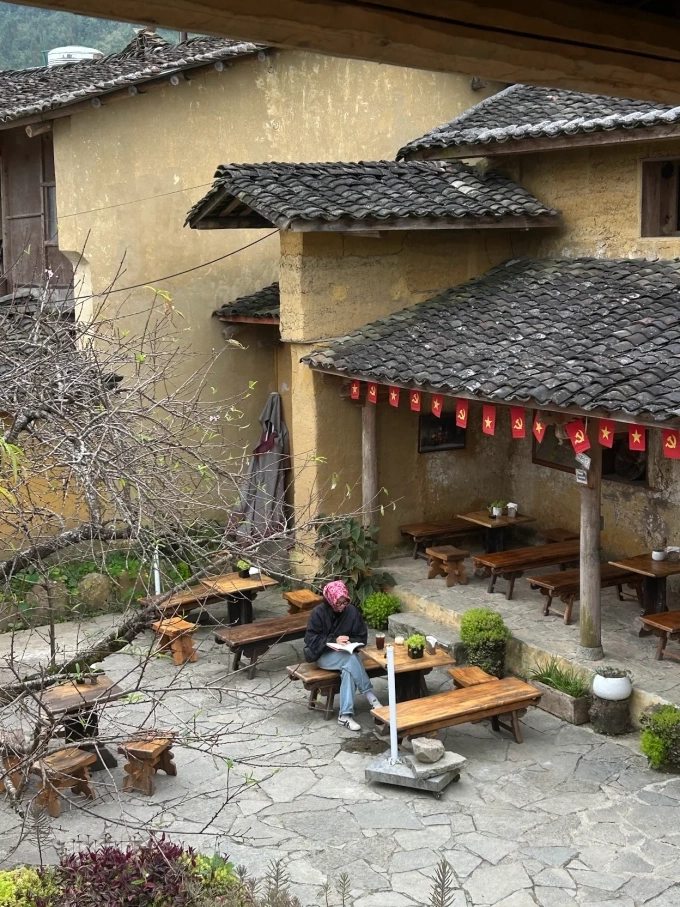 |
A few tables in the backyard of Cuc Bac coffee shop in Ha Giang provide a spot to enjoy beverages outdoors. Photo by Nguyen Ha Chi |
Ogura says persuading locals to shift from farming to tourism was not as difficult as people think.
The village head backed him and Huong’s family understood that his aim was not profit, but preservation of local old houses and improving livelihoods.
The key was sincerity and respect, he says.
“After eating together just a few times, people become close, regardless of ethnicity. What matters is respecting their culture and never discriminating.”
The results are visible across the village, but especially among the family behind the cafe.
Huong, now 24, met Ogura 12 years ago and became the first in her family to attend university.
After graduating from the Hanoi University of Science and Technology, she returned home to work on tourism services with his guidance.
Since transitioning from farming to tourism services, her family’s life has transformed, she says.
“From having almost nothing, we are now much better off. Our meals have improved, and our six-member household can earn up to VND100 million ($3,800) a month.”
Ogura always exhorts her to take pride in her heritage.
Villagers once demolished old houses because they leaked and attracted insects. With guidance from Ogura and experts, her family learned how to preserve belongings and upgrade living conditions while maintaining the architecture.
Their success has inspired other households to retain their homes and adapt them for tourism.
 |
Huong (C) and her family at their home in Lo Lo Chai. Photo courtesy of Yaushi Ogura |
Lo Lo Chai is now popular with both Vietnamese and foreign visitors, and was even recognized as one of the world’s best tourism villages in 2025.
According to Ogura, the line between conservation and overdevelopment is fragile, so it is important for the locals to be proud of their culture and determined to protect their heritage. For years, he has patiently explained that cultural preservation can also generate income.
He emphasizes that tourism in the highlands must be led by locals rather than outsiders. In the past many tourism services in Ha Giang were run by people from outside due to a lack of local knowledge and experience. That is now changing as more people gain access to education.
Sinh Di Gai, head of the village, says the community appreciates Ogura’s contributions to tourism development and cultural preservation.
Today 52 households are involved in tourism, and earn average monthly incomes of around VND30 million ($1,140).
Foreign visitors, including many from Japan, are increasing in number thanks to Ogura’s promotion and support.
Gai says about the Japanese man: “We consider him family. He can visit any home, have a meal or stay the night. Everyone knows him and welcomes him warmly.”
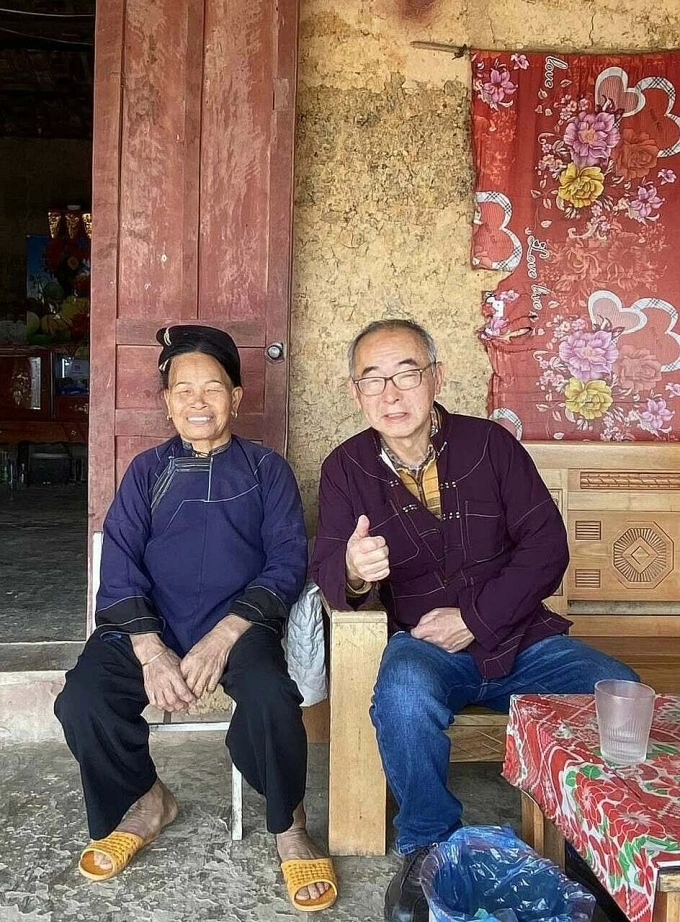 |
Yasushi Ogura (L) visits a family in Ha Giang. Photo courtesy of Yaushi Ogura |
After 16 years in Lo Lo Chai, Ogura has now turned his sights to Sang Tung and Thai Phin Tung communes for developing a “living museum.”
It is the result of 10 years of research into heritage preservation. For him, a “living museum” means preserving life within traditional homes, not building new ones.
The project follows three principles: no selling land to outsiders, fewer visitors to keep the village peaceful and helping some families restore their homes for living so that daily life stays authentic.
His dedication comes from a bond built over 30 years. Ogura says he now has more friends in Ha Giang than in Japan and feels more at home there. The province has become his second home.
Before she passed away his mother visited Vietnam three times and grew to love the country, and encouraged him to continue his work.
“People often say I’m doing charity, but this is my passion. I come to Ha Giang because I love it. If something I enjoy also helps others, that’s wonderful.”
At 69, instead of retiring to a quiet life in Tokyo, he spends two weeks each month traveling through Ha Giang’s mountains.
The long flights and rough journeys are not hardships, but a source of energy and a reminder that he is alive, he says.
What he values most after 30 years is not recognition but the people he has met, those who live in harsh conditions.
“They possess a resilience and wisdom that Japanese or many Vietnamese people may not have. I’ve gained so much emotion and courage from them.”

Comments are closed.