
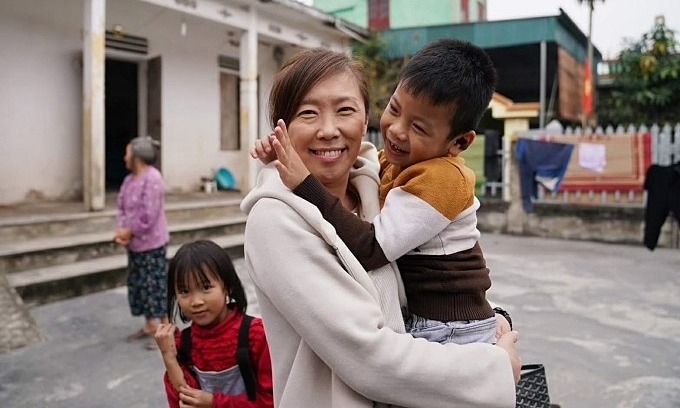

After receiving a call from a Tokyo hospital about a Vietnamese trainee who had given birth alone, the 65-year-old immediately activated an emergency intervention process.
At the hospital, she found the 20-year-old sitting curled up in a corner of a bed, her hair damp with sweat and her eyes filled with panic.
Afraid of losing her job and residency status, the young woman, who spoke little Japanese, had hidden her pregnancy and secretly given birth in her rented room before being discovered.
“I want to keep my baby but I also want to stay in Japan,” she said, adding that her biggest fear was deportation and having a violation recorded in her file.
Yoshimizu started by handling the woman’s paperwork. She contacted her supervising agency to explain the situation and provided medical certification. She also worked with the woman’s workplace to clarify the reason for her absence so it would not be recorded as absconding.
She then helped her complete the procedures for birth registration and residency.
Three months later the woman and her child returned safely to Vietnam with a “clean” record, allowing her to return to Japan in future.
“The woman’s situation is common among many Vietnamese workers in Japan. A lack of knowledge can push them into a dead end,” Yoshimizu says.
Through Japan-Vietnam Support, a non-profit organization she founded, Yoshimizu has assisted more than 15,000 Vietnamese expats over the past 13 years. They included people who lost their residency status, jobs or a place to stay.
Jiho Yoshimizu during a visit to Vietnam in 2023. Photo courtesy of Yoshimizu |
Yoshimizu says she is inspired by her childhood experiences.
She was born in Saitama Prefecture in a Buddhist family. Her father was the abbot of Nisshinkutsu Temple in Minato Ward, Tokyo.
From the 1960s the temple regularly hosted Vietnamese monks studying in Japan and handled funerals for Vietnamese who died abroad.
“My father said helping people in hardship is not a choice but a duty,” she says.
Growing up, Yoshimizu taught the tea ceremony to visitors and helped around the temple, where she met more foreigners who came seeking advice.
When the 2011 earthquake and tsunami hit eastern Japan, her father helped 84 Vietnamese affected by the disaster.
After her father passed that same year she witnessed a Vietnamese trainee die of exhaustion. The young man worked hard but was exploited and did not know where to seek help, eventually falling into despair.
“Why did a young man who came to Japan with dreams have to return home in this way?” she asks.
Yoshimizu then established a formal organization to provide support for Vietnamese workers.
This later became the Vietnam – Japan Support.
In the early years her organization operated mainly on her personal funds and small donations.
During the Covid-19 pandemic demand for assistance increased nationwide and more support came in. It now operates through a combination of subsidies, donations and activities such as lectures and training.
Yoshimizu recalls that in the winter of 2014, while delivering relief supplies, she was stopped on the street and questioned: “Do you prioritize foreigners over Japanese?”
She said they may be foreigners, but they also worked, paid taxes and helped with Japan’s labor shortages.
“There is no boundary between Japanese and Vietnamese, only people living on the same land. They are human beings who need help when they face difficulties.”
When people she helped later returned to clean neighborhood streets or assist with language classes, locals gradually became more open and understanding.
At the end of 2020 the pandemic caused Cong Thang, 33, of Nghe An Province to lose his job in Japan.
His contract was terminated, his savings ran out and there were virtually no flights home.
After asking for help on Facebook, he received a message from Yoshimizu. She asked him how long he could manage his expenses and when his visa expired, and suggested he should stay temporarily at the temple while figuring out his next steps.
Thang, who was staying at a labor union facility in Kitakyushu City, packed his belongings and took a train to Tokyo, where he was given a place to sleep at the temple.
During the day he studied Japanese on his own, and in the evenings he reviewed lessons with other Vietnamese workers.
With Yoshimizu’s support, he obtained a visa that allowed him to stay legally and secure a job at a noodles manufacturing company.
A few months later he passed the Japanese language proficiency test, intermediate level, and went on to get a job at a construction company.
“The most valuable thing was not just the visa but the feeling that someone believed in me and was willing to help when I was at my lowest,” Thang says gratefully.
 |
Jiho Yoshimizu with her Vietnamese colleagues in Japan. Photo courtesy of Yoshimizu |
Yoshimizu says, of the thousands of Vietnamese she has helped, the most troubling case involved a trainee who was paid less than stated in his contract. Unable to live on his income and without a place to turn to, he left the company amid mounting pressure.
An accident at a train station in Tokyo caused him to lose his left arm and left leg.
The young man was on the verge of despair when he met Yoshimizu. After offering encouragement, she contacted an airline to arrange a flight suitable for his medical condition and worked with the local immigration authorities to process his documents.
She also contacted the embassy to ensure his repatriation could proceed normally.
Depending on the case, Yoshimizu and her colleagues work with embassies, the Ministry of Health, Labour and Welfare, the Organization for Technical Intern Training, employment centers, multicultural divisions of local governments, unions, and lawyers to handle paperwork.
“Our job is to coordinate with various parties so that people in crises can have a way out,” she says.
“The most important thing is to help them believe they have the right to stay here legally and legitimately.”

Comments are closed.