
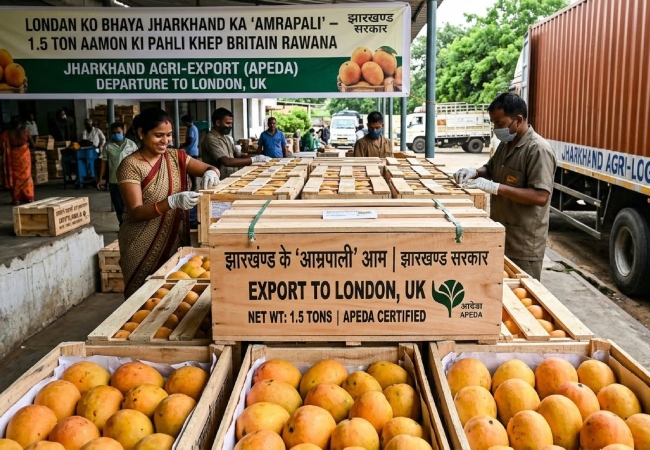
Jharkhand’s ‘Amrapali’ liked by London, first consignment of 1.5 ton mangoes sent to Britain

New Delhi. The demand for Indian mangoes is increasing in the international market. Recently Britain has welcomed Indian mangoes with open arms. According to Union Commerce and Industry Minister Piyush Goyal, the first consignment of 1.5 tonnes of fresh ‘Amrapali’ mangoes from Simdega district of Jharkhand has been successfully shipped to the UK.
Read :- Royal Albert Hall controversy: Pakistani host Fiza Ali’s video on Kumar Sanu’s song goes viral, people expressed displeasure
Big success of women farmers
This export is a completely women driven initiative. Local women farmers of Simdega district associated with ‘Beura Farmer Producer Company Limited’ of Bano block have prepared this consignment. The plantation of these high quality mangoes has been done under the ‘Birsa Green Village Scheme’ of the Government of Jharkhand. Agricultural and Processed Food Products Export Development Authority has provided support in this.
Due to this deal, there has been a significant increase in the income of local women farmers. While the price of these mangoes was only ₹ 25 per kg in the local markets, through this export the farmers got a price of ₹ 42 to ₹ 50 per kg. This premium consignment was sent to Britain from Kolkata’s Netaji Subhash Chandra Bose International Airport in collaboration with JGB Agrofresh Private Limited. ‘Amrapali’ mango has been developed from the hybridization of ‘Dussehri’ and ‘Neelam’ varieties, which is known for its extreme sweetness, deep orange pulp and excellent aroma. This is a unique combination of taste and health.
The amount of carotene (Vitamin A) in it is much higher than other mangoes. Apart from Jharkhand, Amrapali mangoes are also being sent to Britain and Germany on a large scale from Dhenkanal district of Odisha this season. This successful export not only strengthens Indian agriculture’s resolve to ‘Local Goes Global’ but also proves that women from remote rural areas of India are also writing the story of their self-reliance on the platform of global trade.
Comments are closed.