
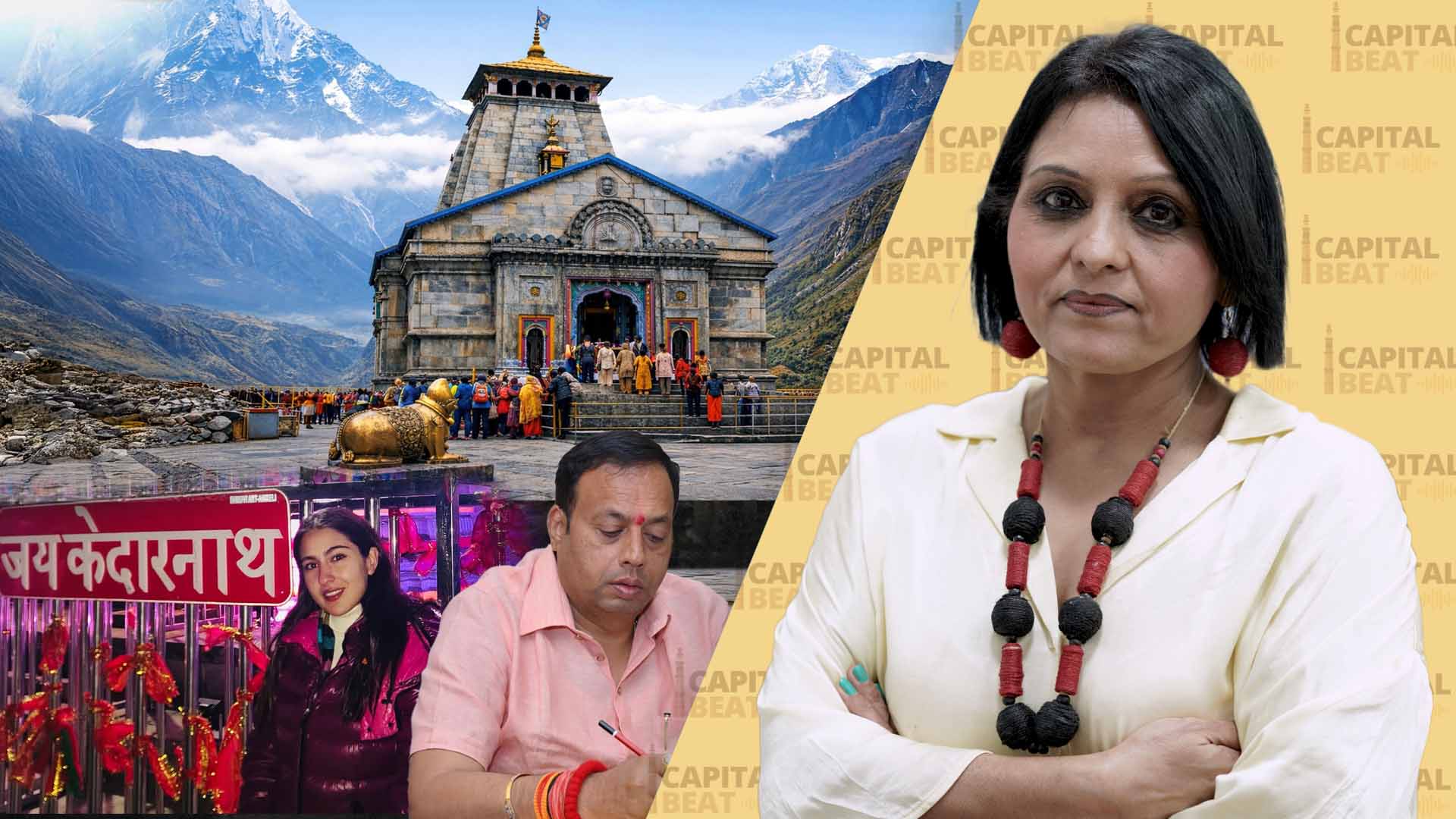

Author and political commentators Sharat Pradhan and Sunita Aron came together in this episode of Capital Beat to discuss the controversy surrounding a directive linked to the Badrinath-Kedarnath Temple Committee (BKTC) requiring non-Hindus to submit an affidavit declaring faith in Sanatan Dharma to enter the shrines. The development comes ahead of the start of the Char Dham Yatra.
Besides, the arrest of 14 youths after an iftar gathering on a boat in Varanasi, Uttar Pradesh, also came up during the in-depth talks.
Also read: India has lost its voice on West Asia: Former Delhi LG Najeeb Jung | Capital Beat
First, about the shrines. The discussion highlighted statements attributed to the president of the BKTC, Hemant Dwivedi, who said, “We have issued a formal order to prevent the entry of non-Sanathanis to our temples… those non-Hindus who submit a written declaration that I am a Sanathani… are welcome here.”
The development gained attention due to its potential implications for visitors, including public figures such as Sara Ali Khan, who has frequently visited Kedarnath in recent years and shared images from her trips on social media. Even her debut film in 2018 is titled ‘Kedarnath’, which featured the temple.
‘There are Hindus who don’t believe in Sanatan’
The rule, if implemented, would apply broadly, including to VIP visitors from other religions.
Pradhan described the move as part of a wider pattern, stating, “All this is happening because there is a race for proving who is the bigger Hindutva icon.” He added, “I won’t be surprised if they do it… this is another device to establish their Hindutva credentials.”
Also read: Bordoloi exit : Has Congress lost the plot in Assam?
The talks also referenced religious diversity within Hindu traditions. Pradhan noted, “Sanatani is not necessarily… there are Hindus who don’t believe in Sanatan Dharma,” citing the Arya Samaj as an example of a sect with different practices and beliefs.
‘Not practical, it’s just because of polls’
Aron questioned the feasibility of enforcing such a rule across large crowds. “How do you know who’s a Muslim or a non-Muslim? They all look the same,” she said. “When you have millions of people going to a temple… how do you check?”
She added, “It’s not feasible, it’s not practical. It is just an issue that they are trying to build as elections are around the corner.” Uttarakhand, where the shrines are located, go to polls in 2027.
Aron also pointed to logistical concerns, stating, “When you are talking about tourism… people go there for different reasons. Are you going to check affidavits everywhere?”
She suggested that the rule may be difficult to implement beyond a limited scope.
Religious identity and personal choice
The discussion touched on the broader issue of religious identity and personal freedom. Aron raised concerns about mandating declarations of faith, asking, “Religion is something which is very personal… what if you go to a temple but you don’t want to be identified?”
Also read: What’s behind Centre’s Governor rejigs? | Capital Beat
She also highlighted practical loopholes, saying, “You are not carrying your Aadhaar card… you can write anything as your identity.”
This, she suggested, could undermine the intent of such a requirement.
Pradhan echoed concerns about religious inclusivity, questioning, “How does a person belonging to any other religion… defile the religious sanctity?”
He added that people across religions visit different places of worship without issue.
Iftar boat incident in Varanasi
The panel also discussed a separate controversy in Varanasi, where 14 youths were arrested after a video allegedly showed them discarding food remnants into the Ganga River during an Iftar gathering on a boat.
The arrests were reportedly made under provisions related to defiling a place of worship and hurting religious sentiments. The incident triggered debate over environmental responsibility and selective enforcement.
Aron said, “Throwing bones… should not be permissible for anybody… everybody should respect each other’s sentiments.” She added that such actions, if proven, should be addressed, but questioned the severity of the response.
Experts calls Ganga pollution a broader issue
Pradhan challenged the basis of the arrests, stating, “Is there any evidence?” He argued that pollution of the Ganga is a broader issue, adding, “All kinds of filth is thrown… nothing is done about them.”
Aron maintained a conditional stance, saying, “If they did, it was wrong. If they did not do, very good.” She emphasised that enforcement should be consistent across communities.
Also read: Why the cultural intermingling that formed the core of ‘Holi Milan’ appears to be losing its hue
The discussion also noted that similar activities by others often go unchecked, raising questions about a uniform application of the law.
Political context and timing
Both panellists linked the developments to upcoming state elections and broader political messaging. Pradhan stated, “Their intention is only to garner votes by spreading… this is a design.”
He added, “Each time they come up with something… to manifest themselves as stronger anti-Muslim leaders.”
Aron described the issue as “a political ploy,” adding, “For some time everybody will be discussing it… after a few days it will become a non-issue.”
Impact on tourism
The discussion also raised concerns about the impact on tourism, particularly international visitors. Aron questioned how such measures would affect religious tourism, noting that people from diverse backgrounds visit places such as Kedarnath and Badrinath.
Also read: Is Mohammed Deepak an exception or a true reflection of India? | AI with Sanket
She said, “People coming from abroad… will they also bring an affidavit? How long, how do you think it is possible?”
The panel highlighted that large pilgrimage sites already face crowd management challenges, making additional verification processes difficult to enforce.
The content above has been transcribed from video using a fine-tuned AI model. To ensure accuracy, quality, and editorial integrity, we employ a Human-In-The-Loop (HITL) process. While AI assists in creating the initial draft, our experienced editorial team carefully reviews, edits, and refines the content before publication. At The Federal, we combine the efficiency of AI with the expertise of human editors to deliver reliable and insightful journalism.

Comments are closed.