
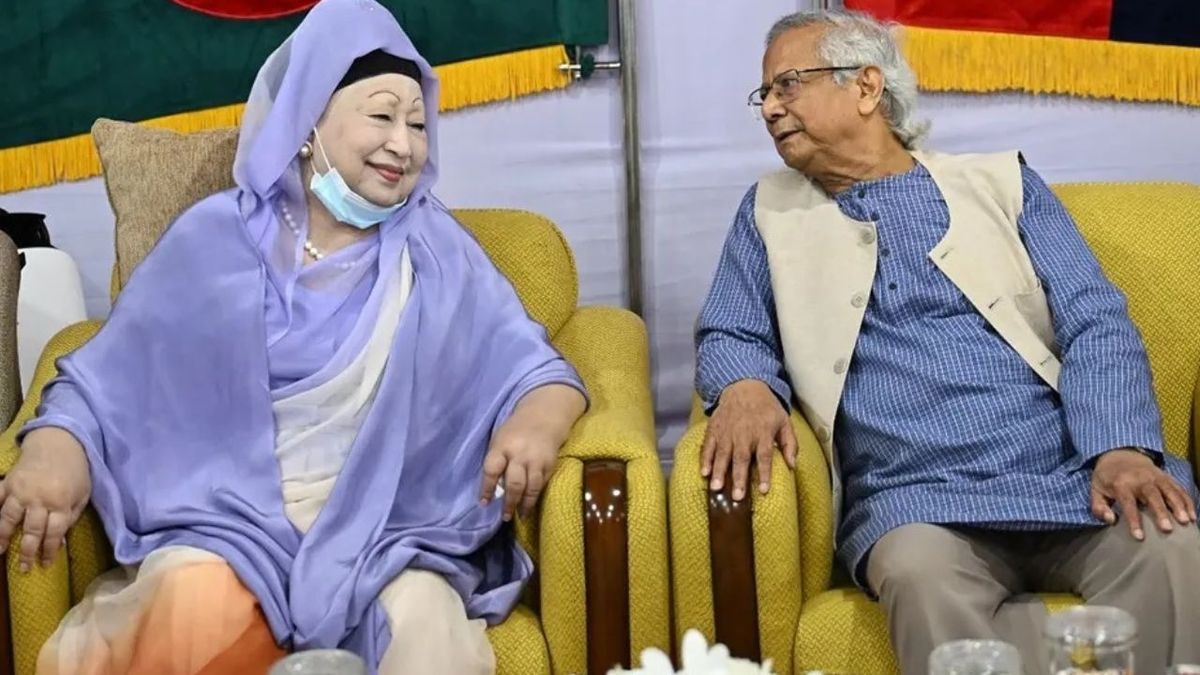

In the early hours of December 30, 2025, Bangladesh lost one of its most consequential political figures. Khaleda Zia, the country’s first female prime minister and longtime leader of the Bangladesh Nationalist Party (BNP), died at the age of 80 after a prolonged illness that included heart complications. Her passing, just weeks before the scheduled February 2026 general elections, marks the end of an era and has sent ripples through an already unsettled political landscape.
Zia’s death removes more than a towering personality from public life. It alters the balance of power at a critical moment. For Nobel laureate Muhammad Yunus, the interim Chief Advisor who assumed office after Sheikh Hasina’s ouster in 2024, it appears to clear yet another obstacle in what many believe is his bid to entrench himself beyond a transitional role.
Zia’s passing is not only a personal loss for her party and supporters; it is a strategic turning point. Bangladesh is facing economic strain, a fragile law-and-order situation, growing Islamist mobilization, and unresolved demands for democratic restoration. In this environment, Yunus now faces fewer counterweights. His critics argue that the checks on his authority are steadily disappearing some by political design, others by circumstance — leaving the country vulnerable to a concentration of power that its institutions are ill-equipped to resist.
Yunus’s rise and the shrinking field
Muhammad Yunus was propelled into the political spotlight by the student-led uprising of 2024 that forced Hasina into exile in India. Backed by the military, he was appointed Chief Advisor of an interim government, pledging rapid reforms and early elections to restore democratic order. Polls initially slated for April 2026 were later advanced to February 12 under pressure from the army and other actors.
Yet Yunus’s tenure has been anything but calm. Allegations of power consolidation, intolerance of dissent, and accommodation of Islamist groups have followed his administration from the outset. Supporters describe him as a reformer cleaning up the excesses of the Hasina era. Critics see a leader increasingly comfortable with authority and reluctant to let go.
Hasina’s removal was the first major barrier to Yunus’s ambitions. Their rivalry dates back to Yunus’s failed political foray in 2007, after which he faced legal cases that he consistently described as politically motivated. With the Awami League banned and thousands of its members jailed, forced underground, or killed during unrest since 2024, the political field narrowed sharply.
Khaleda Zia remained the last figure with the stature to challenge Yunus’s dominance. As BNP chairperson, she was widely regarded as a unifying symbol for opposition forces and a potential rallying point against Yunus’s proposed “July Charter” and broader plans for state restructuring. Her death removes that anchor.
Pressure relieved, resistance weakened
Within Dhaka’s political circles, Zia was seen as a serious constraint on Yunus’s post-election plans. Even as illness limited her public role, her presence mattered. She represented continuity, legitimacy, and the possibility of organized resistance after the polls. Her son, Tarique Rahman, who has led the BNP in exile since 2018, may attract sympathy votes, but he lacks his mother’s authority and cross-generational appeal.
With Zia gone, Yunus’s path looks markedly less crowded. Critics argue that a pattern has emerged: Hasina driven out, her party dismantled, and now Zia removed by fate. While her death was natural, it arrives at a moment that benefits Yunus politically. Online discourse reflects this unease, with opponents accusing him of exploiting chaos and calling him power-hungry and self-absorbed. The interim government’s formal gestures — a state funeral and public condolences — have done little to dispel suspicion among skeptics.
What lies ahead if Yunus stays on
Speculation is growing that Yunus may seek the presidency after the elections — a role that is largely ceremonial but symbolically potent. In a weakened parliamentary environment, even a non-executive office could offer leverage, particularly if constitutional changes extend the influence of the interim leadership.
Concerns deepen when viewed against the current state of the country. Economic momentum has slowed, with the garment sector — once Bangladesh’s growth engine — facing uncertainty. Islamist groups, including Jamaat-e-Islami, have become more visible and assertive, raising fears about secularism and minority safety. Reports of mob violence and deteriorating law and order have become routine, while prolonged protests have strained relations between the civilian leadership and the military.
Yunus’s defenders argue that he inherited a broken system and is attempting overdue reforms, including independent investigations into past abuses. His critics counter that the proposed referendum in February on reforms, timed alongside elections, risks legitimizing an extended interim rule and creating a constitutional gray zone with no clear exit.
A Narrowing Democratic Space
Khaleda Zia’s death closes a long chapter in Bangladesh’s political history. It also sharpens the stakes of what comes next. For Yunus, it eases pressure at a moment when his authority is already expansive. For the country, it raises uncomfortable questions about accountability, pluralism, and the future of democratic competition.
As the February elections approach, Bangladesh stands at a crossroads. Whether the country moves toward stability or slides further into centralized rule will depend not only on who wins power, but on whether meaningful opposition and institutional checks are allowed to survive. Zia’s legacy imperfect but rooted in electoral politics serves as a reminder that leadership without limits rarely ends well. If that lesson is ignored, Bangladesh’s democratic promise may prove harder to recover than its leaders expect.

Comments are closed.