

Unlike traditional project-based outsourcing, this model enables companies to build dedicated offshore teams that work continuously with in-house development units. It allows organizations to maintain consistent resources while scaling capacity as project demand grows.
Lab-type offshore development refers to a collaboration model in which a company establishes a dedicated offshore team managed by a technology partner. Rather than outsourcing individual projects, enterprises work with a stable group of engineers focused exclusively on their systems, products, or platforms.
Key characteristics include dedicated engineering teams assigned to a single client, flexible team sizes based on development needs, continuous collaboration with internal teams, and long-term system development and improvement. Because engineers remain assigned to one client over time, they develop a deeper understanding of both technical architecture and business operations.
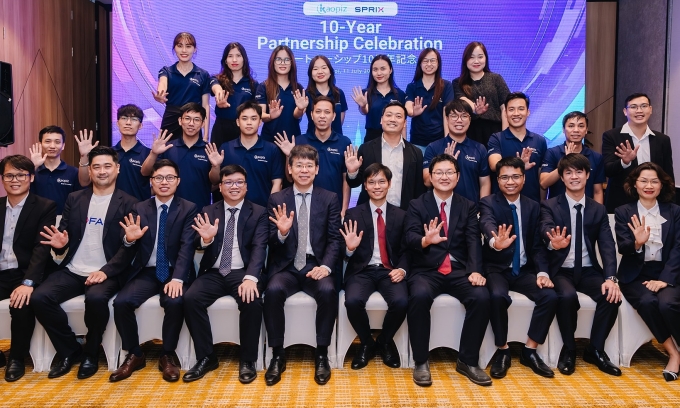
Kaopiz and its clients celebrate the 10th anniversary of their long-term partnership. Photo courtesy of Kaopiz |
Vietnam has emerged as one of the fastest-growing offshore development hubs for Japanese companies.
According to the Japan External Trade Organization, Vietnam is now among Japan’s most important IT outsourcing partners, supported by strong bilateral ties and a growing pool of skilled engineers.
Market data also reflects this momentum. Research from Statista projects Vietnam’s IT outsourcing market to exceed $880 million in revenue by 2028, with Japan remaining a key client.
Several factors underpin Vietnam’s position, including a large and expanding engineering workforce, competitive development costs, strong business cooperation between Japan and Vietnam, and increasing experience with Japanese enterprise systems. These advantages have made the country a strategic choice for companies exploring long-term offshore models.
Project-based outsourcing typically focuses on delivering a system within a fixed scope, budget, and timeline, making it suitable for short-term, well-defined projects.
However, many enterprise systems require ongoing updates, integration, and optimization. Lab-type offshore development, by contrast, supports continuous collaboration, with dedicated teams working closely with internal departments while steadily building system knowledge.
For complex platforms and long-term initiatives, this approach can improve development speed, flexibility, and software consistency.
The lab model is commonly adopted by companies that require stable engineering capacity over extended periods. It is particularly relevant for developing digital products that need continuous updates, modernizing legacy systems, building new digital platforms, and addressing domestic IT talent shortages.
By leveraging offshore teams, enterprises can expand development capacity without relying solely on local hiring.
Successful implementation depends on more than technical capability. A stable engineering team is essential, with members remaining assigned to the same client long enough to build domain expertise and system familiarity.
Clear communication is equally critical. Many offshore teams include bilingual project managers or bridge system engineers to coordinate between Japanese stakeholders and development teams.
Structured processes, such as agile development, sprint reviews, and transparent reporting, help maintain alignment and track progress.
Long-term collaboration between client and partner is another key factor. The model is most effective when both sides focus on building a sustained engineering partnership.
Technology providers with experience in the Japanese market play an important role in offshore development.
Kaopiza Vietnam-based IT service provider, supports Japanese enterprises through offshore development, system integration, and digital transformation projects. The company works with clients to build dedicated engineering teams aligned with internal development processes and quality standards.
With experience serving Japanese businesses, Kaopiz emphasizes team stability and long-term system development support.
As Japanese enterprises expand digital platforms and modernize legacy systems, maintaining consistent development capacity has become increasingly important.
Lab-type offshore development offers a flexible and scalable approach to building dedicated teams while managing costs. By partnering with experienced providers, companies can establish offshore teams that support continuous development and long-term technology growth.
Email: marketing.jp@kaopiz.com
Japan Office: 3F, 3-8-8 Minami Ikebukuro, Toshima-ku, Tokyo
Tel: 03-5809-2633
Singapore Office: 1 Raffles Place #19-61, One Raffles Place Tower 2, Singapore 048616
Vietnam Office – Hanoi: 1-2-4-5F, CT1-C14 Bac Ha Building, To Huu Street, Dai Mo Ward, Hanoi
Tel: 024-6652-2105
Vietnam Office – Da Nang: 12F, SHB Da Nang Building, 06 Nguyen Van Linh Street, Hai Chau Ward, Da Nang
Tel: 024-6652-2105

Comments are closed.