
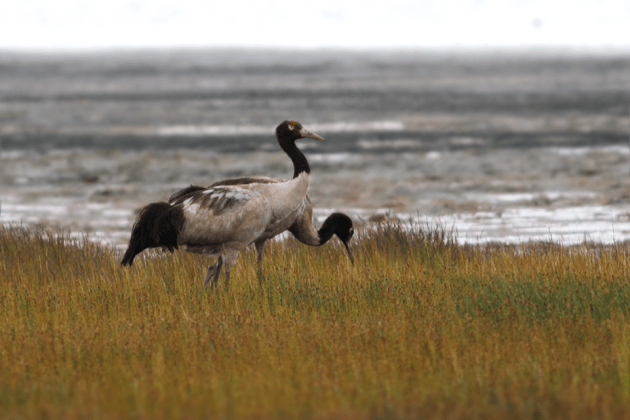

The Union Territory of Ladakh is all set to host India’s first-ever Global Black-necked Crane Festival from August 10 to 14 across Leh, Tso Kar and Hanle.
Dedicated to the conservation of the Black-necked Crane—the State Bird of Ladakh and the world’s only alpine crane—the festival will celebrate Ladakh’s unique natural heritage through wildlife, culture and community participation.
Visitors will get an opportunity to experience the breathtaking landscapes of Changthang while taking part in a celebration aimed at inspiring appreciation for and conservation of one of the Himalayas’ most iconic birds.
The festival seeks to promote wildlife conservation, harmonious coexistence between communities and nature, and nature-based livelihoods across the Changthang region of Ladakh.
“Did you know Ladakh is the only place in India where the rare Black-necked Crane comes home every summer to raise its family?” the Tourism Department of Ladakh posted on its official social media handle on Sunday.
“India’s first-ever Black-necked Crane Festival 2026 is here—celebrating this alpine icon under a landmark conservation initiative by the Lieutenant Governor of Ladakh, Vinai Kumar Saxena, in line with Prime Minister Narendra Modi’s vision for wildlife protection,” the post added.
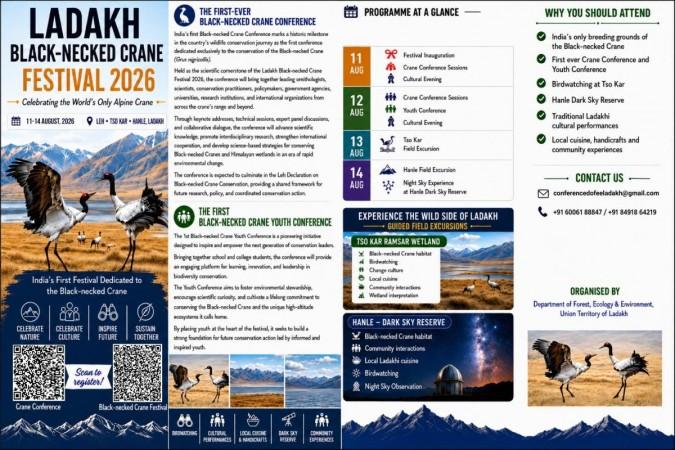
The proposed festival aims to celebrate the iconic Black-necked Crane while showcasing the ecological, cultural and economic significance of Ladakh’s high-altitude wetlands. It is envisioned as a platform to strengthen conservation awareness, promote sustainable tourism and generate livelihood opportunities for local communities.
Ladakh declared the Black-necked Crane as its State Bird in 2021
Following the bifurcation of the erstwhile state of Jammu and Kashmir into two Union Territories in 2019, the Ladakh administration, in 2021, declared the Snow Leopard (Panthera uncia) as the Union Territory’s State Animal and the Black-necked Crane (Grus nigricollis) as its State Bird.
Earlier, the Black-necked Crane was the State Bird of the erstwhile Jammu and Kashmir until August 5, 2019.
According to reports, the Black-necked Crane is found in the high-altitude wetlands and marshes of eastern Ladakh. It is currently listed as Near Threatened on the International Union for Conservation of Nature (IUCN) Red List. The birds arrive in Ladakh in March for breeding and migrate by late October or early November.
Locals in Ladakh believe that spotting a Black-necked Crane is a sign of good fortune.
Recently, a high-level meeting chaired by Ladakh Chief Secretary Ashish Kundra reviewed preparations for the festival.
Chief Secretary calls for a global-scale festival rooted in local communities
The meeting began with a detailed presentation by the concerned officers highlighting the rationale behind the festival and the global significance of the Changthang wetlands ecosystem.
Did you know Ladakh is the ONLY place in India where the rare Black-necked Crane comes home every summer to raise its family?
India’s first-ever Black-necked Crane Festival 2026 is here – celebrating this alpine icon under a landmark conservation initiative by the Lieutenant… pic.twitter.com/x9qfK2374K
— Ladakh Tourism (@utladakhtourism) July 26, 2026
The presentation described the Black-necked Crane as a symbol of harmony between biodiversity, culture and spirituality in the Trans-Himalayan region. It also highlighted the rapidly growing global bird tourism industry, potential tourism revenue, lessons from Bhutan’s successful Black-necked Crane Festival, and the vision and objectives of Ladakh’s proposed event.
The presentation further outlined plans to develop five key crane destinations in Changthang and proposed activities such as birdwatching tours, field visits, technical sessions, livelihood exhibitions and cultural programmes. It also discussed strategies to position Ladakh as a premier birdwatching destination, along with budgetary requirements and promotional plans.
During the deliberations, the Chief Secretary underscored the immense potential of bird tourism as a rapidly expanding global sector and stressed the need for Ladakh to leverage its unique biodiversity in a sustainable manner.
He also proposed incorporating an international component into the festival to attract researchers, conservationists, birdwatchers, photographers and nature enthusiasts from across India and abroad.

Comments are closed.