
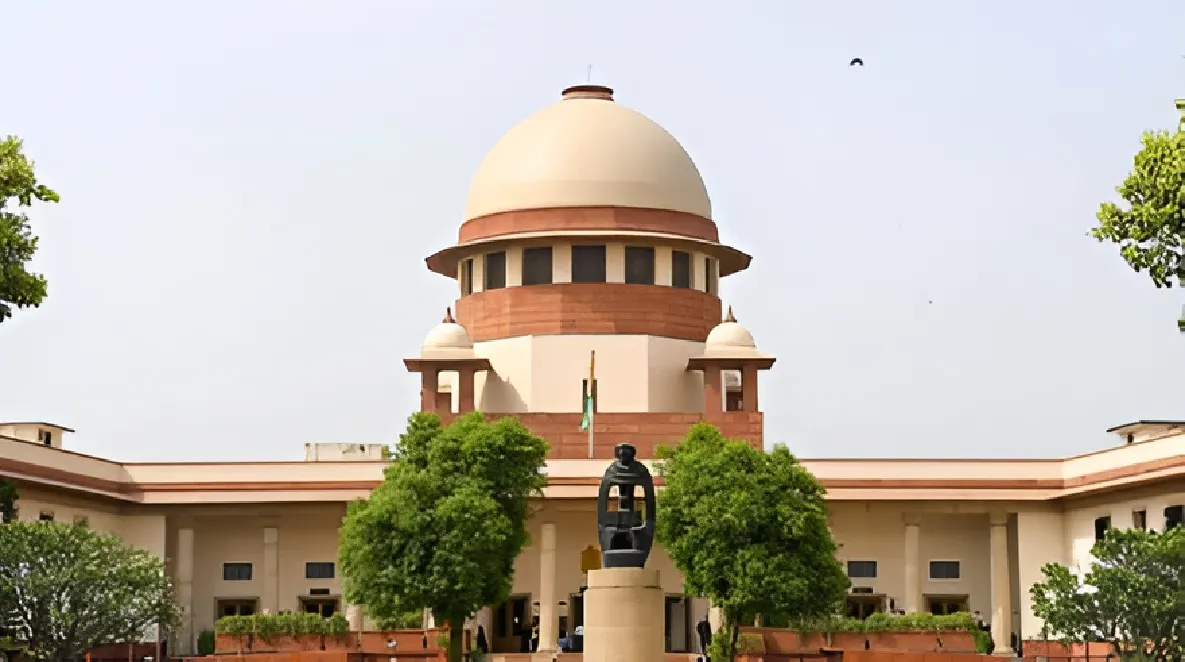
Last scene theory not proved, Supreme Court overturns Bilaspur High Court’s decision in murder case, accused acquitted

In a case of murder in Bilaspur district Supreme Court While commenting seriously on the arguments of the police investigation and the prosecution, it has been made clear that no accused can be held guilty merely on the basis of ‘last seen together’.
The court said that it is the responsibility of the prosecution (Supreme Court Judgment) to prove the crime through solid, convincing and independent evidence. With this, the Supreme Court canceled the order of Chhattisgarh High Court in which Manoj alias Munna, accused of murder, was convicted.
In this murder case, the High Court had upheld the trial court’s decision and awarded the punishment. The accused filed an appeal in the Supreme Court saying that he is innocent and the case is based only on circumstantial evidence. He claimed that the police and the prosecution had failed to present any direct evidence against him.
The case was heard by a division bench of Justice Sanjay Karol and Justice Prashant Kumar Mishra. The Supreme Court observed that the entire case of the prosecution was based on the fact that on the evening of June 6, 2004, the accused and the co-accused were seen accompanying the deceased on a motorcycle.
After this the deceased was not found alive. Serious injuries and burn marks were found on the body. The police claimed that the murder occurred over a dispute over tractor theft, but there was no credible evidence on record to prove it.
Regarding the last scene theory (Supreme Court Judgment), the Supreme Court said that it is only a weak link, it is necessary to connect it with strong evidence. Merely being last seen together does not prove a crime, especially when the prosecution cannot prove the entire chain of events. The court clarified that Section 106 of the Evidence Act can be invoked only if the prosecution first fulfills its onus.
Citing the case of Kanhaiya Lal vs. State of Rajasthan (2014), the Court said that if a situation of doubt arises in a case, then the benefit of the same should be given to the accused. This decision will further clarify the judicial approach and legal standards in future cases based on circumstantial evidence.

Comments are closed.