
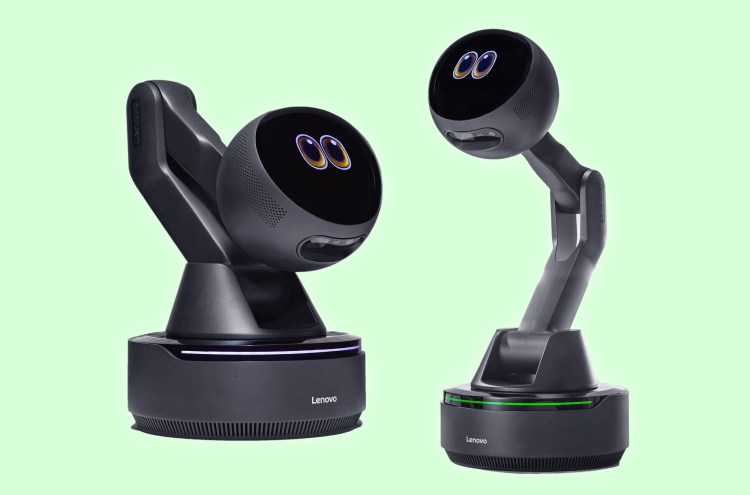

For decades, the relationship between a human and a computer has been static: you sit, the laptop stays. At the 2026 Mobile World Congress (MWC) in Barcelona, Lenovo officially declared that era over. By unveiling a suite of concept devices that blend advanced robotics with “Ambient AI,” Lenovo isn’t just making faster computers; it is creating hardware that anticipates, moves, and adapts to the physical presence of the user.
From a laptop that literally twists its “neck” to follow you around a room to a modular system that reconfigures its own anatomy, Lenovo’s latest showcase highlights a future where productivity is no longer a solo effort, but a partnership between human and machine.
The undisputed star of the showcase is the ThinkBook Auto Twist AI PC. While “AI PCs” have become the industry standard over the last two years, Lenovo has taken the term literally by reintroducing robotics into the chassis. The Auto Twist features a motorized, “Dual Degree of Freedom” hinge that allows the display to rotate, flip, and tilt automatically.
The device utilizes a “Hi Twist” wake command, enabling users to transform the laptop into tablet mode, tent mode, or closed mode entirely through voice. However, the true productivity breakthrough is its Smart Tracking capability. During a video call or presentation, the AI-powered webcam tracks the user’s movement. If you stand up to use a whiteboard or pace across your home office, the motorized hinge silently swivels the screen to keep you perfectly centered in the frame. It’s an “Auto-Follow” feature that feels like having a dedicated camera crew built into your lid.
The Modular AI PC: Productivity Without Borders
Addressing the “carry small, use big” paradox, Lenovo introduced the ThinkBook Modular AI PC Concept. This device challenges the rigid architecture of modern laptops by offering a selectively modular base.
The 14-inch ultra-thin system features a swappable lower deck. Users can snap in a traditional tactile keyboard for deep work, or replace it with a secondary display module to create a vertical dual-screen setup. Even the I/O ports are modular; if a professional needs extra HDMI ports for a specific presentation or a legacy USB-A connection, they can simply swap out the port modules on the side of the chassis. This level of hardware adaptability ensures that the PC evolves with the user’s workflow rather than becoming obsolete.
Spatial Creativity: The Yoga Book Pro 3D
For the creative class, Lenovo unveiled the Yoga Book Pro 3D Concept. This device attempts to bridge the gap between traditional 2D screens and the emerging world of spatial computing. Featuring dual Tandem OLED displays, the laptop provides a glasses-free 3D experience.
The system uses AI to perform real-time 2D-to-3D conversion, allowing designers to take a flat reference image and view it with perceived depth and volume instantly. Integrated gesture sensors allow users to “pull” objects out of the screen or rotate 3D models in mid-air without touching a mouse. By removing the need for bulky AR headsets or specialized peripherals, Lenovo is attempting to make 3D content creation as intuitive as sketching on a notepad.
Lenovo’s robotics and AI play isn’t just about performance; it’s about wellness. The AI Work Companion is a dedicated hardware assistant that resembles a high-tech desk clock but functions as a central nervous system for your workspace.
Equipped with a feature called “Thought Bubble,” the device synchronizes tasks and energy levels across all your Lenovo and Motorola devices. Using a “human-centric” AI model, it monitors screen time, eye strain, and task complexity. If the system detects signs of fatigue or prolonged focus, it proactively suggests work breaks or “micro-meditations.” It represents a shift toward “Ambient Intelligence,” where the machine takes responsibility for the user’s mental health as much as their output.
Lenovo Qira: The Invisible Thread
The glue holding these disparate concepts together is Lenovo Qira, the company’s new unified system-level AI. Unlike a chatbot that lives in a browser, Qira is integrated into the hardware of the 2026 lineup.
Qira understands context across applications; if you are looking at a 3D model on your Yoga Book and pick up your Motorola Razr, Qira automatically prepares the mobile version of that file for viewing. This continuity, combined with the “robotic” hardware of the Auto Twist and Modular PCs, suggests a future where our devices are no longer just tools, but proactive, physical companions.

Comments are closed.