
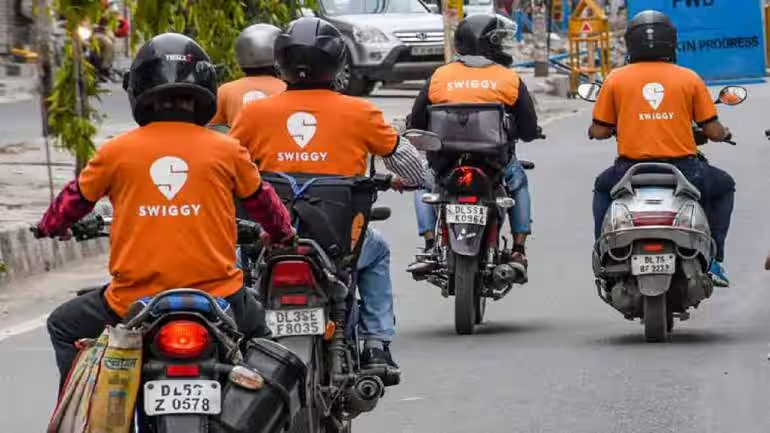
Life running on the bells of the app, insecurity in the name of freedom, know what difficulties we face every day… –

Shiv Shankar Savita- It is six o’clock in the morning. It’s a little cold on the street. A delivery boy starts the bike as soon as he hears the ‘tin’ of notification on the mobile. This notification is his livelihood and also his biggest compulsion. In this era of digital platforms, millions of gig workers in India are running their lives at the behest of the app. Be it cab drivers, food delivery workers, freelancers or warehouse workers, the gig economy has become the new face of employment today, but behind this face, deep lines of insecurity are clearly visible. Gig work in India is completely app based. Work is available at one click and it can also be taken away at one click. Cab and bike taxi, food-grocery delivery, logistics and warehouse shifts, content writing, designing, coding or domestic services, all these works have only one truth, if there is an order today then there is income, if not tomorrow then the pocket is empty. In this model there is no permanent duty, nor fixed future. If demand increases then work, if demand decreases then unemployment.
12 hours of hard work, still uncertain earnings
The average earnings of gig workers may be said to be between ₹10,000 to ₹25,000, but the reality is much harsher than this. If you are getting incentives, you get some money in your pocket, but as soon as the company changes its policy, the earnings are reduced to half. Petrol, mobile, internet, vehicle repair, every expense is on the head of the worker. If you fall ill, there is no money, no leave. Many gig workers are on the road for 10 to 12 hours a day, yet are unable to earn even minimum wages at the end of the month.
No safety, only risk
The lives of gig workers are full of risks. Road accidents, working in rain and sun, late night delivery, misbehavior with customers, all these are part of their daily routine. Despite this, they neither get health insurance, nor pension, nor PF. Legally they are not “employees” but “independent contractors,” meaning outside labor laws. Work may stop as soon as ratings fall. If the account is suspended then the employment is terminated without any hearing.
Challenge double for women
This journey is more difficult for female gig workers. Late night shifts, fear of security and social pressure stop their steps. Despite this, many women remain a part of this system under compulsion. In many countries in the US and Europe, minimum hourly wages, accident insurance and health cover are mandatory for gig workers. In countries like Britain and Germany they have been given partial employee status. There platform companies are accountable. The situation in India is opposite, there is no minimum wage, no strong complaint system, no accountability of the platform.

Comments are closed.