
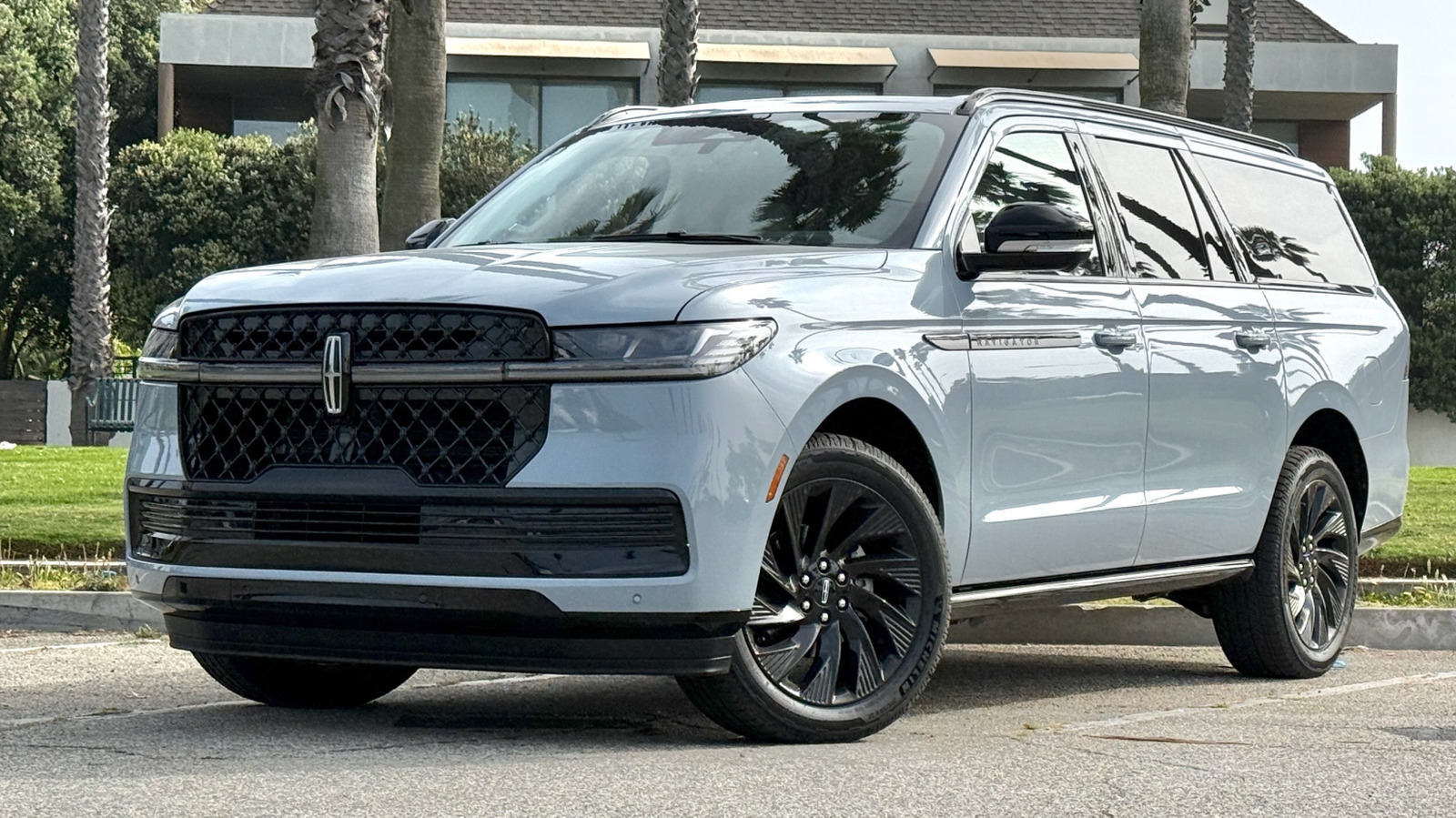

For a long time, the Lincoln Navigator name has been synonymous with large luxury. The hulking three-row SUV has been around for nearly 30 years, and it’s forged a path wide enough for other SUVs to follow behind it. Capable of pulling a large trailer while also transporting a large family, the Navigator L (or the long/extended version) is one of the top choices for families who want to combine space, utility, and luxury. And in 2026, it’s still at the top of its class.
The 2026 Navigator L has a giant and well-organized interior, loads of the latest tech, and robust power from a twin-turbo V6. Interior quality is excellent, the stereo has enough speakers to pump sound through every bedroom of a palatial estate, and enough cargo space for just about every suitcase you own.
There are some drawbacks to a big vehicle like the Navigator, but they’re drawbacks that span basically the entire class of high-end, three-row luxury SUVs. It’s expensive, generally inefficient, and a bit difficult to maneuver in tight spaces – and isn’t that what sizable family-hauling SUVs are all about?
Well-equipped and unsurprisingly expensive
To test out the latest Navigator, Lincoln sent me the mid-level trim, in its biggest size; we’ll get to that in a moment, but let’s talk about how to get there first. There are two main versions of the Navigator and three trim levels to choose from: The standard-length Navigator and the longer Navigator L are the two versions, while the Premiere, Reserve, and Black Label cover the bases as far as trim levels are concerned.
At the base Premiere trim, in the standard length, the Navigator will cost you $95,715 (including $2,895 destination fee and $825 acquisition fee). The L version adds $3,000 to that price tag, and it carries that premium all the way up the ladder of the other trims.
Standard equipment includes stuff like heated and ventilated front seats, heated second-row seats, tri-zone climate control, Lincoln’s expansive dashboard-dominating screen system, a 14-speaker stereo, 14 USB ports throughout the cabin, and a number of high-tech driving aids like adaptive cruise control, lane-keep assist, and a 360-degree parking camera. There’s no poorly-equipped version of the Navigator, but if you don’t need the ultra-plush add-ons, the Premiere is where it’s at.
This as-tested model has a lot going for it
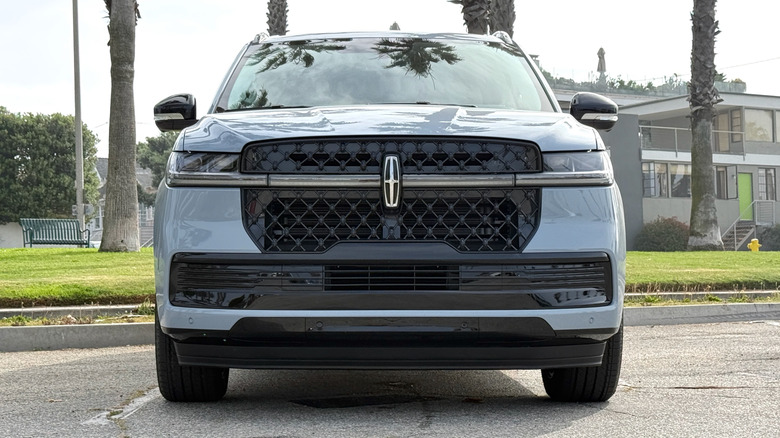
The mid-level trim known as the Reserve is what I tested, and it comes with all sorts of gear. It starts at $105,715 and adds equipment like a panoramic sunroof, and a 28-speaker stereo. With a few options, like second-row seats with heating, ventilation, and massage, as well as a trailer-tow package, and a Jet Appearance package, the as-tested price for the larger Navigator L Reserve I drove was $115,985.
You can still go up from there, with the Black Label trim going well into the $120-130k range, but it mostly adds cosmetic changes and ownership differences like free car washes. Some premium paint jobs will run you an extra $2,000, while specialized wheels and “Atmospheric” packages can put the Navigator L around $140,000.
Those prices, while a bit shocking at first, do include quite a bit of equipment. The Reserve L I tested, for example, came with power deployable running boards, power folding third-row seats, adaptive suspension, and a 28-speaker Revel stereo. That’s on top of all the standard gear and a full suite of driver aids available via Lincoln’s Co-Pilot and BlueCruise features. The Navigator also gets some pretty impressive power.
Sure, it’s a V6, but there’s nothing wrong with that
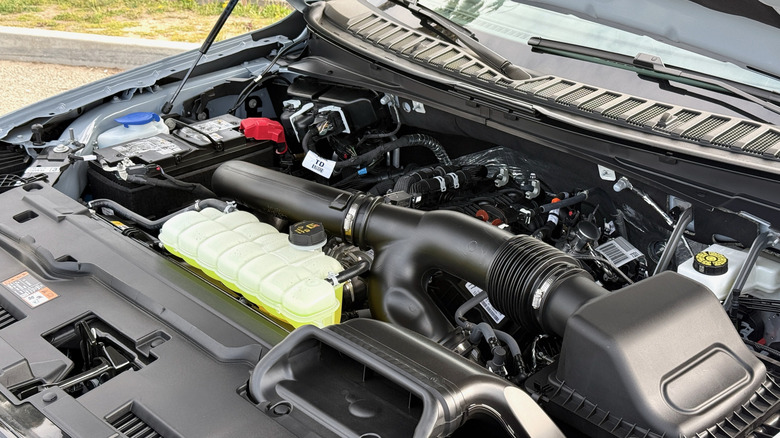
Providing every trim level of the Navigator with forward thrust is a twin-turbocharged 3.5-liter V6 that produces 440 horsepower and 510 lb-ft of torque. It’s paired with a quick-shifting 10-speed automatic transmission, and all Navigators come standard with four-wheel drive.
The Navigator falls behind when compared to three-row luxury SUVs like the Mercedes-Benz AMG GLS 63 and the BMW X7 M60i, both of which have turbocharged V8s and offer outsized performance for the class. There might also be some ultra-niche-occupying Navigator purists out there that will bemoan the lack of an available V8 in this Uber-XL-sized-SUV, but even said-purists should likely be impressed by the power output of the V6 under the hood.
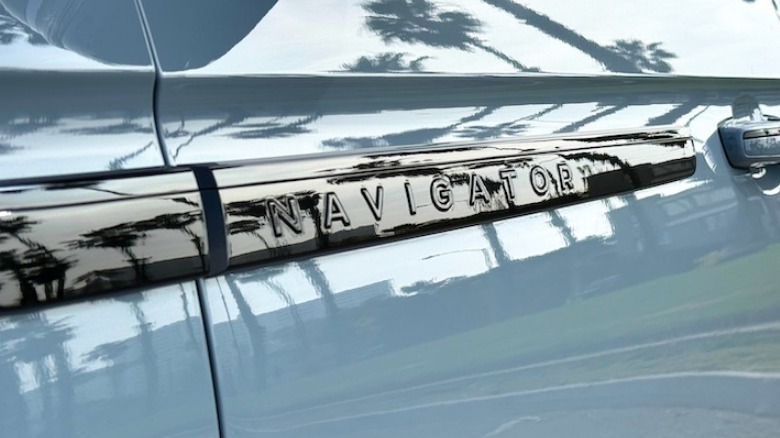 Travis Langness/Read
It’s certainly more than enough for quick merges on the highway and easy passing maneuvers, and if you’ve paired a boat purchase with your new Lincoln, it can handle that, too: the Navigator can tow as much as 8,700 lbs with the Heavy-Duty Trailer Tow Package. According to the EPA, the Navigator will return 17 mpg combined (15 city/22 highway) – an estimate I was able to beat with a bit of light-footed mixed driving.
Stay in boost while you’re scooting your Navigator around town with a heavy right foot, and you’ll pay the price at the pump, but it’s adequate fuel economy for the class. It’s certainly better than the 16 mpg and 13 mpg combined estimates that the Cadillac Escalade (in standard and V trims) gets.
It’s big, but not unmanageable
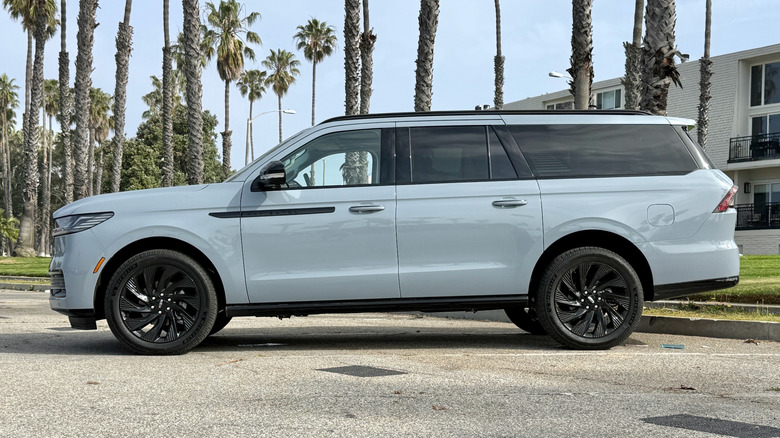
Driving something as large as the Navigator isn’t an exercise in sportiness, like it might be with M- and AMG-branded competitors. Instead, it’s a discovery of how well (or how poorly) an automaker has been able to manage the vehicle’s weight and mask it in daily driving scenarios. With all the years of experience under their belts making the Navigator, Lincoln has done a pretty solid job with these tasks.
 Travis Langness/Read
The Navigator’s height and driving position made it feel a bit like I was driving the world’s plushest bus, but the steering felt relatively well-weighted and accurate, the brakes responded quickly to inputs, and when I took it on a few tight roads, it wasn’t too much to handle. Parking it in tight spaces was a squeeze, no surprise there, but the large mirrors and high-res parking cameras made it easy to spot the vehicle’s corners and keep all the body panels scratch-free. As long as you aren’t expecting something nimble, the Navigator shouldn’t be a let-down.
Impressive space and comfort
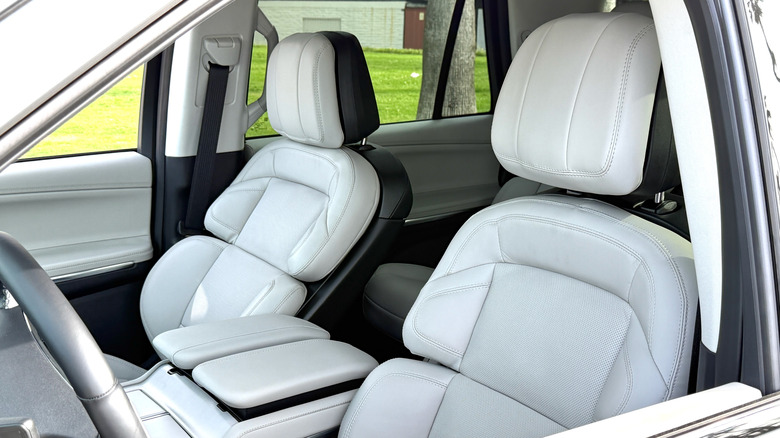
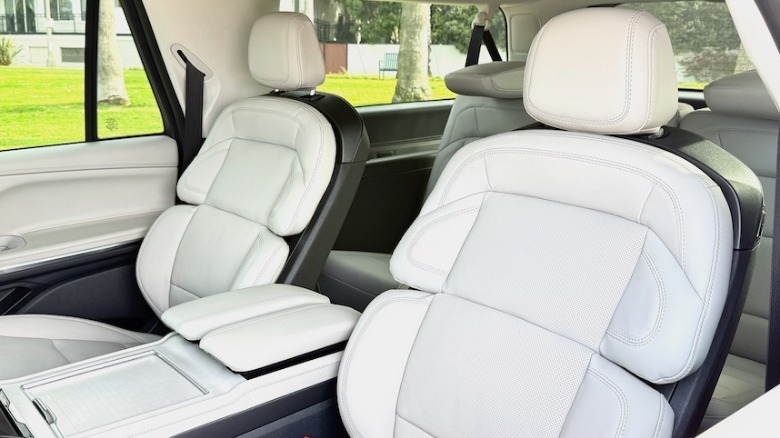
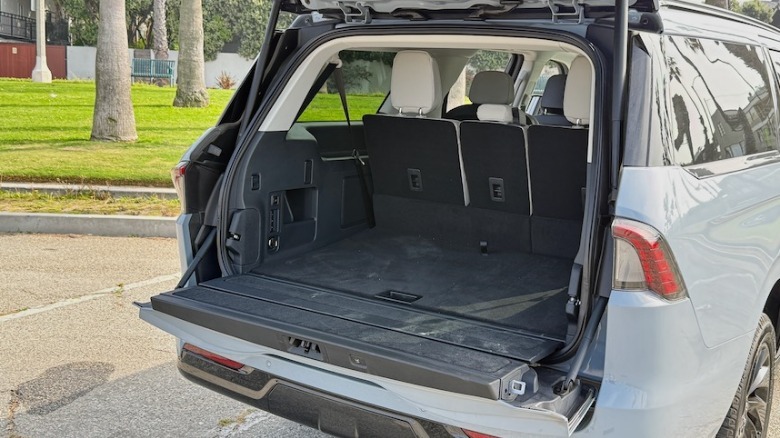
To go along with the big exterior, the Navigator L feels massive on the inside. It’s a hallmark of the body-on-frame truck-based SUVs that dominate this class, but there’s something in particular about the Navigator L that feels extra airy and spacious. There are lots of small cubbies, tons of cupholders, and USB ports everywhere you look. It’s not just big enough for lots of passengers, it has all the creature comforts for anytime you pack the Navigator L to the brim. Behind the third-row seats, there are 37.4 cubic feet of cargo space, which is nearly 15 cubic feet more than the standard model (22.9 cubes).
 Travis Langness/Read
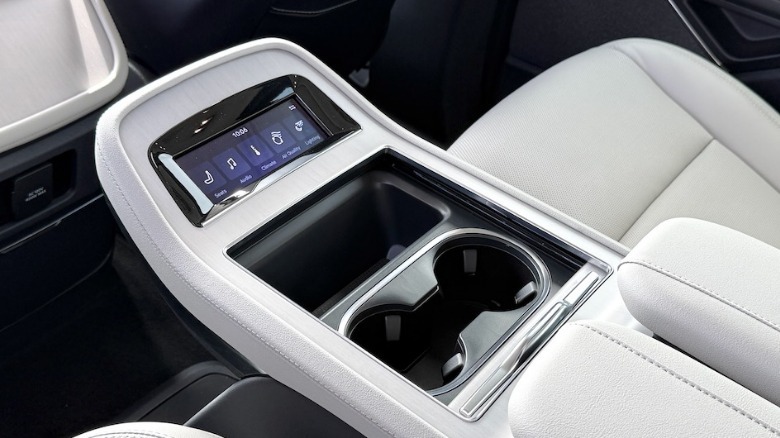
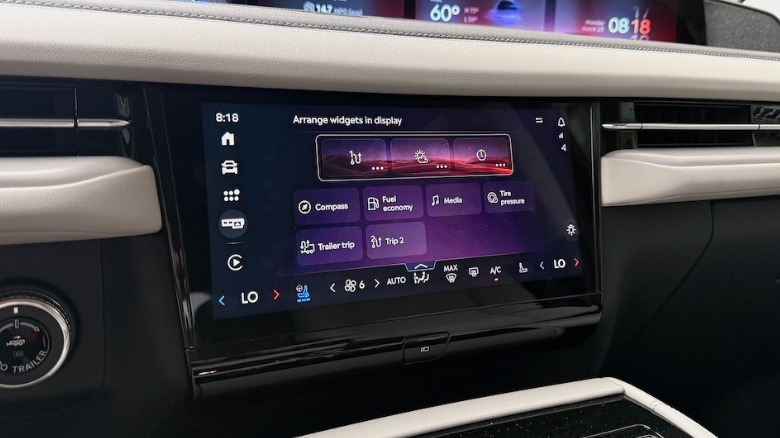
In all three rows, the seats are comfortable. Up front, for the driver and passenger, the 24- and 22-way power adjustable seats give you more than enough range to create the perfect seating position for any body size or shape. Messing with the seating position and the seat heating/ventilation functions is a bit distracting on the low-mounted center touchscreen, but once the seats are set up for you, there shouldn’t be much more adjusting required.
 Travis Langness/Read
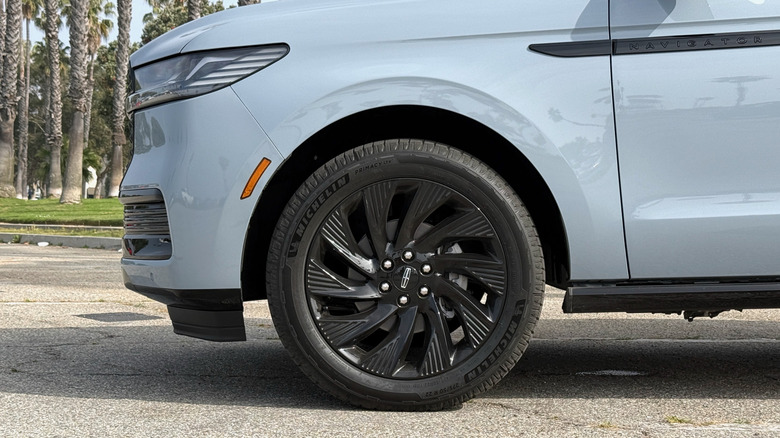
Ride quality on the highway is impressive, even with the 22-inch wheels, though I’d caution buyers away from the available 24-inch wheels that’ll probably absorb only minimal impacts. The Navigator’s adaptive suspension does a bang-up job of balancing comfort and stable on-road characteristics, managing the weight through corners and over rough roads. The ride is quiet, too. Even at highway speeds there’s only the mildest hum from the tires and a small amount of wind noise — an admirable set of traits for something that’s not exactly shaped for maximum aerodynamics.
Problems with the steering wheel
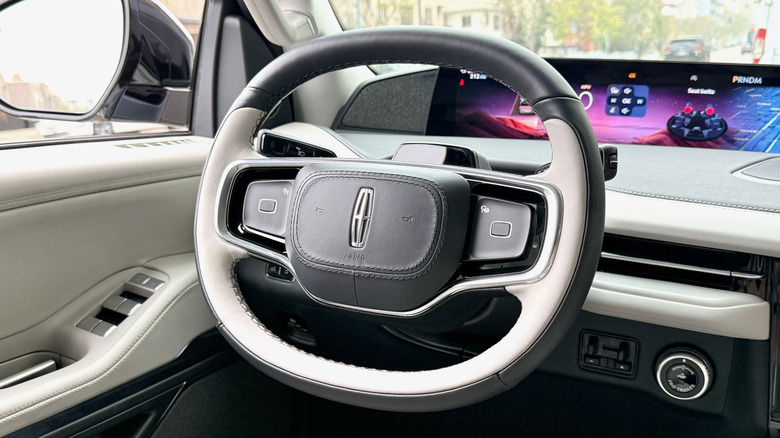
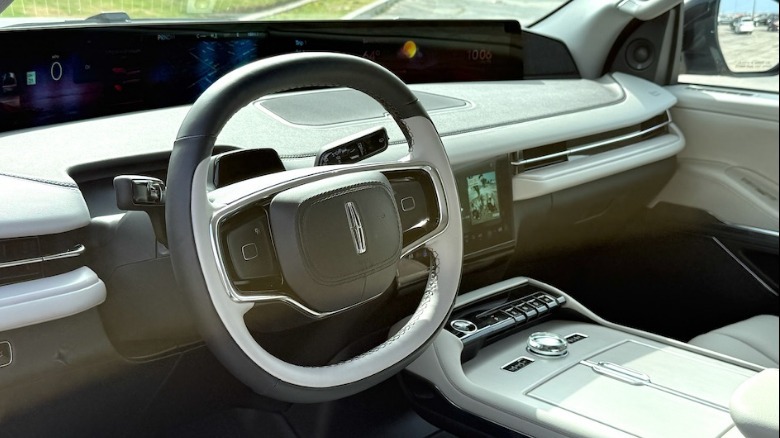
One of the biggest drawbacks in the Navigator is its oblong steering wheel. The same way I feel about this piece in its sibling, the Expedition I tested a few months back, I can’t quite mentally get past the steering wheel’s shape, or the functionality challenges with the steering wheel buttons. It feels like the top of the wheel is flattened for maximum screen-viewing potential, but in my mind, that’s not a big enough reason to justify the drawbacks.
The steering wheel feels awkward to turn in my hands, it looks strange every time I slide into the driver’s seat, and it feels impossible to do multiple-rotation turns in the Navigator without missing a grip or feeling like I’ve done something wrong.
 Travis Langness/Read
The steering wheel buttons, which Lincoln calls steering wheel control pads, are also a struggle. Their functions are hidden, but if you lightly hover your finger on top of the button interface, they activate, and you can see the functions being controlled on the big touchscreen. Then, you can select the next song or turn the volume down. More than once during my test, I had to press the same button twice just to get it to do one action (and because I hadn’t learned the proper order of operations just yet). It might be aesthetically pleasing to see a steering wheel that isn’t overwhelmed with little icons, but it’s not functionally pleasing at all.
Getting used to the big screen takes some time
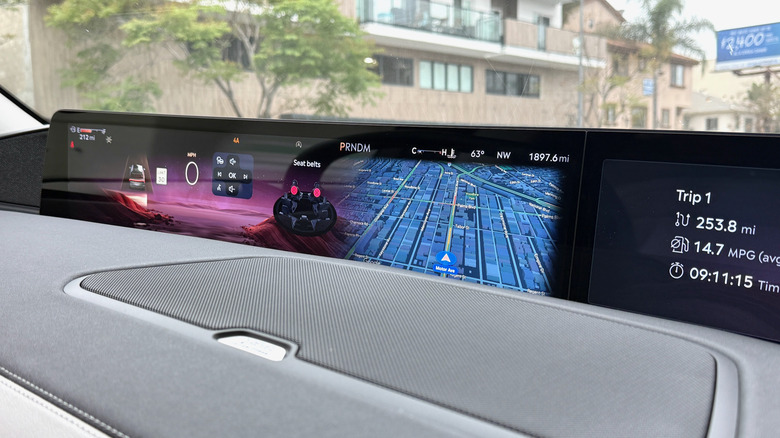
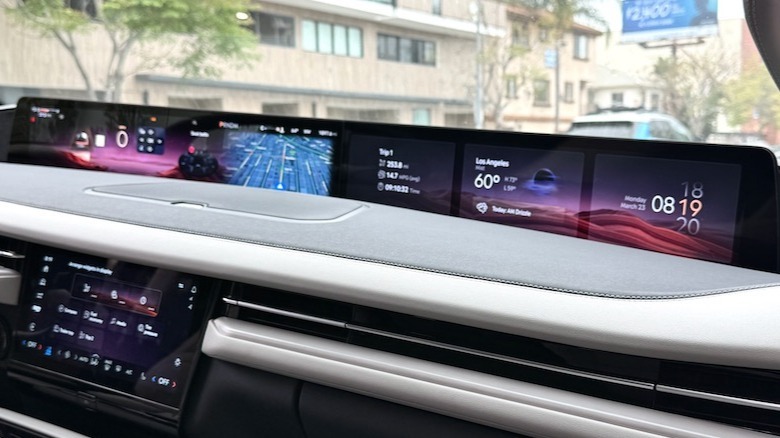
The screen in the Navigator is so big, there’s almost no point in even using measurements any more. Sure, there’s an 11-inch touchscreen on the lower portion of the dashboard that allows you to input certain commands, but the big screen above it stretches nearly the entire width of the Navigator’s windshield. If you must know, it’s a 48-inch screen that stretches nearly from door to door; if you look closely, you can see that it’s actually two panels, separated in the center of the dash. Digitally, each of those two panels is separated up into segments of their own.
 Travis Langness/Read
The screen is super crisp, with excellent contrast and high-resolution graphics, but it does take some getting used to. At first, it’s easy to be distracted by the big display, but after a while, you realize that certain bits of information (like the weather and trip computer, both displayed on the passenger side) can be ignored while you drive along.
 Travis Langness/Read
From the relatively high driver’s seating position, it’s easy to see over the screen and down the hood. The Revel stereo system that comes standard with the Reserve trim uses 28 speakers to provide some pretty impressive sound quality that audiophiles will appreciate, and more-than-adequate levels of volume.
2026 Lincoln Navigator L verdict
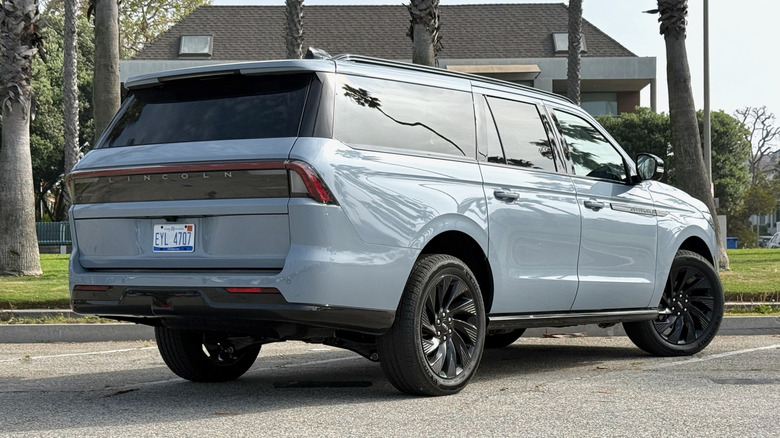
There’s a specific set of needs that have to align for a Navigator (and, more specifically, a Navigator L) to be on your shopping list. The big Lincoln and its rivals, like the Cadillac Escalade — and to a lesser degree the GMC Yukon Denali — all offer maximum luxury paired with maximum utility. The Lincoln feels a bit more premium than the GM offerings in this class, but it’s not head and shoulders above them. It’s also hard to justify the Lincoln’s premium over its platform sibling, the Expedition.
The Lincoln also doesn’t quite rise to the level of refinement of some German rivals, but Navigator and its contemporaries are true towing machines, and the Lincoln in particular is impressively modern. The Mercedes-Benz GLS is one of the most upscale options in this class, but it is even more expensive than the Navigator and has a lower maximum towing capacity.
A number of the features and technologies in the Navigator’s cabin take some getting used to (and I’d replace the steering wheel entirely if it were possible), but living with the Lincoln on a daily basis would be an easy and enjoyable experience. If your needs include towing, wrangling half a dozen humans, and being surrounded by high-class materials, this big SUV should be on your short list.

Comments are closed.