
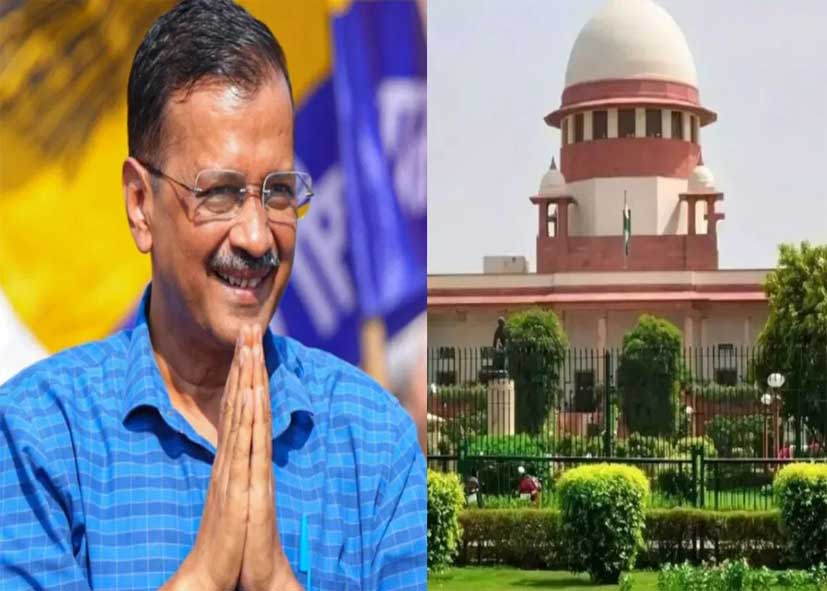
Liquor Policy Case: Arvind Kejriwal reaches Supreme Court after not getting relief from Delhi High Court, appeals to change the judge.

Arvind Kejriwal has now moved the Supreme Court in the matter related to Delhi’s alleged liquor policy. After not getting relief from the High Court, he has filed a petition in the Supreme Court demanding change of the bench hearing the case. In the petition, Arvind Kejriwal has appealed to transfer the case from the bench of Justice Swarn Kanta Sharma of Delhi High Court. Along with him, Manish Sisodia has also filed a similar petition in the Supreme Court. Earlier, DK Upadhyay had rejected the demand to change the judge. After this, this matter has now reached the Supreme Court, where this petition is expected to be heard.
Chief Justice Devendra Kumar Upadhyay has clarified that the CBI petition has been submitted to the bench of Chief Justice Swarn Kanta Sharma as per the existing roster and there is no need for any interference in it. The Chief Justice said that if any party has any objection regarding the judge’s recusal, then only the concerned judge will take the decision on it. He clarified that there does not seem to be any concrete reason for transferring the petition at the administrative level. The Delhi High Court also said that the allocation of cases under the roster system is as per the laid down procedure, and cannot be changed without sufficient grounds.
Kejriwal had demanded transfer
In fact, the trial court had acquitted Kejriwal in this case on February 27, against which the CBI filed a criminal petition. This petition was heard in the court of Justice Swarn Kanta Sharma in Delhi High Court on March 9. Meanwhile, Arvind Kejriwal raised the demand to transfer this petition to some other bench, which was later rejected by High Court Chief Justice Devendra Kumar Upadhyay.
Notice to all 23 acquitted people
The Delhi High Court, after hearing the CBI’s arguments against the trial court’s decision in the liquor policy case, had issued notice to Arvind Kejriwal, Manish Sisodia and 21 other accused acquitted in the case. The High Court had fixed March 23 as the next hearing date. During the hearing, the court said that the observations made by the trial court at the charge stage at the time of acquittal of AAP leaders in the liquor policy case on the statements of witnesses and approvers appear to be prima facie wrong and need to be considered.
In response, Arvind Kejriwal filed an application in the Supreme Court, in which he said that the reasons for the specific irregularities in the trial court’s observations in the March 9 order have not been disclosed. Kejriwal also argued that the concerned bench has already recorded prima facie judgment in several other cases related to the excise policy case and the petitions filed by the accused have been dismissed. For this reason, there is a demand to transfer his case to a different bench.
What did Kejriwal say in the application
Arvind Kejriwal has said in his application filed in the Supreme Court that relief has already been given to the accused in the liquor policy case. He clarified that his argument is not based on any personal preference or personal interest, but is based on legitimate apprehensions raised from the perspective of an impartial and informed litigant. The application states that based on the observations of the trial court and the stance of the cases, there is a serious, genuine and reasonable apprehension that a fair and neutral hearing will not be possible in the present bench. Therefore, he has demanded to transfer the case to some other bench, so that the hearing is completely fair and equitable.
rouse avenue court decision
On February 27, the Rouse Avenue court, while delivering its verdict in the liquor policy case, found that the charges against Arvind Kejriwal were based primarily on the statements of co-accused or witnesses, but there was no independent evidence linking him to any criminal conspiracy or illegal activities. The trial court also noted that the CBI recorded the statements of government witnesses repeatedly over long periods of time. According to the court, this process was often used to cover up shortcomings, strengthen the arguments of the government lawyer and to implicate the accused. At the same time, attempts were also seen to artificially connect the missing links in the chain of circumstances.
During the hearing of CBI’s petition in Delhi High Court on March 9, Justice Swarn Kanta Sharma said that some observations made by the trial court at the stage of framing of charges regarding the statements of witnesses and approvers appear prima facie wrong and it is necessary to consider them. The Court also noted that the incendiary remarks made against the CBI Investigating Officer alleging that he misused his position to conduct a botched investigation appear to be prima facie completely false, especially when made at the stage of framing of charges. Keeping these things in mind, the court banned the comments made against the investigating officer and also canceled the direction to recommend departmental action against him. During the hearing, the High Court directed the trial court to postpone the proceedings in the cases related to money laundering until the decision on the CBI petition is taken after the date fixed by the High Court.
These people were acquitted
On February 27, Special Judge Jitendra Singh acquitted all 23 accused in the case related to the alleged scam in Delhi’s excise policy. The main accused in this include Arvind Kejriwal and Manish Sisodia. Apart from this, the list of accused includes Kavita, Kuldeep Singh, Narendra Singh, Vijay Nair, Abhishek Boinpalli, Arun Pillai, Mutha Gautam, Sameer Mahendru, Amandeep Singh Dhall, Arjun Pandey, Buchi Babu Gorantla, Rajesh Joshi, Damodar Prasad Sharma, Prince Kumar, Arvind Kumar Singh, Chanpreet Singh, Durgesh Pathak, Amit Arora, Vinod Chauhan, Ashish Chand Mathur Sarath Reddy. Are.
Rouse Avenue Court in strong words targeted the CBI investigation during the trial in the case of alleged scam in liquor policy. The court said that there were many shortcomings in the charge sheet, for which there was no concrete evidence from any witness or statement. The Court specifically noted that the CBI had failed to build a prima facie concrete case against Manish Sisodia. Special Judge Jitendra Singh also said that an attempt was made to implicate Arvind Kejriwal without any concrete evidence. According to this decision, Manish Sisodia spent approximately 530 days in jail, while Arvind Kejriwal spent approximately 156 days in jail in two terms combined.
What is the matter?
Delhi government had made a new excise policy in 2021 to increase revenue and improve liquor trade. However, the policy was withdrawn after allegations of irregularities were made during its implementation. After this Vinay Kumar Saxena ordered CBI to investigate the policy. During investigation, CBI and ED claimed that this excise policy was an attempt to completely privatize the liquor trade in Delhi and was used with the aim of giving illegal benefits to private companies at the expense of the public exchequer. The agencies also expressed fear of corruption.
Manish Sisodia was first arrested by CBI on 26 February 2023, and later by ED on 9 March 2023. The CBI FIR alleged that Sisodia and other leaders played a key role in decisions related to the excise policy of 2021-22, without the approval of any competent authority, with the aim of giving illegal benefits to license holders after the tender. The agencies claimed that despite evidence emerging in the investigation, Manish Sisodia gave evasive answers and refused to cooperate. Many AAP leaders were also involved in this case. Nevertheless, the Rouse Avenue court acquitted Kejriwal, Sisodia and other accused, citing lack of concrete evidence in the trial and shortcomings in the charge sheet.
Follow the LALLURAM.COM MP channel on WhatsApp

Comments are closed.