
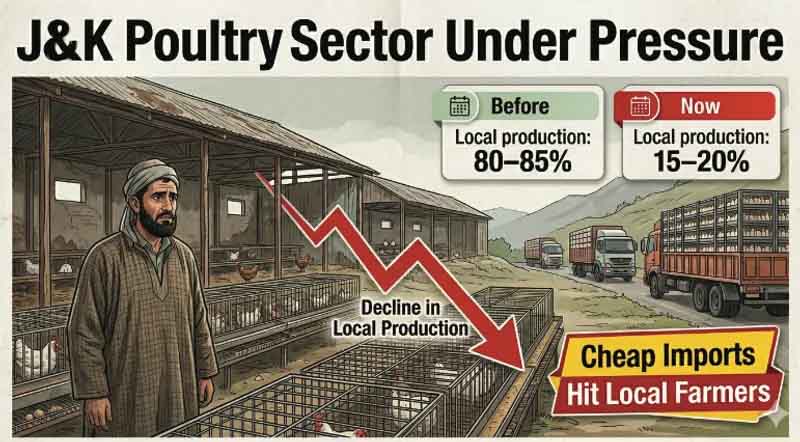

Srinagar Srinagar, Jammu and Kashmir’s poultry industry, once almost self-sufficient, is now facing a severe downturn as local producers struggle to compete with the increasing flood of cheap poultry imports from other states. Industry stakeholders say that the crisis started after 2019 when the government abolished toll tax at Lakhanpur toll plaza after the reorganization of the old state. Before that, a levy of Rs 9 per kg was imposed on adult birds imported into J&K, which was aimed at protecting local farmers from external competition and offsetting the higher production costs in the region. With the removal of the levy, poultry producers say the market dynamics have changed significantly.
GM Bhat, president of Kashmir Valley Poultry Farmers Association, said the decision opened the door for big suppliers from outside the union territory to dominate the market. “After the tax was abolished, poultry from other states started coming to the local market at much lower prices,” Bhat said. “Our farmers cannot compete with producers who operate on much larger scales and enjoy better infrastructure and lower costs.” According to industry estimates, before 2019, about 80 to 85 percent of poultry consumption in J&K was met by local production.
However, now this share has reportedly fallen sharply. “Today local production barely meets 15 to 20 per cent of the demand,” Bhat said, adding that many small and medium poultry units have either scaled down operations or closed down completely due to persistent losses. Farmers say the situation has worsened due to rising input costs. Prices of poultry feed, electricity and labor have increased steadily over the past few years, further squeezing the already thin profit margins.
A poultry farmer from Shopian, who recently closed his unit after working for several years, said the business was no longer financially sustainable. “The cost of feed and other essential commodities has increased rapidly,” he said. “At the same time, the market is flooded with cheap poultry from outside. We were forced to sell below our production costs, and it was no longer profitable to continue the business.”
The decline of this sector has also affected the livelihood of the people of the village, where poultry farming was a reliable source of income and jobs for a long time. Many farmers had invested heavily in poultry sheds, hatcheries and equipment, often by taking bank loans. Industry representatives are now appealing to the government to take steps with policy support to restart the sector. They are demanding measures like protective levy on imports or financial incentives for local producers to help them compete in the market.

Comments are closed.