
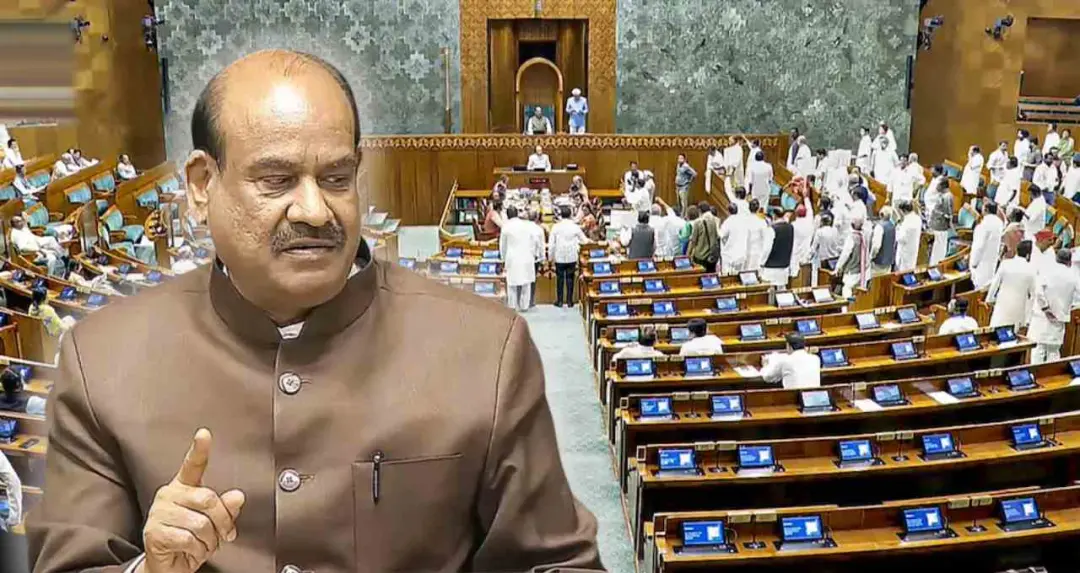

The no-confidence motion brought against the Speaker in the Lok Sabha, the lower house of the Parliament of India, can be discussed and voted on on March 9. Parliamentary Affairs Minister Kiren Rijiju has indicated that this proposal will be debated on the first day of the second phase of the budget session.
New Delhi: The political battle has intensified over the no-confidence motion brought by the opposition against Lok Sabha Speaker Om Birla. Parliamentary Affairs Minister Kiren Rijiju said on Sunday that the opposition’s notice for removal of the Speaker can be discussed and voted on on March 9, the first day of the second phase of the budget session.
He said that the government wants to work on its planned legislative agenda after settling this proposal. This situation has increased the political turmoil in the Parliament for the coming week and all the parties are keeping an eye on this important voting.
Possible debate and voting on March 9
Kiren Rijiju said the government wanted to resolve the issue quickly so that House proceedings could run smoothly and the focus could be on the pending legislative agenda during the budget session. According to him, voting can be held on March 9 after detailed discussion on the proposal. No-confidence motion against the Speaker is a serious parliamentary procedure in the Indian parliamentary system. To pass it, majority support of the House is required.
Rijiju said the Bharatiya Janata Party (BJP)-led National Democratic Alliance (NDA) has the support of 293 MPs in the 542-member House. He also claimed that the government may also get the support of some other parties and independent MPs. In such a situation, the chances of the opposition’s efforts being successful appear slim.
The government’s stand is clear that this proposal is part of a political strategy and it will be rejected through parliamentary majority. According to official sources, the NDA wants to deal with the issue quickly so that the Speaker can preside over the crucial phase of the budget session.
Opposition strategy and possible equations
Opposition parties have accused the Speaker of lack of impartiality in running the House. Parties like Congress, Trinamool Congress (TMC) and Aam Aadmi Party (AAP) are trying to mobilize support for the proposal. There is discussion in political circles that the opposition may adopt the strategy of putting pressure on other issues also, including questions related to the Election Commission. However, there has been no official confirmation on these claims.
In Indian democracy, inspired by the British parliamentary model, the role of the Speaker is considered impartial and neutral. The Speaker conducts the proceedings of the House and is responsible for following parliamentary rules. In such a situation, no-confidence motion against the Speaker is counted among the rare incidents and it is a politically sensitive matter.
Even in global democracies, bringing a motion against the Speaker of Parliament is considered an extraordinary step. This makes the situation of political polarization and parliamentary conflict clear.

Comments are closed.