
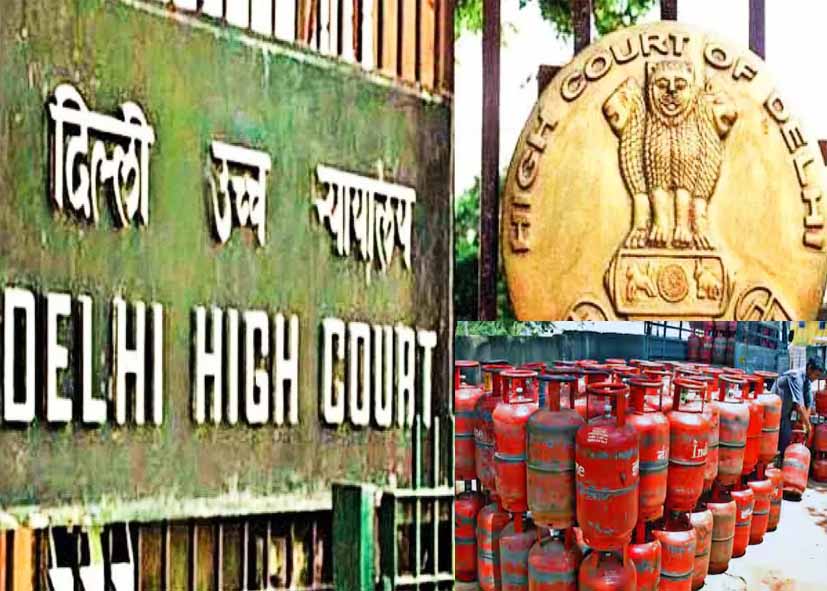
PIL on LPG crisis, important comment of Delhi High Court, said- How to say that black marketing will stop?

Delhi High Court has refused to hear the PIL filed on the allegations of shortage and black marketing of LPG cylinders in the capital. The court clarified that issues like gas supply, distribution system and its monitoring come under the jurisdiction of the executive (government administration), hence the judiciary cannot directly issue orders on this. In the petition, concern was expressed about the lack of availability of LPG cylinders in the capital and alleged black marketing. However, the court said that in such cases only the concerned government departments and regulatory agencies have to take action.
A bench of Chief Justice Devendra Kumar Upadhyay and Justice Tadeus Karia said that the court cannot give such orders which cannot be implemented practically. During the hearing, the court commented that if the court directs that black marketing or hoarding should end completely, then the question arises as to how practically this is possible. The court also made it clear that in such matters, the job of policy formulation and implementation rests with the executive, whereas the judiciary can intervene only within the ambit of law.
Cannot give orders like ‘ending poverty’
Chief Justice Devendra Kumar Upadhyay said that the court cannot issue such directions which cannot be implemented practically. Giving an example, he said that ordering the government to eliminate poverty in two months would not be practical. The bench clarified that the responsibility of the government and oil companies depends on resources, supply arrangements and policy limitations. In such a situation, it is not the job of the court to issue impossible or non-enforceable orders.
What did the petitioner say?
During the hearing on the PIL filed regarding alleged black marketing, petitioner advocate Rakesh Kumar Mittal made many serious allegations. He told the court that despite the price of domestic LPG cylinder being around Rs 1000 in the market, at some places it is being sold for more than Rs 5000, causing huge financial burden on the common consumers. The petitioner also claimed that some time back there was a shortage of gas in the High Court canteen, which raises questions about the condition of the supply system. Apart from this, he also alleged that despite domestic demand and alleged shortage in the country, export of LPG is continuing, which may affect the domestic market.
The court said that the issue related to gas supply in the High Court canteen which was raised, was reinstated on the same day. This makes it clear that the problem was resolved at the administrative level. Justice Tejas Karia said during the hearing that when the government is already taking steps to improve the situation, there is no need for the court to interfere. On the issue of gas export, the court also made it clear that this is a matter related to economic policy and the judiciary cannot interfere in it, because it completely falls under the jurisdiction of the executive.
advice to go to the government
The court made it clear that finding solutions in such cases is entirely the responsibility of the executive and only the government has the right to formulate and implement policies. The court said that if any citizen has a complaint related to supply, distribution or market system, it should be resolved through the concerned government departments and administrative machinery.
Follow the LALLURAM.COM MP channel on WhatsApp

Comments are closed.