
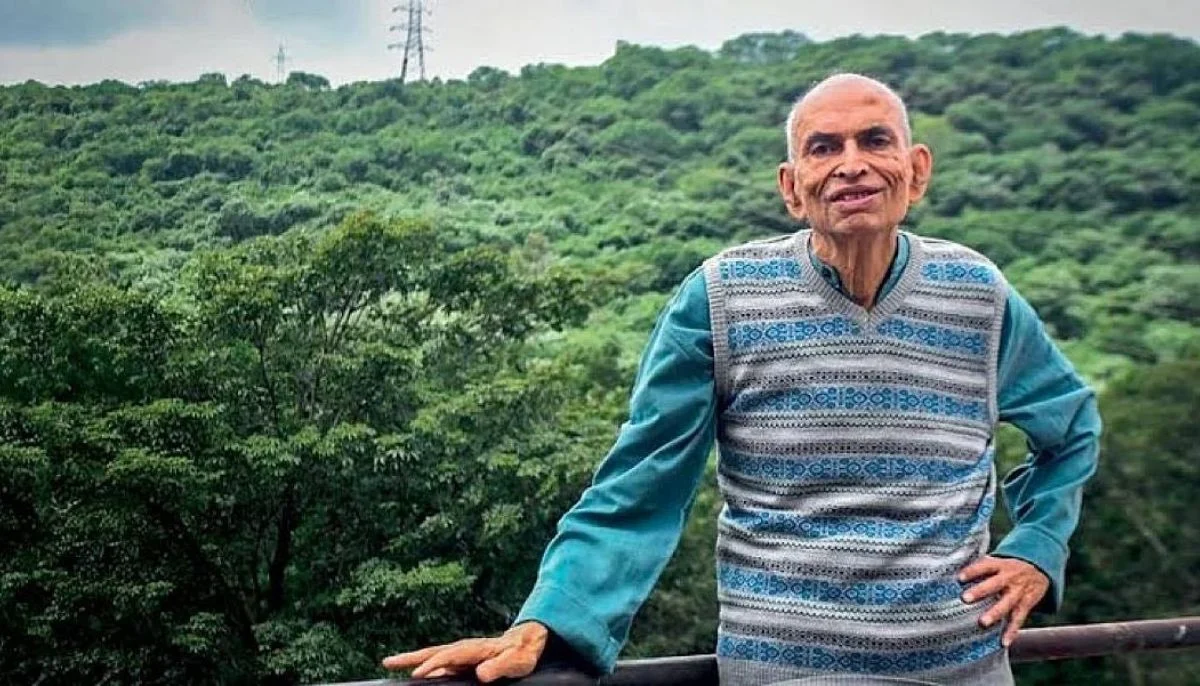

Indian senior environmental scientist Madhav Gadgil passed away at his residence in Pune on January 7, 2026. He was 83. He was known as one of the key thinkers who shaped India’s modern environmental movement.
Madhav Dhananjaya Gadgil was an ecologist, academic, and environmental activist. Over several decades, he worked on issues related to biodiversity, conservation, and the role of local communities in protecting nature. His work environmental policy, research, and public debate in India.
He founded the Centre for Ecological Sciences at the Indian Institute of Science( IISc), Bengaluru, in 1983.
Under his leadership, the locus became an important space for research on ecology and environmental policy. His academic work focused on human ecology, biodiversity, and the long- tenure relationship between people and nature.
Gadgil was widely known for chairing the Western Ghats Ecology Expert Panel in 2010. The panel submitted its report in 2011, which recommended strict protection measures for the Western Ghats, a globally important biodiversity region.
The report advised limitations on mining, quarrying, large dams and polluting industries.
While the report received support from scientists and environmental groups, it also faced resistance from several state governments.
Although its recommendations were later diluted, the report continued to be cited during discussions on floods and landslides in the region.
In an earlier interview with The Hindu , Gadgil had spoken about development pressures in the Western Ghats.
He said, “What we witnessed was a model of development being imposed on people. Mining operations and polluting industries were forced upon communities without their consent.”
Following his death, former Union environment minister Jairam Ramesh shared a post on X (formerly Twitter).
He wrote, “Madhav Gadgil, the pre-eminent ecologist, has just passed away. He was a top-notch academic scientist, a tireless field researcher, a pioneering institution-builder, a great communicator, a firm believer in people’s networks and movements, and friend, philosopher, guide, and mentor to many for over five decades.
“Trained at the very best universities in modern science, he was at the same time a champion of traditional knowledge systems – especially in biodiversity conservation. His influence on public policy has been profound going back to his crucial role in the Save Silent Valley Movement in the late 70s and early 1980s,”he added.
“His intervention to protect forests in Bastar was crucial in the mid -80s. Later, he gave shape to a new direction to the Botanical Survey of India and the Zoological Survey of India. During 2009-2011, he chaired the Western Ghats Ecology Expert Panel and wrote its report in a most sensitive and democratic manner that remains unmatched in both substance and style. He had studied biology at Harvard under E. O. Wilson, who had been hailed as Darwin’s Heir. Although inspired by Wilson, Madhav Gadgil – unlike most others who went to study abroad – came back to India to build its own research capacities and capabilities, guide students, engage with local communities, and make a difference to policy,” Jairam wrote.
“Speaking on a personal note, in the twenty-six months I was Environment Minister during May 2009- July 2011, I turned to him every other day for guidance and advice. And our conversations were not confined to matters related to ecology. We spoke often of his father Dhananjay Gadgil, one of India’s greatest economists and author of that classic The Industrial Evolution of India in Recent Times, first published in 1924. We would also speak of the intricacies of the Indian monsoon, since his wife Sulochana was an authority on the subject,” he wrote.
“Nation builders come in different forms and varieties. Madhav Gadgil was definitely one of them. Above all he had the hallmark of a true scholar— he was gentle, unassuming, and exuded empathy and humility behind which was a vast ocean of knowledge and learning,” Jairam concluded.
During his lifetime, Gadgil received several national and international honours. These included the Padma Shri in 1981 and the Padma Bhushan in 2006. He also received global recognition for his contribution to environmental thought and policy.
Madhav Gadgil’s work influenced discussion on environmental protection development and community rights in India.

Comments are closed.