
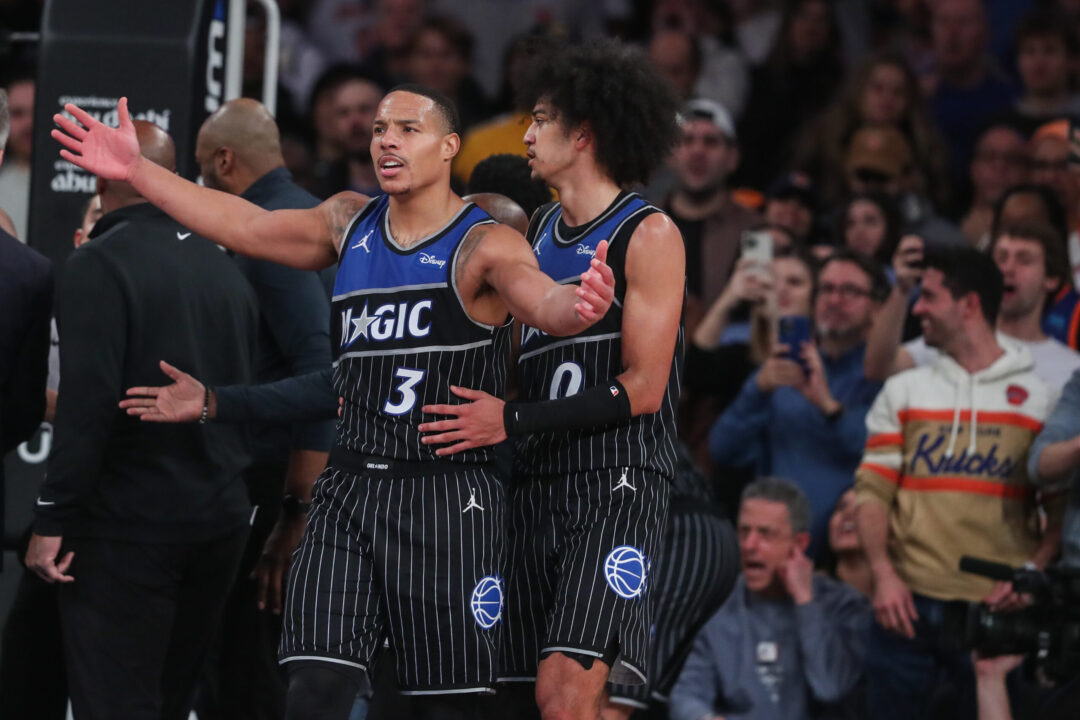

Three straight first-round exits, the latest coming as just the fifteenth team in league history to lose a series after taking a 3-1 lead – this was not the vision in Orlando entering the season. This was not how it was supposed to end.
And yet, even considering the hoped-for growth under coach Jamahl Mosley, perhaps boosted by the summer arrival of Desmond Bane from Memphis, the Magic could have done even worse. After another regular season filled with injuries, poor offense, and a defense that was significantly worse than in recent years, Paolo Banchero and company were in danger of missing the playoffs entirely.
They were saved by a gritty defensive performance when they were on the brink, the same edge that sparked three unlikely wins against Detroit.
Then came another injury to Franz Wagner, scoring blackouts like the one in Game 6, blown leads, and the Pistons taking control late in the first half of Game 7.
The season ended early – and certainly not salvaged – for a group that hoped to be a contender in a balanced Eastern Conference. Now everything could be reevaluated. When things go this badly, does it make sense to keep forcing the same cycle through only minor changes?
Mosley must go
Jamahl Mosley deserves credit for building cohesion over the years with a young group, starting from the defensive end. But this season may have exhausted all the goodwill he had earned.
While it is true the roster still lacks reliable shooting to space the floor, the structure of a stagnant offense looked even more limited than last season.
Sure, one could point to the slow reads of Paolo Bancherowho can stop ball movement and attack in isolation, or Franz Wagner who continues to struggle from the perimeter. But before breaking up a talented duo that may simply need better support, it makes sense to try something different tactically.
And perhaps Mosley failed to create schemes that maximized both players, especially when sharing the floor. Adding a shooter like Desmond Bane was not enough without a tactical overhaul.
It’s been an incredible stretch of more than five years, and this organization and this city will always mean so much to me and my family. In my heart, I truly hope that during my time here we were able to leave a meaningful and lasting impact on the players, staff, and the Magic organization
Jamahl Mosley
Just as happened in Boston, where patience with the Tatum-Brown duo eventually led to an NBA title Orlando should continue investing in its star pairing considering how much it represents. So before giving up, it may be better to try something new – and move on from Mosley.
I want to sincerely thank the DeVos family for the incredible opportunity to be head coach of the Orlando Magic. To our fans, there is nothing but love in my heart. The joy I felt coaching this team, in this city, for the people who live here, is something I’ll never forget. All I ever wanted was to make you proud to be Magic fans, and my journey here will stay with me forever
Jamahl Mosley
Are injuries a valid excuse?
Managing absences has become routine for the Orlando Magic. First Banchero, then Jalen Suggs, while Wagner also missed significant time. Even emerging guard Anthony Black dealt with an untimely late-season injury.
Needless to say, that does not help team chemistry over an 82-game season.
The lineup of Suggs, Bane, Wagner, Banchero, and Wendell Carter Jr. played only 182 minutes across 19 games outscoring opponents by 11.6 points per 100 possessions while allowing just 105.2 – better than the Oklahoma City Thunder.
That same group, during the Detroit series before Wagner went down, outscored the Pistons by 14.7 points per 100 possessions in 61 shared minutes. With Wagner defending Cade Cunningham Detroit’s lead creator had stretches of inefficiency.
Those numbers suggest it makes sense to run it back – perhaps with a new coaching voice that can unlock offensive fluidity.
The longstanding three-point problem
Still, major issues remain. The most obvious is three-point shooting: the Magic continue to struggle creating high-efficiency looks, especially open corner threes.
They ranked 11th in regular season open-shot attempts, but converted too few of them, in line with their poor percentages from deep.
When discussing a clunky offense and the difficulty of generating clean advantages it is clear that having only one reliable scorer like Bane is not enough.
What Orlando lacks most is a true initiator who creates for teammates, with Suggs being more defense-oriented and less of a traditional playmaker.
The Tyus Jones experiment failed midway through the season, while Anthony Black still appears far from being a steady offensive organizer.
That void must be filled – ideally with a player who can stretch the floor and expand the offense.
The talent on the roster is obvious, and much of the work done so far has value. But trying again without meaningful adjustments would be a mistake. Especially for such a young team, another summer of structural growth is essential to become competitive again.
Comments are closed.