
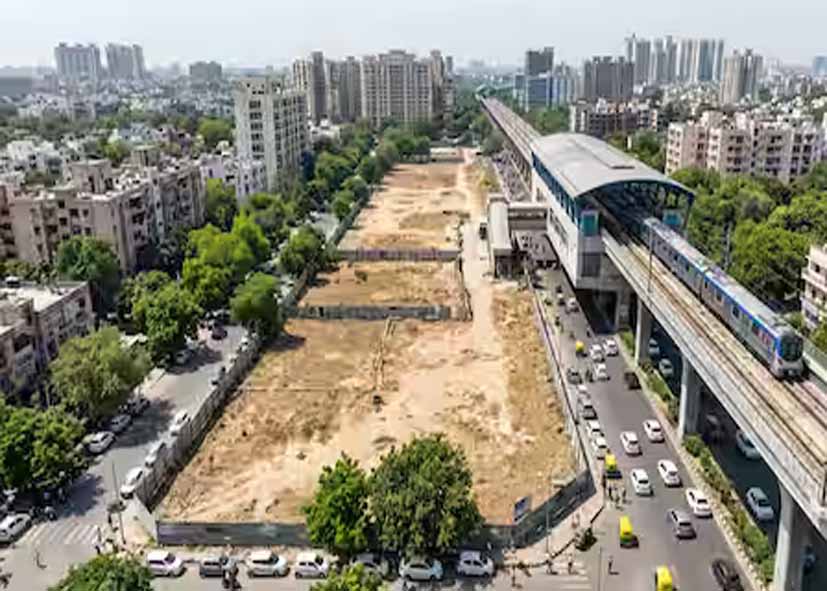
Big plan for cheap houses in Delhi, new housing model will be built around the metro corridor

New Delhi. DDA has intensified preparations to develop large-scale housing projects around the metro corridors in Delhi under the new Transit Oriented Development (TOD) policy. The objective of this scheme is to develop such residential areas where people can take advantage of better connectivity and modern urban amenities while living close to the Metro. Under this, priority is being given to those areas where metro network already exists or is in the stage of expansion.
According to officials, this policy will not only help in reducing the housing problem but will also prevent uncontrolled expansion in the city. The plan is to promote high-density residential and mixed-use development around the metro. DDA believes that with this model people will be able to get facilities like affordable housing facility, better transport system and less travel time simultaneously. Besides, dependence on private vehicles is also expected to reduce and environmental balance will improve.
Identification of 14 big plots around the metro route
DDA has identified 14 prime lands in Delhi for residential and mixed-use development projects, where new housing complexes will be developed in the future. Along with modern residential complexes, mixed use development model will also be promoted on these identified sites, so that residential, commercial and other facilities can be available in a single area. This entire decision was taken in a review meeting held recently, which was chaired by Lieutenant Governor Taranjit Singh Sandhu.
Private builders will also get a chance
Under this scheme, the project will not be limited only to the government level, but private developers will also be included in it. For this, a special online portal will be prepared, where complete details of the identified land will be available. Through this portal, private developers will be able to upload information about their projects and apply for development permission under the TOD policy. According to the plan, as soon as the development plan is finalized, the land use of the concerned plots will automatically change to TOD category. This is expected to make the project approval process faster and more transparent. According to sources, at present four private developers have shown interest in this scheme. After receiving the applications, all the proposals will be sent directly to the committee headed by the Vice Chairman of DDA, where the decision will be taken within the stipulated time frame.
What is TOD corridor?
In the new system, areas around metro, railways and Regional Rapid Transit System (RRTS) will be developed as special development areas. As per the policy, the area up to 500 meters on either side of the metro line has been considered as TOD corridor. Similarly, a radius of 500 meters around railway stations and regional rapid transit systems has also been included in this scheme. The special thing is that this rule will be applicable not only to the existing but also to the metro projects to be built in the future. Its objective is to make urban development more planned and dense by linking it with transportation networks. The government believes that this model will provide people with easy access to housing, employment and public transport. This will reduce dependence on private vehicles, which is likely to reduce both traffic jams and pollution in the capital.
According to officials, the total area of all these plots is more than 3.6 lakh square metres. All these lands are located around the Blue, Red, Green, Pink and Yellow lines of Delhi Metro, where large residential and mixed-use projects will be developed in future. Many areas of East Delhi are expected to get special benefits from this scheme. These include areas like Dilshad Garden, Jhilmil, Preet Vihar, Karkardooma and Mandawali-Fazalpur, where metro connectivity is already strong. Apart from this, many plots have also been selected around the Blue Line in Dwarka Sector-10 and Sector-12. Besides, areas like Rohini Sector-18, Madipur and Peeragarhi have also been included in the scope of this scheme.
Peeragarhi and Karkardooma became the most important centers
The huge plot of approximately 1.24 lakh square meter located on the Outer Ring Road near Peeragarhi District Center near the Green Line is the largest part of the entire project. This area is being seen as a major hub for large-scale mixed-use development in the future. Apart from this, the triangular plot of land located behind Kailash Deepak Hospital in Karkardooma on the Blue Line Corridor is also being considered very important. The location is strategically important due to its already developed urban infrastructure and strong metro connectivity. It is noteworthy that Delhi’s first ongoing TOD project was also developed in Karkardooma area, due to which this area has become a kind of experiment and example of success for TOD model.
Rules become easier for developers, construction will get a boost
Many major reliefs have been given to builders and developers under the TOD Regulations 2026 issued by the Union Ministry of Housing and Urban Affairs. According to the new policy, the minimum plot size has now been reduced to 2,000 square meters. This change will also provide an opportunity to small and medium developers to participate in Transit Oriented Development (TOD) projects. Apart from this, the Floor Area Ratio (FAR) has been increased to 400, which can be increased to 500 by paying additional charges. This will provide more construction capacity to developers and enable better use of land. In the policy, TOD charges have also been fixed uniform for the entire Delhi area, which has been kept at Rs 10,000 per square metre. It is expected that this will bring transparency and uniformity in the development process.
Green space has been given special priority in the Transit Oriented Development (TOD) policy of DDA. Under the new policy, it will be mandatory for developers to keep at least 10 percent of the total land in their projects as open and green area. Its objective is to maintain environmental balance in densely populated urban areas and provide better quality of life to the people.
Apart from this, additional incentives are also being considered for those builders who develop more greenery than the prescribed standards. This will motivate private developers to adopt eco-friendly designs. DDA believes that increasing green cover in these projects being developed around the Metro and other public transport corridors will not only reduce pollution but will also provide a better open and healthy environment to the local residents.
Follow the LALLURAM.COM MP channel on WhatsApp

Comments are closed.