

Rohit Kumar
NEW DELHI, Jan 12: The Indian Space Research Organization (ISRO) on Monday suffered a major setback on Monday after its Polar Satellite Launch Vehicle (PSLV-C62) encountered a critical anomaly during the rocket’s third stage presumably leaving all the 16 satellites on board virtually lost in space.
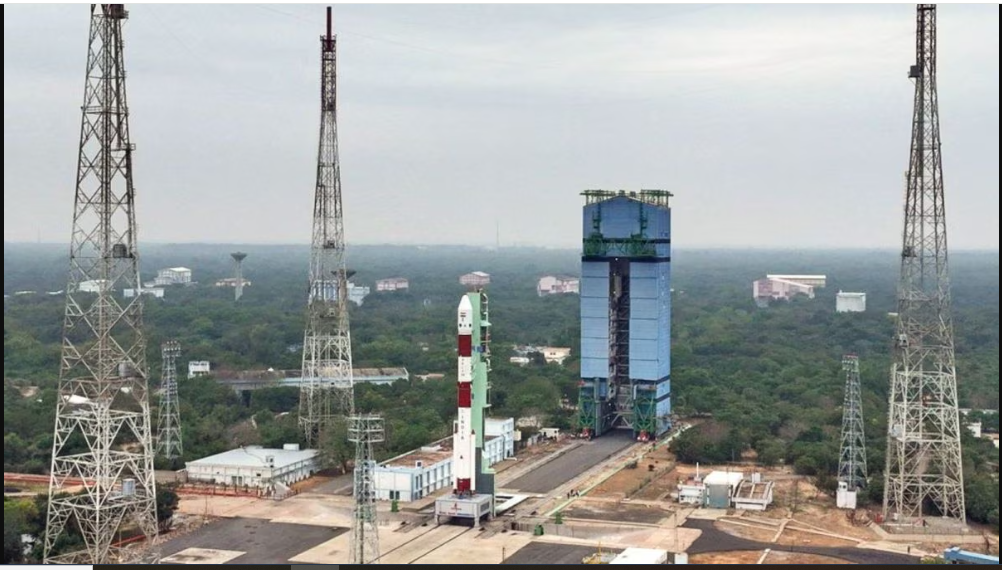
The 44.4-metre-tall PSLV lifted off at 10.18 am from the Satish Dhawan Space Center in Sriharikota, carrying an Earth observation satellite – EOS-N1 (Anvesha) – and 15 co-passenger satellites from India and overseas. The mission was intended to place them into a 512-kilometre Sun-Synchronous Orbit after a 17-minute flight.
The launch began smoothly. ISRO’s live broadcast showed the rocket performing normally through its first and second stages, and the third stage ignited as planned. But soon after that announcement, officials noticed that something was wrong.
ISRO chairman V Narayanan said the trouble began near the end of the rocket’s third stage, when strap-on motors were providing thrust.
“The PSLV is a four-stage vehicle with two solid stages and two liquid stages. The performance of the vehicle up to the end of the third stage was expected. Close to the end of the third stage we are seeing more disturbance in the vehicle and subsequently, there was a deviation observed in the flight path,” Narayanan said at the Mission Control Centre. That deviation meant the rocket could no longer follow its precise trajectory needed to inject the satellites into their intended orbit.
About 30 minutes after liftoff, ISRO confirmed on “The PSLV-C62 mission encountered an anomaly during end of the PS3 stage. A detailed analysis has been initiated,” ISRO wrote.
ISRO has not yet confirmed whether EOS-N1 and the 15 other satellites were successfully deployed. Telemetry and tracking data from ground stations are still being analyzed to determine what happened to the spacecraft after the rocket went off course.
“Today, we attempted the PSLV-C62/EOS-N1 mission… the mission could not proceed in the expected flight path. That is the information right now available,” Narayanan said. He added that ISRO would share more details once data from all tracking stations had been studied.
The anomaly is particularly troubling because the previous PSLV mission in May 2025 also ran into problems in the third stage. That makes Monday’s incident a second consecutive setback for the workhorse rocket.
The PSLV has long been regarded as ISRO’s “workhorse,” having flown missions to the Moon and Mars and launched satellites for dozens of countries. Out of more than 60 flights, only a handful have failed – but back-to-back setbacks now threaten that reputation.
According to ISRO, the first few minutes of the launch went as planned. The Polar Satellite Launch Vehicle, a four-stage rocket, saw its first and second stages perform nominally. However, issues cropped up during the third stage, where a deviation was observed in the rocket’s trajectory. Dr Narayanan later stated that the mission could not proceed on the expected path, though he refrained from categorizing it as either a success or a failure. Typically, any anomaly in the third stage of the PSLV results in a near-total mission failure.
PSLV-C62 was intended as a comeback mission for the launch vehicle. In 2025, PSLV had only one launch, which also failed. That failure, too, occurred during the third stage of the rocket, as stated by ISRO at the time. As per standard procedure, ISRO constituted a failure analysis committee following the 2025 mission. However, the findings of that committee were never made public, leaving the precise cause of the failure unknown.
Despite this, ISRO went ahead with PSLV-C62 as its first launch of 2026. PSLV-C62 was carrying a total of 16 satellites, including EOS-N1 and a surveillance satellite named Anvesha, developed by the Defense Research and Development Organization (DRDO). If the mission is eventually declared a failure, it would be the fifth failure in 64 PSLV launches. Until its 63rd flight, the PSLV had recorded four failures.
While five failures in 64 launches is not considered a poor record, the outcome would still be a setback for the Indian space programme. The setback extends beyond ISRO. The mission carried satellites from foreign countries, including Brazil, Nepal and the UK. Indian space startups are also affected. Hyderabad-based Dhruva Space had seven satellites on-board PSLV-C62, making it one of the major commercial stakeholders in the mission.
The PSLV is regarded as a hardy and reliable launch vehicle and is central to India’s commercial space ambitions. India is also preparing to launch the first industry-made PSLV through a consortium involving Hindustan Aeronautics Limited and Larsen & Toubro.
As of now, ISRO has not officially declared PSLV-C62 a success or a failure. However, Dr Narayanan’s statement that the mission could not proceed on the expected path has raised concerns that the flight may not have achieved its objectives. The outcome, once confirmed, is expected to have significant implications for India’s space agency as well as private startups that are increasingly relying on the PSLV for satellite launches.
In its last mission on May 18, 2025, the PSLV-C61 launch was a rare failure for the ISRO. On Monday January 12, roughly 50 minutes after the launch of PSLV-C62 failed again.
For a rocket to reach orbit, it must maintain a very precise orientation. While some rotation, called spin stabilization, is sometimes intentional, an unintended roll, or disturbance, can be fatal for two reasons. First, the rocket’s ‘brain’, the inertial navigation system, uses gyroscopes to know which way is ‘up’. If the rocket acquires a high roll rate, meaning if it starts spinning violently, the sensors can become saturated or dizzy, leaving the system to lose track of which way it’s pointing. Eventually it can no longer steer the rocket towards the correct orbit.
Second, while the PS3 motor generally provides thrust, it doesn’t have its own roll control thrusters. Instead it uses the small thrusters of the stage sitting on top of it, i.e. the PS4 stage, to keep it steady. The disturbance reported during the PSLV-C62 mission implies something on the PS3 motor, for example a gas leak from the side of the nozzle, generated a large twisting force. This torque could have been stronger than what the small PS4 thrusters could counteract, leaving the rocket to corkscrew out of control.

Comments are closed.