
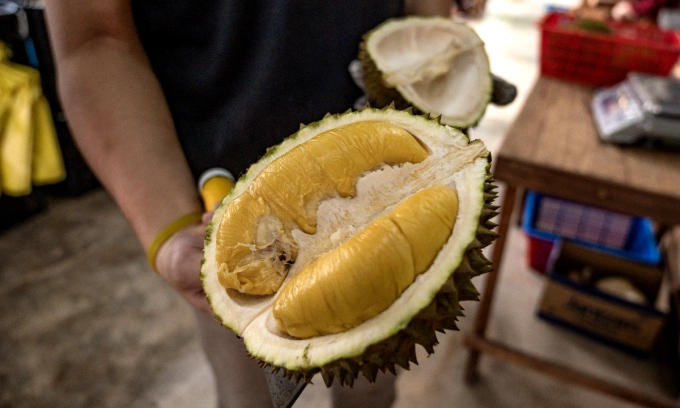
Malaysia durian glut caused by sub-standard export clones, cutting Musang King prices to $2.4/kg

Faisal Iswardi Ismail, deputy director-general for Food Security and Operations at the Federal Agricultural Marketing Authority (FAMA), said the oversupply has also been fuelled by newer orchards producing lower-quality cloned varieties such as Musang King.
These fruits do not meet export standards for major markets like China and Singapore, he told national news agency Named.
Local media earlier reported that excessive supply has pushed prices of Musang King to RM10 (US$2.4) per kilogram, or even lower in some places, from RM60-80 per kilogram during the main harvest in May-August.
Other popular or premium varieties such as Black Thorn, IOI, D24 and Red Prawn were also sold for as low as RM10-15 per kilogram. The sharp drop has left some growers selling directly from their orchards to consumers, cutting out intermediaries to keep their businesses afloat.
Aminuddin Zulkipli, FAMA’s chairman, stressed that the glut is largely the result of higher production and that local demand for the fruit remains robust, as quoted by Sin Chew Daily.
The agency noted that the price pressure has largely been confined to Grade C (lower-quality) durians, not Grade A (highest-quality) ones.
FAMA said it has stepped in to support farmers by buying affected village durians and sending them to specialized facilities for processing into paste and pulp.
It also launched the Agro MADANI sales program last Thursday. The two-day event sold more than 30 tonnes of durians and seasonal fruits, generating RM100,000 in revenue on the first day alone.
Excess durians purchased by the agency are processed into higher-value products such as durian paste and tempoyak, a type of fermented durian.
Penang unaffected
Amid the glut, Penang, a state known for the pungent fruit, said it is unaffected by the issue of sub-standard cloned durian.
Fahmi Zainol, chairman of the state’s Agrotechnology, Food Security and Cooperative Development Committee, said the majority of Musang King trees there are over a decade old, yielding more consistent fruits that comply with export requirements.
“The cultivation of Musang King durians in Penang is not done hastily or excessively, but follows a mature phase that allows quality management to be implemented more effectively,” he said on Sunday.
Penang has two durian seasons each year, including the main harvest, which peaks in June and July, and a smaller crop that may take place between November and January.
Fahmirudin Zainol Abidin, Penang Agriculture Department’s assistant agricultural officer, acknowledged that wholesale prices of that variety have fallen sharply as processing plants are unable to absorb the surge in supply caused by overlapping harvests across Penang and other major producing states like Perak, Pahang and Johor.
“This is not a demand issue but a capacity problem,” he stressed, as quoted by The Star.
Commenting on the decline in prices of the premium variety, durian orchard owner Tang Boon Ley said newer durian varieties such as Black Thorn and Tupai King have intensified competition for the once undisputed favorite.
“For durian lovers, this is the best time to enjoy affordable Musang King. This is expected to last until Chinese New Year,” he said. “Prices are likely to return to normal when the new durian season begins in May.”

Comments are closed.