
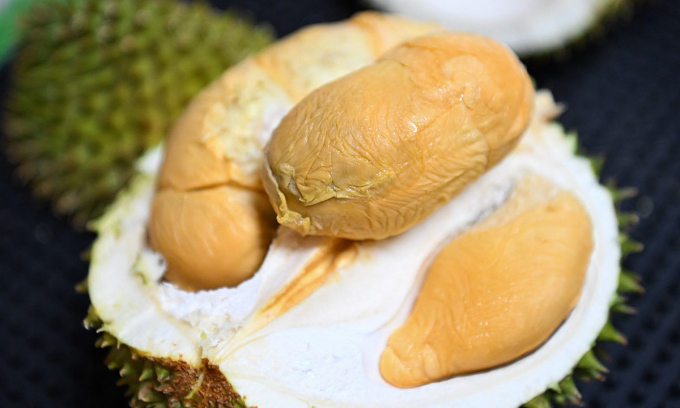
Malaysia’s durian setback: Prices plunge as China’s buying shift leaves growers with surplus

Liew Jia Soon returned to Malaysia in 2018 after years abroad as his father’s durian farm in the hills north of Kuala Lumpur was set to generate record earnings, according to The New York Times.
Durians are seen at a fruit distributor’s operating center in Guangzhou, south China’s Guangdong Province, Oct. 17, 2025. Photo by Xinhua via AFP |
Eight years on, the plantation now spans twice the area it did a decade earlier, but its profits have been plunging.
“We farmers have seen a 60% drop in profits during this season,” he said while surveying hundreds of unsold durians last month at a collection center near his farm in Raub.
Demand from Chinese consumers has not faded. The country’s strong appetite for durian has persisted despite an economic slowdown late last year.
However, buyer preferences have shifted over the past year: instead of frozen shipments – Malaysia’s traditional export format – most now prefer fresh fruit. That shift has unsettled Malaysia’s durian sector.
“We need to get the supply chain to cater for this change in exporting fresh durians,” said Eric Chan, president of the Durian Manufacturer Association, which represents Malaysian durian farmers and distributors.
“I am worried,” he said. Only a limited number of flights from Malaysia to China are able to handle fresh produce shipments, he added.
The change in market demand has resulted in a surplus for Malaysian growers, with some describing the situation as a “durian tsunami.”
Prices dropped in December to a 10-year low of MYR10 ringgit (US$2.56) per kilogram, roughly one-tenth of previous asking prices.
Volatility is compounded by the nature of durian cultivation. Newly planted trees take between five and 10 years to mature and produce fruit, forcing farmers to forecast demand far into the future.
In 2017, Malaysia’s frozen durian pulp and paste exports were gaining ground in China, prompting farmers to plant more trees in anticipation of continued growth.
When China approved frozen whole durians from Malaysia in 2019, prices surged and growers expanded further.
By 2024, government data showed national output reached 568,000 tons, nearly doubled from 2016. That rapid expansion is now contributing to oversupply.
Lim Chin Khee, an adviser to the Durian Academy, which trains Malaysian growers, said China’s recent economic slowdown has made buyers more selective and tougher in negotiating prices.
Additional pressure has come from regional competitors – including Thailand, Vietnam and Indonesia – increasing their own fresh durian exports.
Ken Tan, whose family operates Durianhill Plantation in Penang, said shipments to China have declined 40% this season compared with last year.
The drop in exports means Malaysians are able to enjoy durians at discounts. The sharp drop has left some growers selling directly from their orchards to consumers, cutting out intermediaries to keep their businesses afloat.
Aminuddin Zulkipli, chairman of the Federal Agricultural Marketing Authority, said that the glut is largely the result of higher production and that local demand for the fruit remains robust, as quoted by Sin Chew Daily.
The agency noted that the price pressure has largely been confined to lower-quality durians, not premium fruits.
Authorities have stepped in by purchasing some of the surplus crop to support farmers.
The agriculture ministry said it aims to help the industry recover partly by positioning Malaysian durian as a premium product rather than focusing on high-volume sales.
Agriculture Minister Mohamad Sabu called the oversupply “temporary,” saying the next peak season in June would provide a clearer measure.
“I still believe that durians will be the economic boom for Malaysia,” he told The New York Times.
His belief is supported by China’s growing appetite. Last year, China’s durian imports rose 7% to $7.5 billion. The country accounts for more than 90% of global durian export destinations.
The complexity of some premium Malaysian varieties, such as the Musang King, also distinguish them from the fruits produced in Thailand or Vietnam.
“Even if only 2% of Chinese people want to buy durians, that’s more than enough business,” says Chee Seng Wong, factory manager of Fresco Green, a durian exporter in Raub, as reported by BBC.
“Maybe in the beginning we only liked durians that were sweet. But now we look for things like fragrance, richness and nuanced flavors,” says Xu Xin, a Chinese durian importer.
Official projections indicate Malaysia’s output will increase further to 590,000 tons this year, while exporters are exploring alternative destinations such as Taiwan and Peru.
However, farmers are still concerned about the high supply.
Stephen Chow, who runs the Chow Kai Pheng Enterprise durian plantation, said production is expected to exceed demand over the next three to five years as many previously planted trees begin fruiting.
What Malaysia is experiencing now “is just a preview,” he said.

Comments are closed.