

Prices for Musang King, the country’s best-known durian, have tumbled to roughly US$5 in recent weeks from about US$18 per kilogram last year and are likely to drop further with the harvest expected to arrive in the weeks ahead.
This year, Malaysia is expecting an earlier durian season with higher yields, driven by hot and dry weather, according to The Star.
While bumper harvests had typically been a boon for farmers, this year has proved different, according to Stephen Chow, director of Chow Kai Pheng Enterprise, which exports durians from his 25-acre orchard in Pahang to China and Hong Kong.
An oversupply late last year, for instance, pushed prices of Musang King and several other popular varieties down to a decade low of RM10 (US$2.4) per kilogram, according to the New Straits Times.
Further adding to the strain is an export trade hit by higher packaging, energy and transport costs, with the Iran war disrupting fuel supplies and making cargo more expensive.
Chow said packaging and logistics costs had previously made up about 20% of export revenue, but he is bracing for that share to rise to as much as 50%. “We didn’t expect the war to impact us this badly,” Chow told the South China Morning Postadding that his firm is trying not to pass the higher costs on to consumers.
For growers like Chow, the priority now is to simply sell their fruit and break even. “We are in survival mode, we are cutting costs and we hope the government can help with some relief to help farmers get through this period,” he said.
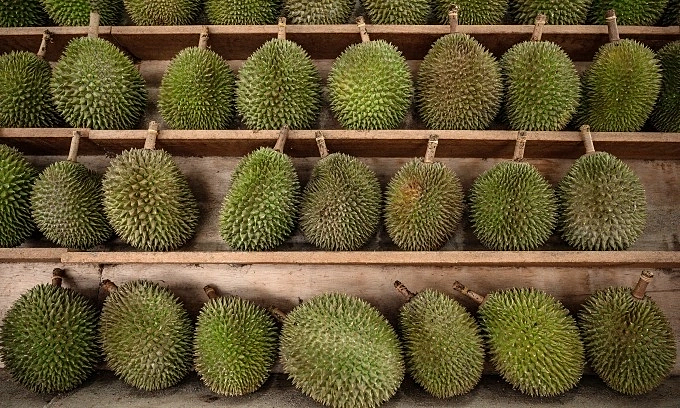
This picture taken on July 8, 2020, shows durians displayed for sale in Kuala Lumpur. Photo by AFP |
A large portion of Malaysia’s durian exports goes to China, the world’s largest market for the pungent fruit.
China imported US$7.5 billion worth of durians last year, with Thailand supplying about 941,000 tonnes valued at $4 billion while Vietnam shipped roughly 920,500 tonnes worth $3.4 billion, according to a March report by BMI cited by Named.
Malaysia, meanwhile, has marketed its fruit, especially Musang King, as premium to compete on quality instead of volume. While its shipments to China were far smaller at 3,064 tonnes worth $37.2 million last year, its durians commanded much higher prices, averaging $12,138 per tonne compared with $4,239 for Thai and $3,739 for Vietnamese fruits.
This approach relies on fast shipping and a tightly managed cold chain to maintain quality.
Chinese consumer preferences have also shifted toward fresh durians over the last year, moving away from frozen shipments that Malaysia had traditionally exported, according to The New York Times.
As a result, pressure on exporters is particularly high because premium fresh fruit must reach consumers in China within 48-72 hours, leaving little flexibility to opt for slower, lower-cost transport.
Lim Chin Khee, an Asian durian expert based in Malaysia, said Musang King’s premium status is an advantage, but it leaves the trade more exposed to logistics disruptions.
“If air freight becomes too expensive or less reliable, exporters may reduce shipments or shift more volume into frozen products, which generally fetch lower margins,” he noted.
Another weakness in Malaysia’s premium fruit trade is its lack of diversification, with the sector heavily reliant on China, according to durian industry experts.
Eric Chan, president of the Durian Manufacturer Association, which represents Malaysian durian farmers and distributors, said some surplus supply was being redirected to the domestic market and Singapore.
Nonetheless, the industry needs to diversify by expanding into new markets such as the Middle East and other parts of Asia and developing processed durian products.
Lim said the current conditions are not just a temporary disruption but a test of the industry’s resilience and ability to adapt.
“Those who can manage quality, cost, and flexibility will continue to do well, but the gap between stronger and weaker players is likely to widen.”

Comments are closed.