
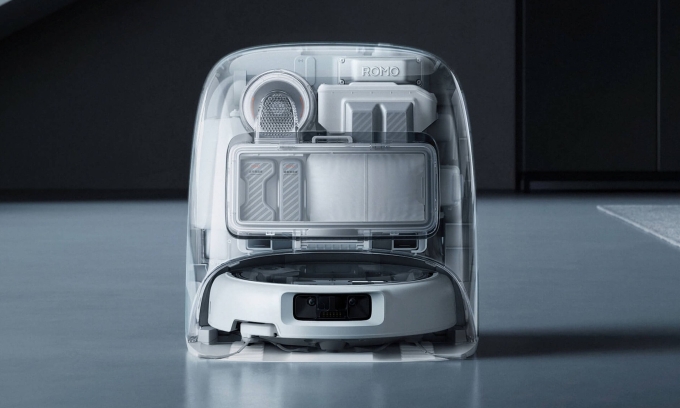

Azdoufal, an AI strategy lead at a vacation rental company in Spain, purchased a DJI Romo, the Chinese drone giant’s first robot vacuum, and used Anthropic’s Claude Code, an AI-powered coding tool, to build a custom app that would let him steer the device with a gaming controller, The Verge reported earlier this month.
The app worked. But when it connected to DJI’s cloud servers, it did not just authenticate his own vacuum. DJI’s servers treated his single security token as a master key, granting him control over roughly 7,000 Romo units across 24 countries.
“I found my device was just one in an ocean of devices,” Azdoufal told The Verge.
Within nine minutes during a live demonstration for the outlet, his laptop had cataloged thousands of devices and gathered more than 100,000 messages, according to Inc. magazine.
Using just a 14-digit serial number, he located a Verge journalist’s review unit, produced an accurate floor plan of the journalist’s apartment and accessed a live video feed, all from another country, as Malwarebytes reported.
Azdoufal insists none of this amounted to hacking. He simply extracted his own device’s private authentication token, and DJI’s servers returned data from thousands of other customers as well.
“I didn’t infringe any rules. I didn’t bypass, I didn’t crack, brute force, whatever,” he told The Verge.
The vulnerability stemmed from what DJI acknowledged was “a backend permission validation issue affecting MQTT-based communication between the device and the server,” according to a DJI statement provided to PC Gamer.
MQTT is a lightweight messaging protocol commonly used for communication between internet-connected devices and cloud servers.
Once a user authenticated with a single device token, DJI’s message broker had no topic-level access controls, meaning anyone could see traffic from other devices in plaintext, according to Audacy.
The flaw meant Azdoufal could view live camera feeds, activate microphones, check battery levels, generate 2D floor plans of homes and determine approximate locations through IP addresses, according to Popular Science.
The access extended beyond vacuums. Even DJI Power portable battery stations were showing up and reporting diagnostics.
DJI told Popular Science it had identified the vulnerability through an internal review in late January and began remediation immediately.
“The issue was addressed through two updates, with an initial patch deployed on Feb. 8 and a follow-up update completed on Feb. 10,” the company said, adding that the fix was deployed automatically and required no user action.
However, DJI’s initial response drew criticism. A spokesperson told The Verge the flaw had been fixed, a statement that arrived roughly 30 minutes before Azdoufal demonstrated that thousands of robots, including the journalist’s own review unit, were still reporting in live, according to Malwarebytes.
DJI later issued a fuller statement confirming the issue was “resolved” and that “remediation was already underway prior to public disclosure.”
Azdoufal said additional vulnerabilities remain unpatched, including the ability to view a DJI Romo video stream without the required security PIN. A second vulnerability was deemed too severe to disclose publicly, with The Verge withholding details until DJI addresses it. DJI told The Verge the remaining issues would be fixed “within weeks.”
Azdoufal also pointed out a deeper structural problem, telling Tom’s Hardware that all user data is stored in plain text on DJI’s servers and can easily be read by anyone who gains access. While DJI said its devices rely on encrypted TLS communications, Azdoufal argued that encryption protects the connection, not the data itself once it reaches the server.
“People stick to the bug bounty program for money. I don’t care. I just want this fixed,” Azdoufal said.
The incident comes at a sensitive time for DJI. The Chinese company, best known for its dominance in the consumer drone market, was added to the U.S. Federal Communications Commission’s Covered List on Dec. 22, 2025, effectively blocking new DJI products from receiving authorization for sale in the U.S., according to the FCC. DJI filed a lawsuit challenging the decision on Feb. 20, according to Commercial UAV News.
The Romo launched in China on Aug. 6, 2025, with prices starting at CNY4,699 (US$654) for the base model, according to Vacuum Wars. It expanded to Europe on Oct. 28, 2025, where the flagship Romo P is priced at 1,899 euros ($2,014).
The DJI Romo’s availability in the U.S. remains uncertain due to DJI’s regulatory challenges.
As for Azdoufal, he did eventually get what he wanted. He can now drive his robot vacuum around his home with a PS5 controller.
“It’s so weird to have a microphone on a freaking vacuum.”

Comments are closed.