
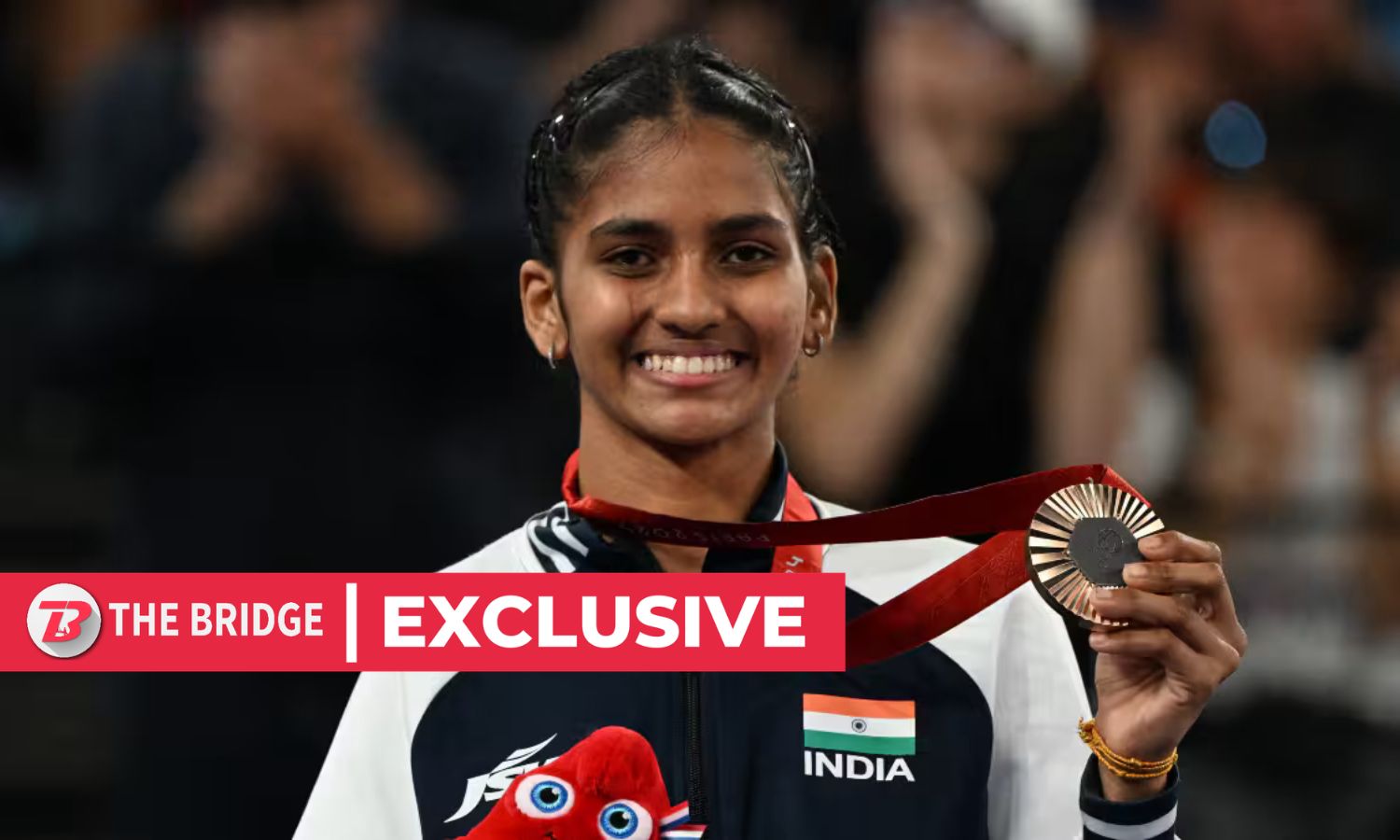

There’s a moment, almost thrown away in a rapid-fire round, where Manisha Ramadass pauses for a word to describe what it means to sit atop the world rankings for over 180 weeks.
“The domination.”
It’s not said with swagger. It’s an acknowledgement of something she has come to live with, day after day, session after session, tournament after tournament.
In an exclusive conversation with Read, Manisha peeled back the layers of dominance to reveal the doubt, discipline, and drive behind it.
The stillness behind the spotlight
The last year should have changed everything. A 2024 Summer Paralympics bronze medal.
A historic first, India’s first woman to win a Paralympic badminton medal.
Titles across continents. Recognition, headlines, expectations.
And yet, she shrugs.
“After Paris 2024… I don’t know if anything has changed,” she says. “Apart from the medal, people calling me a Paralympic medallist… everything else is the same. Same routine, same training every day.”
That’s the contradiction at the heart of her rise. The world sees a breakthrough; she sees continuity.
Even that medal, career-defining to most, was, in her own words, never the destination.
“Winning bronze was not my goal,” she admits plainly. “But I’m still grateful. It was my first Paralympics, a tough draw… winning a medal from there was huge.”
Long before the medal, before the applause, before history, there was anxiety she couldn’t shake.
“Before Paralympics Paris 2024, I was so nervous,” she says. “One week before I left for Paris, I was crying… I was feeling so nervous.”
A tough draw only added to the weight. The stage felt enormous. For a first-time Paralympian, everything was unfamiliar and overwhelming.
But something shifted the moment she entered the village.
“Once I entered, all I could think of was to be consistent and focus on one match at a time,” she says. “Because that’s all I could do.”
That simplicity, almost stubborn in its clarity, became her anchor.
“However tough the matches are… at the end of the day, I have to go and play.”
If the nerves defined her beginning in Paris, heartbreak defined the middle.
“I was not feeling good at all,” she says of the semifinal loss. “It was a very close match… I was almost there in the finals.”
What followed was not immediate resilience. It was something far more real.
“I couldn’t focus on the bronze medal match for the next day,” she admits. “I was completely down… completely demotivated.”
This is where many stories rush forward, to the comeback, the medal, the redemption.
But Manisha lingers in that moment. Because that’s where the decision was made.
“Somewhere I felt like… this is just once in four years,” she says slowly. “If tomorrow I don’t perform well, I’m going to regret it for the next four years.”
There it was, not motivation, not inspiration, but perspective.
“So I just showed up with that mindset of giving my everything,” she says. “Whatever has happened has happened. Now all I can do is focus on my next match.”
The result was a dominant bronze-medal performance at the 2024 Summer Paralympics.
But even now, it’s not the medal she remembers first; it’s the feeling.
“It still feels like it just happened… I couldn’t forget that emotion.”
And then, almost immediately, the pivot: “My only target now is to win gold in LA.”
The year that tested her body
What makes her last year even more remarkable is what she carried through it.
“I had a knee injury on my right knee,” she reveals. “I was not expecting much of myself. I just wanted to give my best.”
That expectation, or lack of it, didn’t stop her from winning.
“I did win a few titles last year,” she says, almost understated.
One moment, though, stands above the rest.
“Winning against the two-time Paralympic champion from China… that was one of my huge victories.”
World No. 1: not a moment, but a mindset
She became World No. 1 in 2022, within months of entering the circuit.
“I started in March… and by August I became World No. 1,” she recalls. “I didn’t expect it in such a short time.”
But what defines her is not how she got there; it’s how she stayed.
“I do care about my world ranking,” she says. “I want to stay at the top for as long as possible.”
Every tournament carries that intention. “To defend my title again, to maintain my rank.”
And when it slips?
“There were times my rank went down,” she says. “But every time, I was catching up.”
It’s dominance as a pursuit.
Her breakthrough year, 2022, was explosive. Eleven international gold medals. A world title. Recognition as the best in the world.
“That was a dream run for me,” she says.
But today’s Manisha is different.
“I think now I’m more focused and calmer than how I used to be in 2022,” she reflects. “In a good way.”
The sport has evolved. The competition has intensified.
“It’s getting really harder,” she says. “And I’m pushing myself much harder than before.”
Despite everything she has achieved, she speaks like someone still absorbing the game.
Playing alongside Pramod Bhagat has been a big part of that.
“He has been in this field even before I was born,” she says, smiling. “I’ve been learning so much from him, on and off the court.”
“Don’t give up… especially on your dreams”
Her journey has not been untouched by doubt from the outside world.
“People have said sports is not for girls,” she says. “Especially me… having a disability, they tried to stop me so many times.”
So when she speaks to young athletes, it comes from lived experience.
“Sports is not always about winning,” she says. “You will win sometimes, you will lose sometimes.”
But loss, to her, is not failure.
“When you lose, you learn so many things… and that’s when you start winning.”
Her message is simple, but hard-earned.
“Don’t give up anything easily. Especially on your dreams.”
And through it all, one word remains
At the end of it all, medals, injuries, pressure, expectations, she circles back to that one word.
“Domination.”

Comments are closed.