
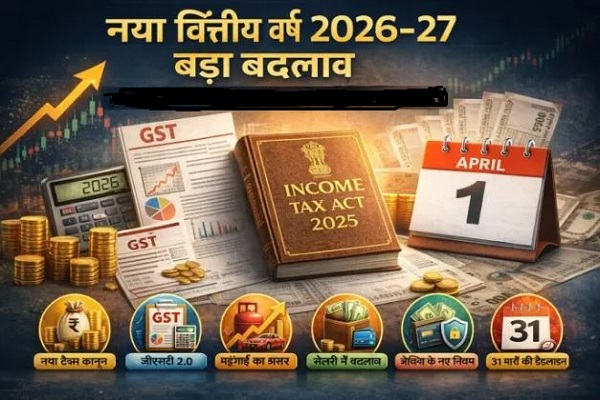
Many rules changed on the first day of the new financial year (2026-27), from Income Tax Act to GST and banking.

New Delhi, 1 April. In India, many major changes have been implemented in the economic life of the common man from the first day of the new financial year (2026-27) i.e. April 1, 2026. The new Income Tax Act 2025 has now come into force in place of the nearly 65 year old Income Tax Act 1961, the aim of which is to make the tax system simple, transparent and user-friendly. Along with this, many important changes related to GST system, banking rules, digital payments and everyday expenses have also been implemented, which will have a direct impact on your pocket.
New tax system implemented
- Under the new tax system, now only ‘Tax Year’ has been implemented instead of ‘Financial Year’ and ‘Assessment Year’, which will make tax calculation easier. The government has announced to keep income up to Rs 12 lakh tax free. Also, tax related rules have been presented in simple language to make it easier for common people to understand and improve compliance.
- Some changes have also been made in the deadline for filing ITR. For employed people, the last date will remain 31st July, while for other taxpayers it has been fixed as 31st August. For cases where audit is necessary, the last date will be October 31.
- Apart from this, now the tax exemption limit on gifts and vouchers has been increased to Rs 15,000, which was earlier Rs 5,000. A major increase has also been made in the education and hostel allowances of children, which will provide relief to the families.
Price of commercial LPG gas increased
However, in the meantime, inflationary pressure also seems to be increasing. Due to the ongoing tension in West Asia, the price of commercial LPG cylinder has increased by Rs 195.50. The price of 19 kg cylinder in Delhi has reached Rs 2078.50, which was earlier Rs 1884.50. This may have an impact on the prices of food and drinks in hotels and restaurants, due to which the expenses of the common people are sure to increase. However, there has been no change in the prices of domestic LPG cylinders at present.
IOC increased premium fuel prices
- Government oil marketing company Indian Oil Corporation (IOC) has increased the prices of its premium fuel in the national capital. The price of XP100 petrol has now become Rs 160 per liter, which was earlier Rs 149. Similarly, the company has also increased the price of Extra Green Diesel (Premium Diesel).
- Now its price in Delhi has become Rs 92.99 per liter, which was earlier Rs 91.49. However, there has been no change in the prices of normal petrol and diesel. Despite a surge in global crude oil prices due to rising geopolitical tensions in West Asia, fuel prices have remained stable in major cities of India.
Rules related to PAN card are also strict
The rules related to PAN card have also been made strict. Now it will not be possible to make PAN on the basis of Aadhaar alone and it will be necessary to provide additional documents. PAN has been made mandatory for large transactions. Also, information about big expenses from credit cards will now be given to the Income Tax Department, which will increase financial transparency.
HRA rules tightened
The rules of House Rent Allowance (HRA) have also been tightened. Now it will be mandatory to provide PAN and other details of the landlord to get the rent rebate. Along with this, Bengaluru, Hyderabad, Pune and Ahmedabad have been included in the metro cities, due to which the people living in these cities will get HRA discount of up to 50 percent.
Changes in the field of banking and digital transactions also
Changes have also taken place in the field of banking and digital transactions. Now cash withdrawal from ATM through UPI will also be counted in the free transaction limit. At the same time, ‘two-factor authentication’ has been made mandatory for all digital payments, which will prevent online fraud.
Many changes in rules for railway passengers
Railway rules have also been changed for passengers. Now to get refund on confirmed tickets, the ticket will have to be canceled at least eight hours before the departure of the train. At the same time, the facility to change boarding station will now be available till 30 minutes before the departure of the train.
Fastag is expensive for traveling on the highway
Fastag has become expensive for those traveling on the highway and cash payment at toll plazas has been completely stopped. Now payment will have to be made only through digital means, otherwise fine may have to be paid.

Comments are closed.