
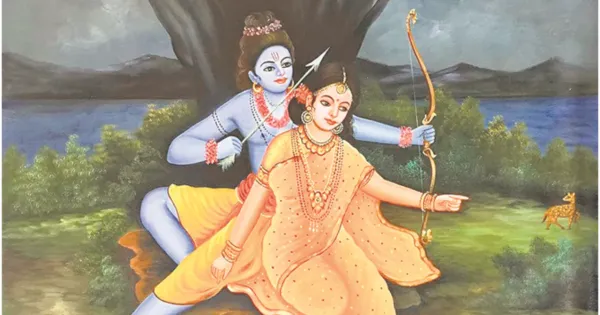
Mata Sita: A unique embodiment of sacrifice, patience and self-power…a life that has inspired women’s consciousness for ages.

In the rich spiritual consciousness of Indian culture and Hindu religion, Mother Sita is not just a mythological character, but a living embodiment of sacrifice, dedication, patience, compassion, infinite purity and women’s dignity, which has been defining women power for ages. His life teaches us that no matter how difficult the circumstances are, if religion, restraint and self-confidence are firm in the mind, then every ordeal of life becomes worthwhile. The personality of Mother Sita presents that form of female consciousness, in which a balance of gentleness and unwavering strength is visible.
The story of the appearance of Mother Sita is one of the most divine and meaningful stories of Indian tradition. According to Ramayana, there was once a severe famine in Mithila. On the advice of the sages, King Janak of Mithila resolved to plow himself, so that Mother Earth would be pleased and there would be rain. When King Janak was plowing the fields, the front part of the plough, called ‘Seet’, hit a golden urn embedded in the earth. From that urn appeared a divine, radiant and beautiful girl. Childless King Janak accepted her as God’s offering. Because she was born from the front part of the plough, she was named Sita, because she was the daughter of King Janak, she was called Janaki and because she was born from the earth, she was called Bhumija. Thus the birth of Mother Sita itself became a symbol of the sacred union of nature and religion.
The entire life of Mother Sita is a living example of sacrifice, tolerance and self-confidence. Leaving the comforts of the royal palace and accepting exile, enduring kidnapping, loneliness, loquacity and severe trials – despite all this he never compromised his character, self-respect and religion. She was not only the better half of Lord Rama, but also his companion and moral strength on the path of religion. Her life shows that women’s power is not silent tolerance, but an unshakable commitment to values.
Mother Sita is seen as an ideal wife, daughter and woman, but her role goes far beyond these traditional boundaries. They balance self-respect with dedication in relationships. His conduct teaches that self-respect is necessary even in love and sacrifice does not mean self-forgetfulness. This is the reason why even today Mother Sita is considered the cornerstone of family life, social structure and moral values.
In Indian tradition, Mother Sita is also considered to be the form of Lakshmi – a symbol of happiness, prosperity and stability. His personality shows the importance of internal prosperity more than external glory. This message is extremely relevant for today’s consumerist and materialistic society. The vision of seeing woman not only as a tolerant or an embodiment of sacrifice, but as a center of creation, balance and social power is developed from the life of Mother Sita.
Amidst the hustle and bustle of modern life, mental stress and increasing complications in relationships, the life of Mother Sita inspires introspection. She teaches that patience is not a weakness, but the greatest strength. When the mind is stable, decisions are clear and sweetness automatically develops in relationships. This is the reason that even today, from rural society to metropolitan cities, the name of Mata Sita is associated with family peace and social balance.
Worship of Mother Sita is not limited to mere external worship, but is a determination to imbibe her virtues – restraint, compassion, self-confidence and integrity – in life. If we adopt his ideals in our life, be it family, society or personal struggle, then even the most difficult path of life can become easy and meaningful. The way he kept his self-respect and patience firm even while living in Ashok Vatika, he is a source of inspiration for every era. In today’s times, when the need for women’s respect, mental balance and sensitive relationships is greater than ever, the life of Mata Sita makes us understand the meaning of true power – the power that comes from within and gives direction to the entire society.
Shweta Goyal, Writer

Comments are closed.