

Mercedes Benz Says All BS6 Cars Are E20 Materially Compliant But Owner’s Manual Says Otherwise: Proof

The debate around E20 petrol has now reached Mercedes-Benz India as well. Recently, a video by vlogger Sourav Joshi went viral. In it, he said that the mileage of his Mercedes GLC300 dropped drastically after using E20 petrol. After this, Mercedes-Benz released an official statement. It said that all its BS6 petrol cars are compatible with E20 fuel. This claim now seems baseless as the official user manuals of some of its BS6 cars prohibits the use of petrol with more than 10% ethanol content (in other words E10).
Mercedes’ big claim came as a response to the vlogger’s viral video. In it, Sourav Joshi mentions that his Mercedes Benz GLC 300 SUV now returns single digit fuel efficiency figures- much lower than what it used to deliver in the past.
He says that the SUV now gives a range of 480 km per tank. This used to be 800-850km in the past. The vlogger believes that the use of E20 (20% Ethanol-blended petrol) has caused this fall. He also expressed fears that the vehicle may suffer from other damages due to the fuel used.
Mercedes Benz put out an official statement/ clarification on its official X (previously Twitter) handle, as soon as the video went viral. In it, the company claimed that ‘all Mercedes-Benz petrol BS VI vehicles are materially compatible with E20 fuel and certified accordingly by relevant authorities’. It did not explain the drop in fuel efficiency directly, but reassured that it would ‘support customers for technical queries’.
Not addressing the mileage drop itself created concerns among owners. The compatibility claim, however, caused a bigger damage.
Mercedes Benz models sold today are E25 compatible. There is no question in that. The way this advisory was phrased seems to be the issue. BS6 cars have been around for a long time now. We all know that. India made its official transition into Bharat Stage 6 (BS6) norms on April 1, 2020. Manufacturers started making their vehicles E20 compatible from around 2023- 3 years later.
Making a statement that ‘BS6 cars are E20 compliant’ can automatically give an added credibility to the claim. Furthermore, Mercedes Benz was one of the first carmakers to transition to BS6. It took the leap in 2018!
If the claim made in this advisory is true, all cars from 2019 to the present day should be E20-compliant. They should be safe to run on 20% Ethanol-blended petrol. More importantly, their user manuals should have E20 marked as a supported fuel type. This is unfortunately, not the case!
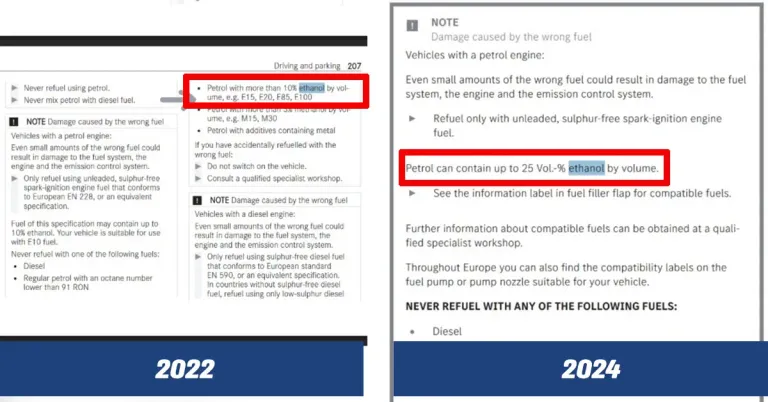
We pulled user manuals of the GLC300 (the same model as the one owned by the vlogger in question) from the official Mercedes India website. We downloaded multiple user manuals from various model years and cross-checked the recommended fuel type and specifications in each of them.
As can be seen above, the user manual from 2022 calls ‘petrol with Ethanol content beyond 10% by volume’ as ‘wrong fuel’, the use of which could damage the vehicle. E15. E20, E85 can all be damaging- it says. In a 2024 user manualhowever, the car is said to support blends of up to E25 (25% Ethanol-blended petrol).
These manuals are both available on public domain and can be accessed by anyone with an internet connection! They destroy the claim that ‘all BS6 petrol cars from Mercedes’ are E20-compliant. They are not! The actual compliance happened in September 2023. Even the user manual from July 2023 says E10 as the highest blend usable.
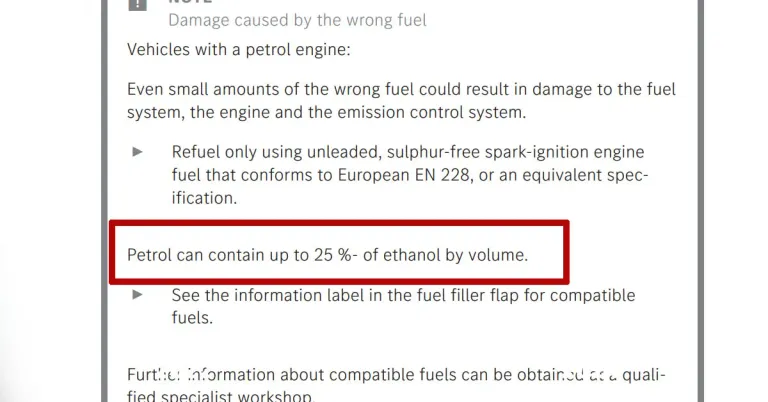
Image: September 2023 User Manual
Between the user manual and an online advisory, we know which one to believe and go by. To us, this seems to be a poorly planned crisis management by the PR/social media teams.
Interestingly, this incident and its aftermath have surfaced days after Mercedes Benz India Managing Director/CEO Santosh Iyer won much praise online for boldly saying that India’s Ethanol blending program needs a clear roadmap for older cars, and manage them effectively. He said that different fuel grades (blends) need to be offered to buyers.
Yes, there could be a political side to things here. Mercedes Benz may have had pressure from the political establishments here to issue such a statement. We lack clarity on that front. What we do know is that automakers cannot take a stand against the government or its policies if they want to do business in the country. In another recent instance, we had seen Toyota issue an explanation after E20 fuel allegedly caused issues in a Hycross.
In the case of the Hycross, the final blame was put on fuel adulteration. It was reportedly found out that the use of ‘adulterated petrol’ had caused the vehicle to malfunction. This is something we could possibly see more manufacturers play in the future if something goes wrong with their vehicles- putting the blame on adulteration.
Circling back, the real question here is whether Mercedes Benz would honour warranty on its vehicles if they develop issues related to fuel systems due to the use of Ethanol-blended petrol- we are talking specifically about older, non-compliant vehicles here- or if the blame would still go to fuel adulteration! This question is critical, as Mercedes Benz is a brand which people trust and admire a lot.
Comments are closed.