
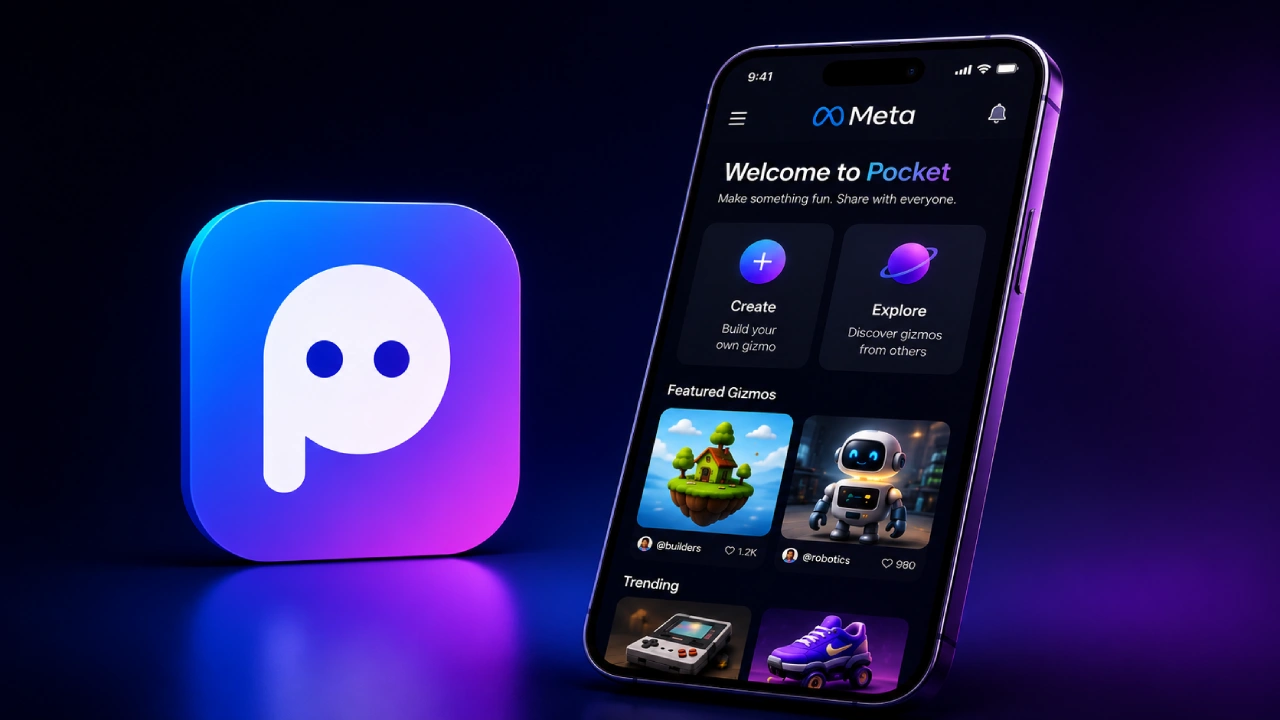

Meta has quietly rolled out a new Meta Pocket app, a new AI-powered creative app that lets users make small interactive experiences by describing them in natural language.
The app is listed on Google Play under Meta Platforms, Inc. and is described as a platform for making and sharing “gizmos.” According to the listing, a gizmo is a small interactive thing users can tap, play with and create just by describing it.
Pocket appears to be Meta’s latest experiment in AI-powered creativity, bringing the “vibe coding” idea into a more social, mobile-first format.
Meta Pocket at a Glance
| Detail | Information |
| App | Meta Pocket |
| Company | Meta Platforms Inc. |
| Category | AI creative app / interactive content |
| Main Output | Gizmos |
| Core Feature | Create interactive experiences by describing them |
| Coding Required | No coding required for basic creation |
| Platform Listing | Google Play |
| Availability | Not yet available everywhere |
| Use Cases | Mini games, interactive tools, playful experiences and experiments |
| Social Features | Feed, profiles, likes, comments and playlists |
What Is Meta Pocket?
Pocket is a creative platform for making and sharing interactive AI-generated experiences.
Meta calls these experiences gizmos. They can be playful mini games, small interactive tools, camera-based effects, soundboards, puzzles or other lightweight digital experiences.
The key idea is simple: instead of opening a game engine or writing code, users describe what they want to create. Pocket then helps generate a playable interactive experience that can be refined, shared and discovered by others.
What Users Can Create
| Creation Type | Example Use |
| Mini Games | Simple puzzles, tapping games or arcade-style ideas |
| Interactive Toys | Touch-based playful experiments |
| Camera Effects | Gizmos using the camera or photos |
| Soundboards | Interactive music or sound experiences |
| Creative Tools | Small drawing, remixing or visual apps |
| Playable Concepts | Quick prototypes from text prompts |
Pocket Uses the “Gizmo” Concept
The word “gizmo” is central to Pocket.
Meta’s Google Play listing describes a gizmo as a small interactive thing users can tap and play with. Gizmos can respond to touch and phone tilt, play sound effects or music, use the camera, pull photos from the camera roll and, in some cases, reason about the world around them.
That makes Pocket broader than a simple AI game maker. It is closer to a social feed of interactive AI-generated experiences.
Gizmo Features
| Feature | What It Enables |
| Touch Response | Users can interact directly on the screen |
| Phone Tilt | Motion-based interactions |
| Sound Effects | Audio feedback and playful experiences |
| Music | Music-based gizmos or soundboards |
| Camera Input | Camera-powered interactive ideas |
| Photo Roll Access | Personalized creations using user photos |
| Reasoning | Some gizmos can respond more intelligently |
No-Code Game Creation Through Prompts
Pocket fits into the growing trend often called vibe coding.
Instead of building software line by line, users describe an idea in plain language and let AI generate the first version. In Pocket’s case, that idea becomes a playable gizmo.
This lowers the barrier for users who want to experiment with game ideas but do not know programming, game engines or interface design.
How Pocket Changes the Creation Flow
| Traditional Game Creation | Pocket Creation |
| Requires coding knowledge | Uses natural language prompts |
| Needs game engine setup | Starts from a mobile app |
| Takes hours, days or months | Designed for fast experiments |
| Built mainly by developers | Open to casual creators |
| Requires manual design work | AI helps generate the interactive experience |
| Harder to share quickly | Built around sharing and discovery |
Explore, Create and Curate
Pocket is not only a creation tool. It also has a social feed.
Users can scroll through gizmos created by other people, interact with them, like them, comment on them and save favorites into playlists. Meta’s listing highlights playlists for things like puzzles, selfie cameras, music soundboards and other community-made collections.
That gives Pocket a social layer similar to a feed, but instead of only watching videos or images, users interact with playable AI-generated content.
Pocket’s Main Sections
| Section | Purpose |
| Explore | Scroll through gizmos from people around the world |
| Create | Make a gizmo by describing it |
| Editor | Tweak and refine the generated gizmo |
| Profile | Share created gizmos |
| Playlists | Save and organize favorite gizmos |
| Community | Like, comment and discover creators |
Built on Meta’s AI Creator Ambitions
Pocket fits into Meta’s wider push into generative AI and creator tools.
Meta has been adding AI features across its apps, including Meta AI, AI image generation, video tools and creator-focused features. Pocket expands that strategy into interactive content, where AI does not only generate text, images or videos, but creates something users can play with.
The app also follows Meta’s earlier move to hire the team behind Atma Sciences, the company behind the Gizmo app, and obtain a non-exclusive license to its technology.
Why Pocket Matters for Meta
| Area | Why It Matters |
| AI Creation | Moves Meta beyond text, image and video generation |
| Interactive Content | Lets users create playable experiences |
| Social Feed | Turns AI creations into shareable content |
| Creator Tools | Gives non-coders a way to prototype ideas |
| Mobile AI | Uses phone sensors, camera and touch input |
| Vibe Coding | Aligns Meta with the prompt-to-app trend |

Availability Is Still Limited
Pocket should not be described as a global launch yet.
Meta’s Help Center says the Pocket app is not yet available everywhere, and some features may not be available in every region. That means users in some countries may not be able to download or use the app right away.
For publication, the safest wording is that Meta has quietly rolled out or soft-launched Pocket, rather than saying it is fully available worldwide.
Availability Status
| Detail | Status |
| Google Play Listing | Live |
| Developer | Meta Platforms, Inc. |
| Global Availability | Not confirmed |
| Regional Availability | Limited |
| iOS Availability | Not fully confirmed across regions |
| Full Meta Announcement | Not issued as a major public launch |
Pocket vs Traditional Game Engines
Pocket is not a replacement for Unity, Unreal Engine or professional game development tools.
Instead, it is better understood as a fast creative platform for lightweight interactive ideas. Professional developers still need full game engines for complex mechanics, advanced graphics, multiplayer systems and commercial-scale production.
Pocket is more useful for casual creators, students, educators, social users, designers and hobbyists who want to quickly turn an idea into something playable.
Pocket’s Best Use Cases
| User Type | Possible Use |
| Casual Creators | Make playful mini games quickly |
| Students | Learn interactive logic through experiments |
| Educators | Create simple classroom activities |
| Designers | Prototype interaction ideas |
| Content Creators | Build shareable interactive posts |
| Hobbyists | Test game ideas without coding |
Why It Matters
Pocket matters because it shows how AI creation tools are moving from passive content to interactive experiences.
Text-to-image and text-to-video tools made it easier to create visual media. Pocket points to the next phase: text-to-interaction. Instead of only generating something to look at, users can generate something they can tap, tilt, remix, play and share.
That could make AI-generated content feel more like a social experience than a static output.

The Bigger Picture
AI-assisted software creation is becoming more mainstream.
Tools that create apps, websites, prototypes and games from prompts are growing quickly. Pocket brings that idea into Meta’s social ecosystem, where discovery, remixing and sharing are just as important as creation.
If Pocket grows beyond its early rollout, it could become a new type of social feed built around playable AI-generated content instead of photos, videos or text posts.
Bottom Line
Meta has quietly rolled out Pocket, an AI-powered app for creating and sharing interactive “gizmos.”
Users can make gizmos by describing them in natural language, then tweak, share and organize them through a social feed. These experiences can respond to touch, phone tilt, sound, camera input, photos and, in some cases, reasoning features.
The app is still not available everywhere, so it should be treated as an early or limited rollout rather than a full global launch.

Comments are closed.