
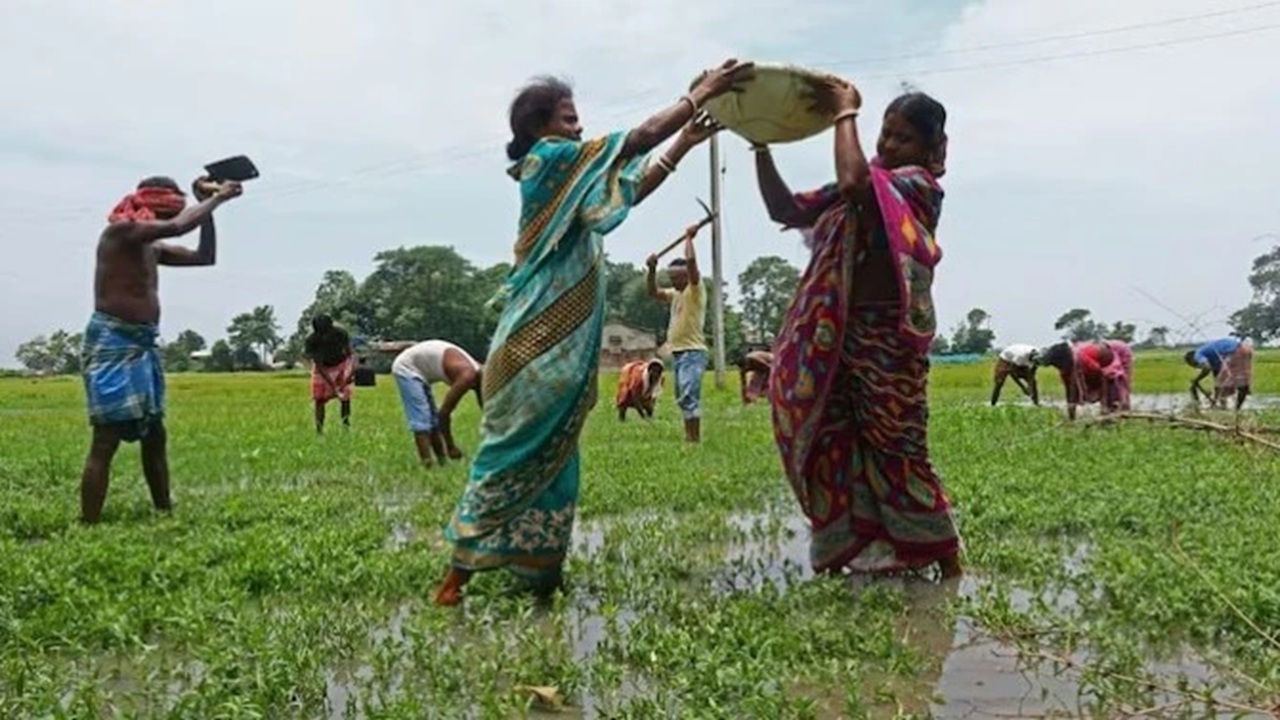
MGNREGA to VB G Ram G Bill 2025 : Farmers’ ‘Achche Din’ ! MGNREGA ends…; Change in money rules with new employment scheme

- Repeal of the Mahatma Gandhi National Rural Employment Guarantee Act (MNREGA).
- The government will introduce a bill in the Lok Sabha
- The new scheme is considered beneficial for farmers
MGNREGA to VB G Ram G Bill 2025 News In Marathi : The Narendra Modi government at the center is going to introduce a new employment scheme. The implementation of this scheme will abolish MNREGA and replace it with a new scheme. The government will introduce a bill in the Lok Sabha to repeal the Mahatma Gandhi National Rural Employment Guarantee Act (MNREGA) and make a new one. The new scheme is seen as beneficial for farmers, although opponents are criticizing the attempt to remove Mahatma Gandhi’s name from the scheme.
The new Bill will be called the Developed India – Guarantee for Employment and Unemployment Mission (Rural): VB-G Ram Ji Bill, 2025. The new Bill will be called the Developed India – Ji Ram Ji, Bill 2025. MGNREGA has been in existence since 2005. Now the government is going to change its name to Pujya Bapu Rozgar Hami Yojana.
The role of states in the new scheme
The bill gives more powers to states, allowing them to decide which priority tasks to use workers for based on local and regional needs. Linking with Prime Minister Gati Shakti will ensure complete transparency in the scheme and eliminate possibility of duplication of work. Detailed, developed Gram Panchayat Plans will be prepared so that villages can also become an active part of India’s national development vision developed in 2047.
Allergic to Gandhi name to Modi government; Bapu is now renamed MGNREGA.
The new bill will establish accountability not only for the central government but also for the states. Earlier, the central government provided all the funds, but now the central and state governments will share 60:40. The ratio of cost sharing for general states has been fixed at 60:40, while for North Eastern and Himalayan states it will be 90:10. Thus, if the state governments also invest in the scheme, there will be better monitoring of both work and funding.
The new scheme brought relief to agriculture
Due to the central government’s employment guarantee scheme, there were frequent complaints of shortage of labor or workers to work in the fields during the farming season. This new bill has found a solution to this problem. This crisis is over. The 125-day employment guarantee will continue, but people will be given the flexibility to work in agriculture and related work, even on their own farms.
States are now empowered to suspend public works for 60 days in a year to ensure availability of labor during agricultural activities like sowing and harvesting. However, this adjournment should not exceed 60 days continuously, but should be limited to 10-15 days so that public work is not disrupted for a long time. Additionally, wage inflation will be controlled during the farming season. This will allow laborers to work in their own fields during the farming season.
Preparation for development of advanced gram panchayat scheme
The new law will provide 25% more employment opportunities to labourers. Digital presence, Aadhaar-based verification and electronic payment have been made mandatory. States will be required to pay unemployment allowance to laborers if they do not find work on time. Currently, approximately 40 lakh people in the country are benefiting from the 100-Day Rural Employment Scheme. Under the new scheme, this period will be extended from 100 to 125 days. MNREGA used to run throughout the year earlier, but the new scheme will be suspended during the farming season.
A developed gram panchayat scheme will be developed to avoid duplication of work and then linked to the Gati Shakti scheme. The Gram Panchayat will work to determine the infrastructure required in the village, such as Anganwadi buildings, and then work and allocate funds accordingly.
Work will also be done during natural calamities
Work under this scheme will also be possible during national natural calamities. Currently, ₹1,51,282 crore has been allocated as against ₹86,000 crore last year. Panchayats will be classified into A, B and C categories according to the amount of work completed. For example, development and grading of each panchayat should be done according to where work has been done and where work is needed and where work has been done. To ensure that less developed panchayats are given attention under the scheme, villages will be classified into categories A, B and C. This will enable the states to decide which panchayats need the most important development work and increase participation.
Four primary areas have been identified for the new scheme
The VBG RAMG Bill identifies four primary areas for rural development: water security, core rural infrastructure, specific works to cope with extreme weather events and livelihood-related infrastructure. All assets created under the scheme will be integrated into the Develop India National Rural Infrastructure Stack, which will improve coordination and monitoring of schemes.
Opponents take a strict stand regarding the name change
As a new law is being prepared to replace MGNREGA, the opposition has raised questions as to why Mahatma Gandhi’s name is being omitted from the scheme. When asked about the government’s move, Congress MP Priyanka Gandhi Vadra said, “Whenever a scheme is renamed, numerous changes are made in offices and stationery, which costs a lot of money. So what’s the point? Why is this being done?”
Mahatma GandhiExpressing disappointment over the removal of his name, Priyanka said, “Why is Mahatma Gandhi’s name being removed? Gandhi is considered the greatest leader not only in the country but also in the world. Now, I really don’t understand the motive behind removing his name. What is their (the government’s) intention?” Trinamool Congress leader and Rajya Sabha MP Derek O’Brien termed the government’s decision as an insult to Mahatma Gandhi.

Comments are closed.