
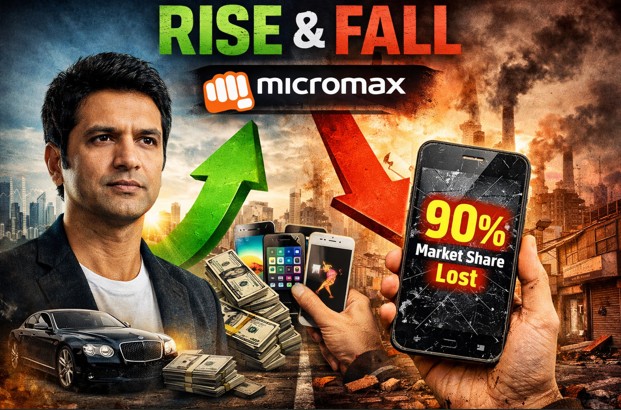
Micromax Mobile :- Micromax’s success-failure story: How it lost 90% market share within a few years?

- Considering the problem of electricity in rural areas, he created a phone with a 30-day battery
- The Canvas series became very popular
- Company peak in 2014 — ₹12,000 crore business
Always great to sit down because today we have a very special person – Rahul Sharma, Founder and Managing Director of Micromax. Everyone loves success stories. Today I am going to talk to Rahul Sharma. A boy from a middle class family like us. Today we have with us a person who became a big change maker in the field of entrepreneurship. He started Micromax, one of the largest smartphone companies in India. During that time he had a successful business, a Bentley car and big headlines. An Indian brand that has always distinguished itself in the market. We had started 23 offices. That means he had achieved everything a middle-class boy could dream of. A perfect ‘rags to riches’ story. But then something happened that took a sudden U-turn to this story.
Micromax was one brand that completely disappeared from the smartphone market. In fact, the entire market has changed. In 2015, Micromax was the second largest mobile manufacturer after Samsung. But by 2019, they lost 90% of their business. So in just 4 years Micromax came from Arsha to the floor. But the question was how did this happen? How did a billion dollar business end up on the verge of collapse and what exactly did they do wrong? Some people were saying it was because of Chinese companies. Some said that research and development was not done properly. But when I did some research, I realized that the real reason was something else.
Privacy of smartphone users in danger? Apple and Google tracking data even when the phone is not in use? A big revelation in the report
In 2015, Micromax’s valuation was $3.5 billion. Before that only Nokia name was running in the market, but that year Micromax overtook even Nokia. And the main person behind this was Rahul Sharma. Born in Delhi, this boy completes engineering. Although he is from a middle-class family, he asks his father for a computer worth ₹56,000. It was a huge amount in those days, but his father believed in him and gave him the computer.
Rahul learned C++ first. There was no internet at that time, so he learned by reading books. After some time they started making software and supplying hardware parts. Around 2000 mobile phone was a luxury in India. In villages and small towns, people used to call from PCO booths. Nokia dominates the entire system. They were making landline based phones. Rahul saw a big opportunity here. They saw that landline installation was expensive and maintenance was difficult. So they made SIM-based calling phones that were perfect for PCO booths. This eliminated the need for landlines, reduced costs, simplified installation, and simplified maintenance. Nokia liked the idea and partnered. The business started doing well and their revenue reached crores. But suddenly Nokia closed its PCO business. This was a big shock for Rahul. He took a bold decision that if Nokia won’t sell, we will sell phones ourselves. He tied up with companies like Airtel, Idea and Vodafone and built his network across India. His business reached 100 crores. After this he identified a major problem in rural areas — batteries were dying quickly and electricity was not available. So they created a phone with 30 days of battery life — the Micromax X1i. Initially no one was willing to sell it, but 10,000 phones were sold in just 10 days.
New Redmi smartphone launched at less than 15 thousand! A powerful battery and a 120Hz display, the design is a must-see
They launched the Micromax Bling phone for women. Initially the sales were low, but after the promotion during Karva Chauth, the demand increased. After this, they started making Android smartphones. The Canvas series became very popular. The company also ventured into tablets and smart TVs. By 2014, the company had reached its peak. But in 2016, Reliance Jio was launched. Free calling and cheap data completely changed the market. Demand for 4G phones increased, but Micromax had a stock of 3G phones that became useless. At the same time, Chinese companies like Xiaomi, Oppo and Vivo entered the market. They already had 4G technology, but Micromax didn’t. So it fell behind the competition. By 2019, Micromax’s market share was reduced to 90% and the company almost disappeared from the market.
Today Rahul Sharma is not in consumer electronics but his components business is successful. He believes that technology should reach as many people as possible — that is good for the country and society.

Comments are closed.