
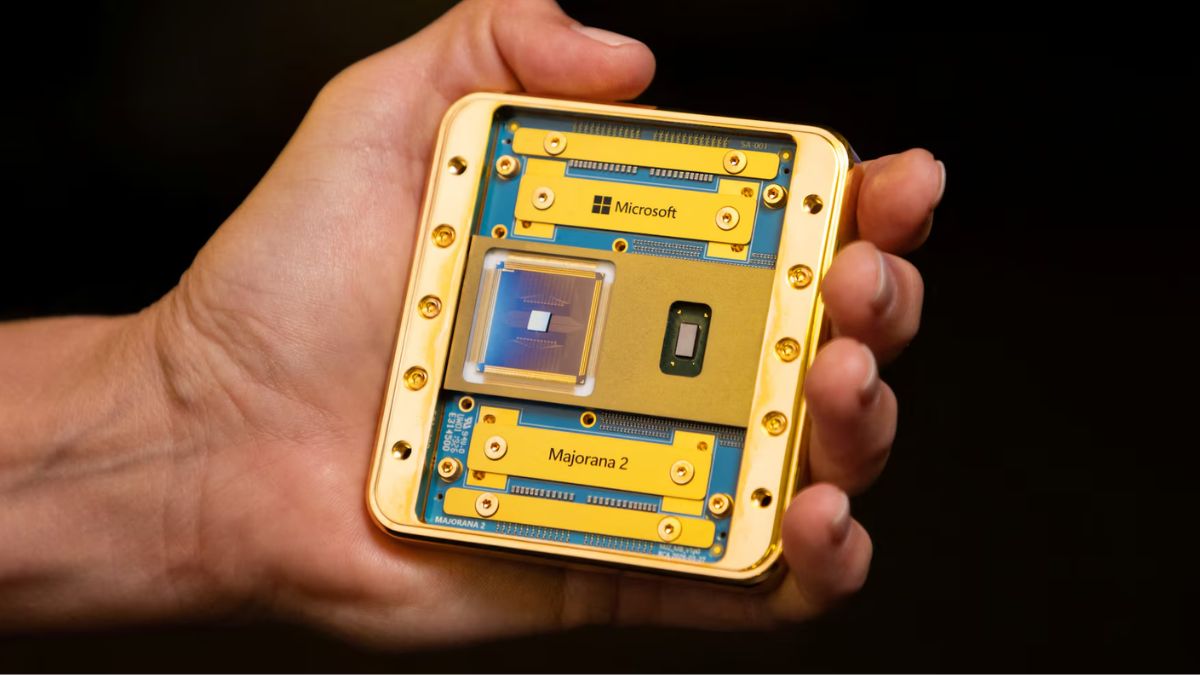

For years, quantum computing has been stuck with the same problem. Researchers could create powerful quantum systems, but keeping them stable long enough to perform useful work remained incredibly difficult.
Now Microsoft believes it has found a way forward.
The company has unveiled Majorana 2, a new quantum chip that it claims delivers a massive leap in reliability. More importantly, Microsoft says the breakthrough could shorten its path to a scalable quantum computer and bring practical quantum technology closer than many expected.
Majorana 2 focuses on the biggest problem in quantum computing
Most discussions about quantum computing focus on speed and processing power. In reality, stability has been the industry’s biggest obstacle.
Quantum computers use qubits instead of traditional computer bits. These qubits can perform calculations in ways classical computers cannot. The problem is that qubits are extremely fragile. Even tiny disturbances can cause them to lose information and generate errors. Microsoft’s latest chip tackles that issue directly.
Instead of relying on conventional quantum designs, Majorana 2 uses topological qubits. These are designed to protect information at the hardware level. The approach aims to make qubits naturally more resistant to outside interference.
According to Microsoft, the result is a dramatic improvement. The company says Majorana 2’s qubits can remain stable up to 1,000 times longer than those used in its previous generation of quantum hardware.
That may sound like a technical detail, but it could have a huge impact. More stable qubits mean fewer errors, less correction work, and a much clearer path toward building larger quantum systems.
AI played a bigger role than the quantum chip itself
While the hardware breakthrough grabbed headlines, another part of Microsoft’s announcement could prove just as important.
The company revealed that its AI-powered research platform, Microsoft Discovery, was deeply involved in the chip’s development process.
Building quantum hardware is notoriously complicated. A single adjustment in materials, fabrication, or testing can affect dozens of other variables. Researchers often spend months evaluating possibilities before finding workable solutions.
Microsoft says its AI agents helped speed up this process by analyzing experimental data, identifying hidden patterns, automating measurements, and suggesting new design paths.
In some cases, tasks that once took weeks were completed much faster because AI could test multiple possibilities simultaneously.
This signals a larger shift happening across the technology industry. AI is no longer being used only to write text or generate images. Companies are increasingly deploying AI systems to help create entirely new scientific discoveries.
The quantum race is becoming a battle of strategies
Microsoft’s announcement also highlights a growing divide in how major technology companies are approaching quantum computing.
Late last year, Google introduced its Willow quantum chip and focused heavily on error correction. Google’s strategy accepts that qubits are naturally fragile and aims to build systems that can continuously detect and fix mistakes.
Microsoft is pursuing a different vision. Instead of correcting errors after they occur, the company wants to make qubits inherently more stable from the start. If successful, that approach could reduce the amount of correction required and simplify future quantum systems.
Both companies are chasing the same goal, but they are taking very different roads to get there.
The next few years will reveal which strategy scales more effectively.
For now, Majorana 2 represents more than another quantum chip launch. It offers a glimpse of a future where AI does not just power software products but actively helps invent the next generation of computing itself. If Microsoft’s timeline stays on track, the race to practical quantum computing may be entering its most important phase yet.

Comments are closed.