
Middle East flight collapse leaves overseas Vietnamese with no way back to Europe after Tet

Phuong Thanh had everything planned. She would fly back to Poland on March 3, transiting through Dubai on an Emirates ticket that cost her just over VND21 million (US$800). It was a routine booking, the kind that millions of overseas Vietnamese make every year after visiting family for Tet.
Then on Feb. 28, the U.S. and Israel launched military strikes on Iran, and within hours, the skies over the Middle East went dark.
Iran retaliated with missiles and drones targeting U.S. forces and cities across the Gulf, according to Reuters. At least eight countries shut their airspace, including the UAE, Qatar, Kuwait and Bahrain. Dubai International Airport, one of the world’s busiest transit hubs, suspended all flights. So did Hamad International Airport in Doha. For anyone holding a ticket that routed through the Middle East, the path home simply vanished.
Thanh, who had traveled to visit family in Hue in central Vietnam during the Year of the Horse holiday, found herself refreshing booking websites around the clock. The cheapest alternative she could find was a three-leg route from Hanoi through Thailand and Turkey to Poland for VND34 million ($1,300). A path through South Korea cost VND56 million ($2,140). Both required transit visas that are difficult to arrange on short notice.
“I’ve been anxious for days because I can’t be away from work in Poland for long. I’m looking for alternative flights, but ticket prices are rising by the hour,” Thanh said. “If I have to take a roundabout route to Europe, the cost is enormous. But if I wait for Middle East flights to resume, there’s no telling when that will be.”
She is far from alone. Hong Nhung, a Vietnamese worker based in Munich, returned to Vietnam for the holiday and has been unable to get back to Germany since her Qatar Airways flight through Doha was canceled. Qatar Airways suspended all operations from Feb. 28 when Qatari airspace closed, and as of March 3 the airline said its next operational update would not come until 9 a.m. on March 4 (Doha time), according to a statement on the Qatar Airways website.
Nhung’s options are bleak. Vietnam Airlines’s direct Hanoi-Munich service was sold out in economy, with only business class seats left at VND100 million ($3,820). Roundabout routes through Japan, South Korea, or Thailand would require three or four transfers, take 20 to 25 hours, and still cost at least VND40 million ($1,530).
“For someone working abroad like me, every ticket change or schedule delay means significant additional costs,” Nhung said. “Spending tens of millions of dong more on airfare is no small burden.”
The crisis has exposed how dependent Vietnamese travelers are on Middle Eastern transit hubs. Most flights from Vietnam to Europe pass through airspace over the Gulf or connect at major hubs in Dubai, Doha, or Abu Dhabi.
These transit routes have long been the affordable option, making them the default choice for the country’s large diaspora of workers, students, and families spread across Europe and the Middle East. With Russian airspace still restricted to most airlines due to the war in Ukraine, Europe-Asia traffic was already concentrated through Middle Eastern corridors, as aviation analyst Linus Bauer noted in comments to The National.
At Noi Bai International Airport in Hanoi, 16 Middle East-bound flights operated by foreign carriers were canceled between Feb. 28 and March 3, affecting roughly 3,800 passengers, according to an airport spokesperson. Qatar Airways accounted for seven canceled flights and about 2,100 passengers, Emirates three flights and 1,200 passengers, and Etihad Airways two flights and 500 passengers. One Emirates plane and two Qatar Airways aircraft remained parked on the tarmac at Noi Bai, unable to return to their home bases.
Airlines have offered affected passengers rebooking or refunds and arranged hotel stays in Hanoi for stranded transit travelers. Passengers who had not yet arrived at the airport were notified by email. No passengers were reported stuck at Noi Bai as of March 3.
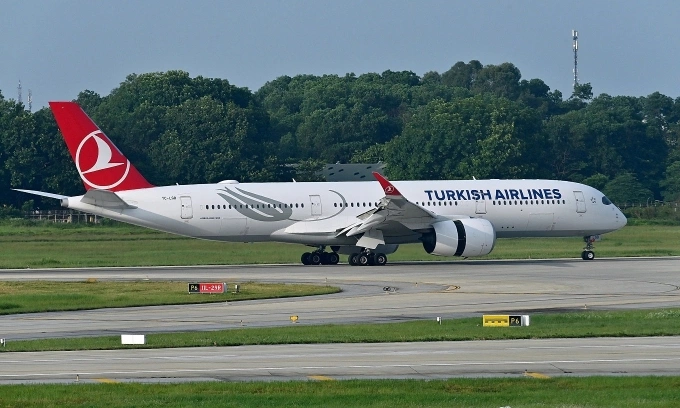
The Civil Aviation Authority of Vietnam said that as of March 3, Turkish Airlines was the only Middle Eastern carrier operating normally from Vietnam, maintaining its routes between Hanoi, Ho Chi Minh City and Istanbul. The airline did cancel services to many other Middle Eastern destinations, including the UAE, Qatar and Iran, according to its communications office.
Qatar Airways, Emirates and Etihad Airways continued to cancel March 3 flights and were awaiting clearance for March 4 services.
Dubai Airports confirmed that limited operations resumed from the evening of March 2, but stressed that passengers should only go to the airport if contacted directly by their airline, according to Khaleej Times.
Emirates began a small number of flights, prioritizing passengers with earlier bookings. Aviation data firm Cirium reported that as of March 2, roughly 41% of all flights scheduled to the Middle East had been canceled, with the UAE, Qatar, and Bahrain among the hardest-hit destinations.
For Thanh and Nhung, the math is simple and unforgiving. Every day they wait is a day of lost wages. Every alternative route costs more than they budgeted.
Thanh said she still does not know how she will get back to Poland.
Nhung said she is hoping the conflict will ease and flights through the region will resume before her situation becomes untenable.

Comments are closed.