
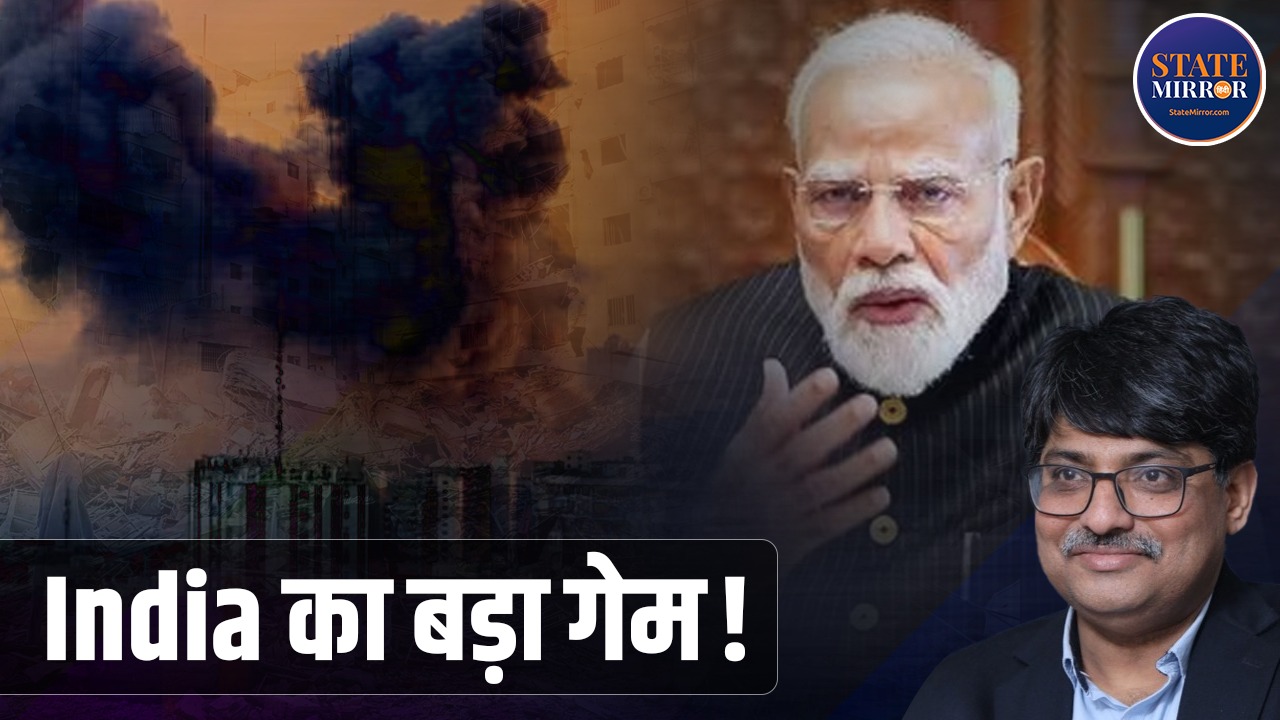

middle east The ongoing conflict has once again put India’s foreign policy to the real test. On one hand, India has deep strategic and economic relations with Israel, on the other hand, there are strong ties with Iran and Gulf countries in terms of energy and diaspora. The balanced approach adopted by the Narendra Modi government amid such complex equations is indicative of a ‘multi-alignment’ strategy, different from traditional non-alignment. India neither seems to openly side with any one side nor remains completely neutral, but gives priority to its national interests (energy security, trade and security of NRIs). This is the reason why the ‘Middle East Crisis’ has become not only a diplomatic challenge for India, but also an opportunity to establish itself as a ‘smart power’. Professor on this issue Music Ragi Understand what he said in conversation with the representative of Read in his own language.
Actually, Sangeet Ragi is a professor and contemporary thinker in the Department of Political Science of Delhi University. He expresses his views openly on national and international issues. He asked whether ‘neutral India’ became ‘power player India’ amid the Middle East war? In response to this I said, “There is no such thing as ‘power player’. There is a difference between non-aligned India and today’s India. Our stand is clear, the Strait of Hormuz should not be closed.”
He further said, “If any country occupies the Strait of Hormuz, then anyone can do the same on the Strait of Malacca if necessary. The occupation of the Strait of Hormuz is not acceptable to India.”
It is clear from PM’s statement, India is with whom?
According to RSS thinker Sangeet Ragi, PM Modi has given his stand on this issue in Lok Sabha and Rajya Sabha. The PM has said that what Iran is claiming is not acceptable to us. Secondly, India is clearly saying that despite the presence of American energy and nuclear bases in Qatar, Kuwait, United Arab Emirates, Saudi Arabia and other countries in the Middle East, civilian targets should not be bombed.
According to Ragi, the interesting thing is that he spoke on the attack by Iran on this issue, but did not say anything on what Israel did. It was definitely said that there should be no loss of life or property of citizens. This statement means that India stands with Saudi Arabia, UAE, Qatar, Israel and America in the Middle East war, but it cannot be taken as a power play.
American ‘bossism’ But What is India’s opinion?
Yes, India also does not stand with American ‘bossism’. Since no one is opposing America. Neither Russia nor China. That’s why India is also silent. This is because India also does not want to ignore its national interests.
From the moral point of view, America should also be criticized. Because America is showing ‘bossism’. Not only is he interfering in the affairs of any country, but he is also violating its sovereignty. Still, why should India upset America by making statements against it? Neither UAE, Saudi Arabia or other countries of the Gulf and Middle East want Iran to become a nuclear power. More or less, India is also in favor of this opinion.
Then it is not the case that Iran has supported India. If we talk about the reign of King Pahlavi, he neither supported India in 1971 nor on the Kashmir issue, nor after that. Ayatollah Khamenei was never in favor of India even on Kashmir. He even said that if Muslims unite, Kashmir cannot be India. In such a situation, why should India willingly sacrifice its national interests?
Let us mention here that India was once considered a symbol of non-alignment. Today it seems to be emerging as a “power player” through multi-dimensional diplomacy (Multi-Alignment). The question is whether this change with multi-alignment is real or just perception? Let us understand this through seven important questions.
1. Is ‘Non-Aligned India’ irrelevant now?
India, which was among the founding countries of the Non-Aligned Movement (NAM) during the Cold War, kept itself away from poles like America and the Soviet Union. The basic objective of the policy of the country’s first PM Jawaharlal Nehru was – strategic independence. But today’s global scenario has changed. India cannot remain completely ‘neutral’ amid the US-China competition. India is now pursuing its interests not by maintaining distance from any one group, but by building relations with many powers. Therefore ‘non-alignment’ has now changed into ‘strategic autonomy’.
2. Is India’s ‘Multi-Alignment’ strategy making it stronger?
Today India is active on many global platforms simultaneously. Like in the Quadrilateral Security Dialogue (QUAD) with America, Japan and Australia, on the other hand in BRICS and Shanghai Cooperation Organization (SCO) with China and Russia. This balance shows that India is not dependent on any one pole. This ‘Multi-Alignment’ makes India a flexible and influential power, where it can choose partnerships as per its interests. Now India’s closeness with NATO has also increased.
3. Did the Russia-Ukraine war highlight India’s new foreign policy?
During the Russia-Ukraine War, India did not openly support any side, but several times adopted a neutral stance in the United Nations. On one hand, India bought cheap oil from Russia, while on the other hand it maintained strategic relations with America and European countries. This balance proved that India now gives priority to national interests along with morality.
4. Is India increasing its soft power by becoming the voice of ‘Global South’?
India has tried to establish itself as the voice of developing countries. While hosting the G20 Summit 2023, India gave prominence to the issues of the Global South – debt crisis, climate change, food security. Apart from this, India has strengthened its soft power through vaccine diplomacy, digital public infrastructure (UPI model) and humanitarian assistance. Due to this, India has emerged as a responsible and trustworthy global leader.
5. China’s growing influence forced India to become a ‘Power Player’?
China’s growing global and regional influence, especially the Belt and Road Initiative (BRI), has created a strategic challenge for India. After the Galwan Valley clash, India made its foreign and security policy more aggressive. Activism in QUAD, Indo-Pacific strategy and increasing connectivity with neighboring countries – all these steps are changing India from ‘reactive’ to ‘proactive’.
6. Economic and military strength gave a new dimension to India’s diplomacy?
India is today included among the major economies of the world and is rapidly moving towards becoming self-reliant in the defense sector. According to IMF data, India’s economy is growing rapidly. Along with this, defense exports and strategic partnerships (such as the Rafale deal with France) have strengthened India’s global position. Economic power and military capability together make diplomacy effective – and this is the foundation of India becoming a ‘Power Player’.
7. Are there any risks in going from ‘Neutral’ to ‘Power Player’?
While India’s new foreign policy is making it powerful on the global stage, it also comes with some risks: maintaining a balance with both the US and Russia could be challenging. Tension with China can increase at any time. It is not easy to live up to the expectations of the ‘Global South’. Moreover, if India gets too involved in ‘Power Politics’, its traditional moral image may be harmed.
What is multi-alignment policy?
PM Narendra Modi’s “multi-alignment” policy means building strategic relationships with multiple global powers simultaneously, without being tied to any one group. Today India works with America, Japan, Australia in QUAD, and is also associated with China-Russia in BRICS and (SCO). Its objective is to take advantage of every platform while giving priority to national interests. This policy reflects flexible, pragmatic and results-based diplomacy, where India plays an active role in the global balance of power.
What is India’s Non-Alignment?
India’s non-alignment policy started during the Cold War era under the leadership of Jawaharlal Nehru, the objective of which was to adopt an independent foreign policy by maintaining distance from powerful groups like America and the Soviet Union. Through Non-Aligned Movement (NAM), India gave the message that it will not be a part of any military or political block. The basic premise of this policy was peace, sovereignty and strategic autonomy. Non-alignment provided India with moral leadership at the global level and the ability to take independent decisions.
Is the change real or just perception?
The change in India’s foreign policy is not just symbolic but structural. ‘Neutral India’ has not completely ended, but it has now transformed from a passive neutrality to an active strategic autonomy.
Today India is neither a ‘Follower’ of anyone nor completely ‘Neutral’. He is becoming such a ‘Power Player’ who can influence global equations according to his interests. It will be interesting to see in the coming years how efficiently India is able to maintain this balance, because this is where the real test lies.

Comments are closed.