
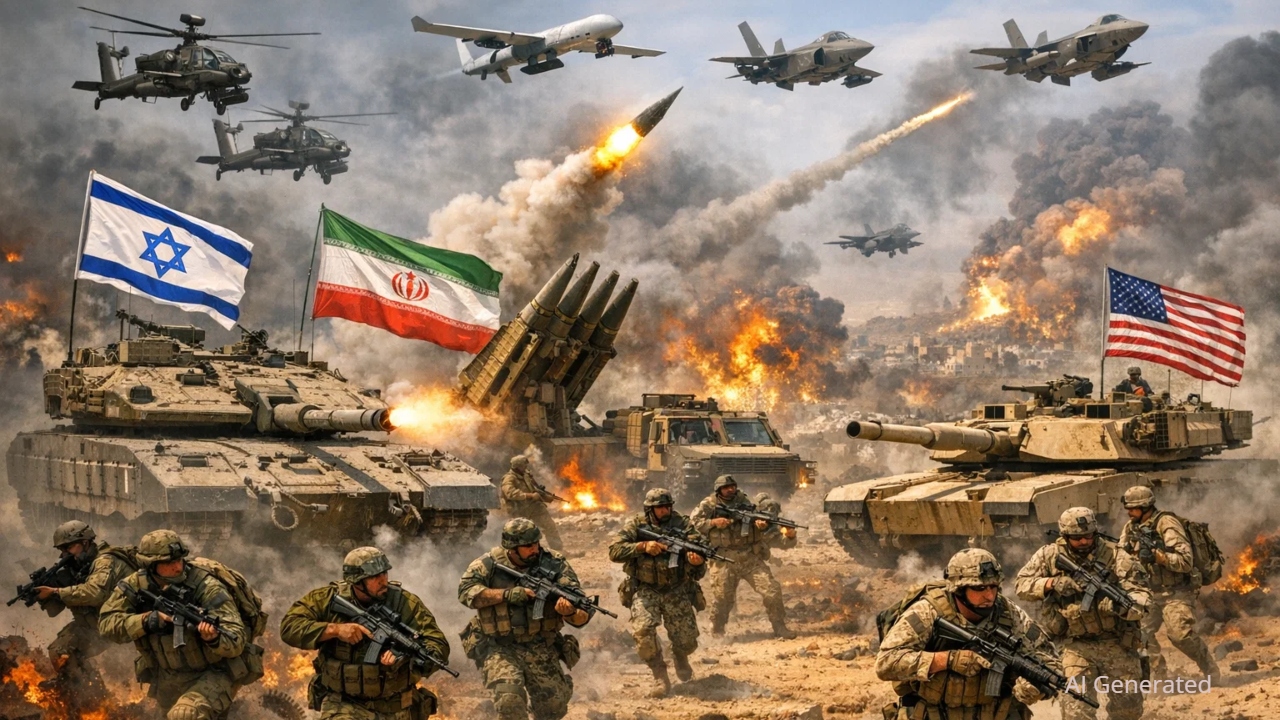

Amidst the tension in the Middle East war, the biggest question is that if the war comes “on the ground” then who will have the real power, America, Israel or Iran? This question is important. This is because ground war is not decided only by the number of soldiers, but training, technology, logistics, geography and war experience decide who will prevail over whom? Know who will prove to be the hero if there is a ground war.
Who is stronger in terms of military?
The military strength of Iran, America and Israel is different. Their strong cores are also based on different strategies. America’s biggest weapon is its high-tech military ecosystem. It has modern tanks (M1 Abrams), long-range artillery, attack helicopters (Apache), drone network and stealth air support (F-35, B-2) bombers. Satellite and real-time intelligence give it an edge on the battlefield. Its global logistics, network-centric warfare and joint military operations (Army + Air Force + Navy) are quite strong. This is the reason why America is considered the most capable of carrying out swift and decisive attacks. The US Army is capable of starting a war in any corner of the world within 18 hours.
Israel’s strength lies in its precise and smart war machine. It has air defense systems like Merkava tanks, Iron Dome and David’s Sling, advanced drones and cyber warfare capabilities. Israel’s intelligence agencies Mossad and Shin Bet are its real backbone. Its strong core is – rapid mobilization, mastery of urban warfare and accurate strikes. He is expert in causing huge damage to the enemy in a short time.
Iran’s strength lies more in its strategy than in conventional weapons. It has ballistic missiles (Shahab, Fateh), drones (Shahed series), rocket artillery and a large number of ground troops. But its biggest weapon is its proxy networks – such as Hezbollah and regional militias. This is its strong core – guerrilla warfare, asymmetric strategy and the ability to tire the enemy in a long war.
Is America the most dangerous power in land war?
If we talk about conventional war in the open field, then America’s army appears to be at the forefront. Its strength lies not only in the number of soldiers but also in the high-tech network. From satellite to real-time intelligence and modern weapons. The US Army has a global logistics network, through which it can rapidly deliver troops and resources to any part of the world. But the challenge comes when the war drags on, because political pressure and lack of local support in a war on foreign soil can weaken the US.
Is Israel a gamechanger in ground war despite its small size?
The Israeli army may be small in numbers, but its “war readiness” and urban warfare capability make it extremely dangerous. The military training of every citizen and the ability to rapidly mobilize reserve forces enable Israel to respond quickly. Continuous operations in areas like Gaza and Lebanon have made him an expert in urban warfare. However, in a long and large-scale war, limited population and resources can become a challenge for it.
Iran’s real strength is strategy, not army?
Iran is not as technologically strong as the US or Israel in a direct confrontation, but its real strength lies in its asymmetric warfare strategy. Iran exerts pressure on many fronts through proxy networks such as Hezbollah and other militias. Its geography (mountains and desert) also gives it a defensive advantage. Iran adopts the strategy of tiring the enemy in a long war, where its numbers and networks come in handy.
If the war is in the open field, who will win?
Technology, air support and logistics are decisive in the open battlefield. In this situation, America will clearly be in the lead, because its combined military capability (land, water, air) is the strongest and it can use firepower on a large scale. The weakness of the US in the case of Iran is that it has to fight thousands of kilometers away.
Will Iran prevail in a long and guerrilla war?
If the war drags on and guerrilla tactics are adopted, Iran’s model may be more effective. Proxy networks, local support and difficult geography make it strong in a war where the enemy is gradually exhausted.
Will there be a decisive winner of a full-scale Middle East war?
If a major war breaks out across the region, the outcome will not be straightforward. Initially, the United States may be overwhelmed by its technology and power, Israel will launch precise and swift attacks at the regional level. Whereas Iran will counterattack through its network in a long war.
What is the ultimate truth?
Today’s war is not just about tanks and soldiers. The real power lies in who can change strategy quickly, who has strong alliances and who can turn the tide in their favor. Therefore, the answer to the question “Who is the most powerful” will not be uniform, but will be decided according to the circumstances.
who started it? of soldiers Recruitment?
Amidst the ongoing war in the Middle East, the three countries Iran, America and Israel have intensified military preparations, in which recruitment has also become an important part. Iran has started the mobilization of the army on the largest scale. According to reports, in view of the possibility of a possible ground attack, Iran has started the process of preparing more than 1 million fighters. Not only this, it was also revealed in some reports that Iran’s security agencies are also including young youth in supporting roles, which clearly shows its ground war strategy.
The US is also relaxing rules to increase recruitment. The US Army has increased the maximum age limit for recruitment to 42 years and has also removed some old restrictions. So that more and more people can join the army. Along with this, discussion is also going on on large scale military deployment in the Middle East.
Israel relies more on its reserve force and mandatory military service than on traditional recruitment. In the current war, it has rapidly called up reserve troops and intensified operations on the northern front, especially against Hezbollah.

Comments are closed.