
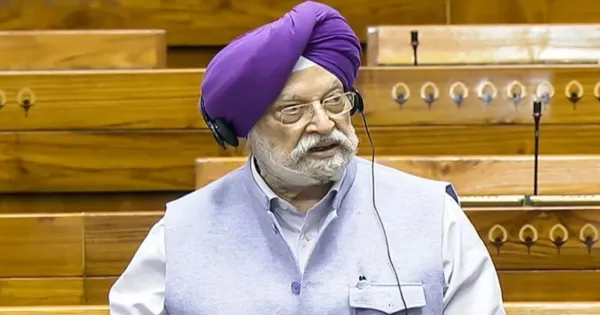
Minister Hardeep Singh Puri said in Lok Sabha – LPG production increased by 28 percent, there is no shortage of petrol and diesel.

New Delhi. Union Petroleum and Natural Gas Minister Hardeep Singh Puri said on Thursday that there is no shortage of petrol, diesel and kerosene in the country, LPG production has increased by 28 percent and the government’s priority is that there is no shortage of gas for cooking in the kitchens of crores of families in the country. He also said that rumors should not be spread on this issue.
Referring to the adverse situation created in the Strait of Hormuz due to the war between US-Israel and Iran, Puri said in the Lok Sabha that despite having no role in the conflict in West Asia, India will have to overcome its consequences. After the issue was raised by Leader of Opposition in Lok Sabha Rahul Gandhi, Puri said, “The world has never seen such a crisis in the history of energy.” 20 percent of crude oil is supplied through the Strait of Hormuz. For the first time in history, Hormuz has been effectively closed to commercial shipping.
Referring to the steps taken to deal with the shortage of LPG cylinders in the country, he said, “LPG production has increased by 28 percent in the last five days. The top priority of the Modi government is that the kitchens of 33 crore families of India, especially the poor and the underprivileged, should not face any shortage (of LPG). Puri said that as a demand management measure, LPG cylinders can be booked at a minimum interval of 25 days in cities, while in rural and inaccessible areas, cylinders can be booked after 45 days.
He said, “The supply of crude oil to India is secure. 45 percent of crude oil comes from Hormuz. Due to the excellent diplomatic outreach of Prime Minister Narendra Modi, the crude oil received by India during this period is more than the quantity that could be supplied from the crisis-hit Hormuz at such a time. Puri said, “Refineries in the country are working at high capacity. In many cases, they are working more than 100 percent. There is no shortage of petrol, diesel, ATF (aircraft fuel), kerosene in the country. “Retailers have stock and supply chains for these products are functioning normally.”
Puri said that the standard time from booking to delivery of domestic LPG cylinder remains two and a half days, which has not changed. He also said that uninterrupted supply to hospitals and educational institutions is being done on priority. He said that commercial LPG is being sold in a fully regulated manner and is available at market price. Puri also said that after the recent adjustment of Rs 60, the price of a non-subsidised cylinder is Rs 913, while the market settled price is around Rs 987.
Without naming Pakistan, Puri said that a neighboring country has closed all schools, issued work from home rules and halved the number of government vehicles on the roads. He said universities in another neighboring country were closed ahead of schedule and Eid holidays were extended to save fuel. The minister said this is not the time to spread rumors and create false narratives.
He said that schools are open in the country and petrol and diesel are being available normally. Amid opposition sloganeering, the Petroleum Minister said that before this crisis, about 45 percent of India’s crude oil was being imported through the Hormuz route. “Crude oil imports from non-Hormuz sources have increased to about 70 percent from 55 percent before the conflict began,” he said.
Puri said in the House that today India imports crude oil from 40 countries which was from 27 countries in 2006-07. After the joint attack by America and Israel on February 28, Iran has stopped the movement of ships carrying oil and gas through the Strait of Hormuz.
20 percent of crude oil, natural gas and LPG is supplied to the world through this sea route. Puri said supplies were blocked due to conflict in West Asia. He said crude oil purchases have been diversified and apart from available sources in the Gulf region, cargo ships are coming from the US, Norway, Canada, Algeria and Russia.

Comments are closed.