
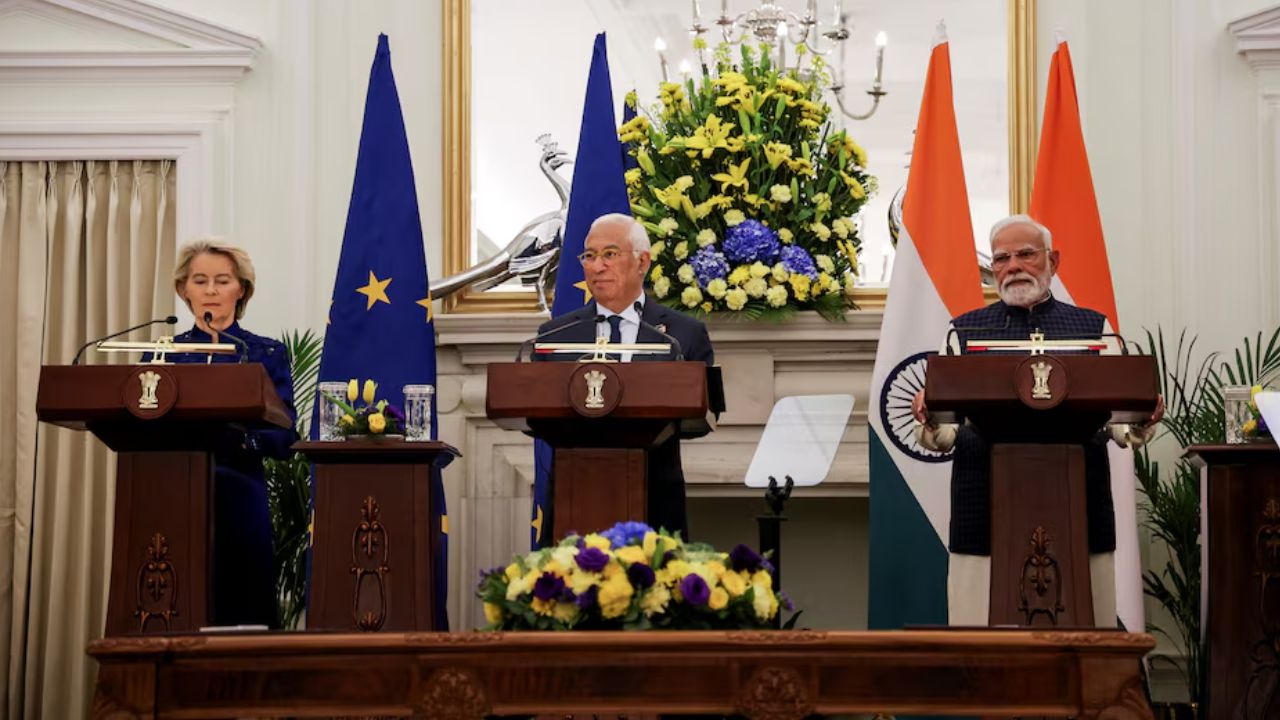

India and the European Union (EU) will now give each other ‘Most Favored Nation’ (MFN) status. In January, after lengthy negotiations, both the parties finalized this agreement, which is being called the ‘Mother of All Deals’. Under the agreement, 93 percent of Indian exports will be able to enter the European Union without customs duty.
In the India-EU agreement, there is a proposal to give MFN status to each other. This means that trade terms between India and EU will be liberal for the next 5 years. Provisions related to export and import will be simplified, so that better trade opportunities can be created between the two sides.
It is named Most Favored because the benefits that the most favored country gets, are also available to everyone. This rule is against trade discrimination according to the WTO.
Also read: From opportunity to apprehension, what are the challenges of India and European Union on FTA?
Why are big changes expected?
Luxury cars and wines coming from EU will become cheaper in India. In the draft, work should be done on not imposing new import-export restrictions beyond WTO rules, increasing cooperation in digital trade, making food safety and plant health standards in line with the World Trade Organization (WTO).
After one year of implementation of the agreement, both the parties will release annual export data, so that the profits arising from this agreement can be known. EU is India’s largest trading partner.
India-EU bilateral trade was to reach $135 billion in the year 2023-24. The agreement is still in the draft stage. It is expected to become effective in about a year after the legal process and parliamentary approval.
What will you get from this deal?
- There will be no tax on 93 percent of India’s exports in the European Union.
- Tariffs on 96.6 percent of EU traded goods will be eliminated or reduced
- European companies expect to save around 4 billion euros
- Luxury cars and wines from EU to become cheaper in India
- EU exports to India are estimated to double by 2032
Also read: Why are organizations like SCO not as strong as UN, European Union, G-7?
What is not included?
Some sensitive products related to agriculture have been kept out of the scope of this agreement. Soya, beef, sugar, rice and dairy products are not part of this deal.
What changes will there be in digital and business rules?
- Both sides have agreed to reduce the difficulties faced in digital trade and create a secure online portal. In this, electronic contracts and e-signatures will be given legal recognition.
- A ‘fast-track mediation’ process will be adopted to resolve any disputes. Food safety and photosanitary rules will be made in line with WTO standards to simplify the certification process.
What else is special in this deal?
- Data and Privacy: Privacy has been considered a fundamental right in the draft. Both parties will reserve the right to make their own rules on data security and cross-border transfers.
- Climate Cooperation: The EU will help mobilize funds and investments for India’s efforts to reduce greenhouse gas emissions.
- Data Sharing: One year after the agreement comes into effect, the two sides will begin sharing annual import data to monitor whether the deal is delivering benefits.

Comments are closed.