
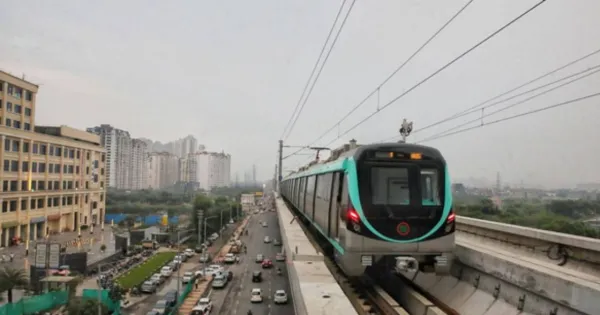
Modi Cabinet approves Noida Metro expansion: Botanical Garden will become a big interchange, work will start from March 2026

Delhi. The government has approved the 11.56 km long extended corridor of the Metro from Botanical Garden to Noida Sector 142 in Noida, adjacent to the national capital. This scheme was approved in the Cabinet meeting held here on Friday under the chairmanship of Prime Minister Narendra Modi, information about which was given by Information and Broadcasting and Railway Minister Ashwini Vaishnav on Saturday. Giving information about the decisions taken in the Cabinet meeting, Vaishnav said that the Cabinet has approved the extended corridor of Noida Metro Rail Project from Botanical Garden to Noida Sector 142. This corridor will be 11.56 km long and will have eight elevated stations.
With the commissioning of this corridor, the active metro rail network in Noida and Greater Noida will be 61.62 km. He said that the construction of this corridor is a major advancement in the infrastructure development here and will act as a major expansion of the metro rail network in the city. He said that with the completion of the new scheme, public transport will improve significantly. Wherever good connectivity is currently lacking, it will be improved and will establish direct connectivity with high demand corridors.
Vaishnav said that its aim is to connect the special area of Noida, which includes many commercial centers like
Advanced Business Park in Sector-142, Skymark One Mall in Sector-98, Mall of Noida in Sector-93,
Microsoft in Sector-145, TCS in Sector-157, Havells in Sector-126, Infosys in Sector-132,
Cognizant is included in Sector-135, Adobe in Sector-132 and Oracle in Sector-127. many on this route
Multinational corporations or multinational companies (MNCs) and information technology (IT) centers are located here. He said that along with this, there are big tourist places like Amity University in Sector-125, Panchsheel Balak Inter College in Sector-91, Mahamaya Balika Inter College in Sector-44, health centers like Max Super Specialty Hospital in Sector-128, Botanical Garden, Sector-93 Park in this corridor. He said that by connecting these important areas with the metro network, the extended corridor from Noida Sector 142 to Botanical Garden (Noida) will not only increase traffic connectivity but will also boost economic activities.
He said that Metro Rail as a good alternative road transport and expansion of Metro Rail network in Noida and Greater Noida city along with the extended corridor from Noida Sector 142 to Botanical Garden (Noida) is expected to reduce traffic jams. Reducing road traffic can ease vehicular movement, reduce travel time and increase overall road safety.
The Information and Broadcasting Minister said that the addition of the extended corridor from Noida Sector 142 to Botanical Garden (Noida) will enhance the Noida Metro Rail Project and the overall Metro Rail network in Noida and Greater Noida city and can significantly reduce carbon emissions compared to traditional fossil fuel based transportation. He said that this corridor will provide better access to transport hubs like Delhi Airport, Delhi Railway Stations and various bus depots from different parts of the city and will allow people to easily reach their places of work and other destinations.
Better connectivity can boost local business, especially in areas near new metro stations, leading to investment and development in previously inaccessible areas. He said the extended corridor from Noida Sector 142 to Botanical Garden (Noida) Metro Rail Network in Noida will provide greater access to public transport, benefitting different socio-economic groups and reduce the transport gap. This will reduce commuting time and improve access to essential services, thereby improving quality of life.
He said that this will prove effective for bringing about big changes in the times to come. This will lead to better connectivity, reduced traffic jams, benefits to the environment, economic development and improved quality of life. By addressing the city’s key challenges and providing a foundation for future expansion, it will play a key role in shaping the city’s growth trajectory and sustainability.

Comments are closed.